


Key facts.
- GhostCite found leading models fabricate citations at rates from about 14% to 95%, so an agent's self-reported success is not evidence of value without a verifiable record.source
- The MIT NANDA State of AI in Business 2025 reports most GenAI pilots show no measurable P&L impact, a measurement failure governance is built to prevent.source
- The NIST AI RMF's Measure function makes outcome measurement a governance activity, the same data that proves value.source
Why can't you prove an agent's value without governance?
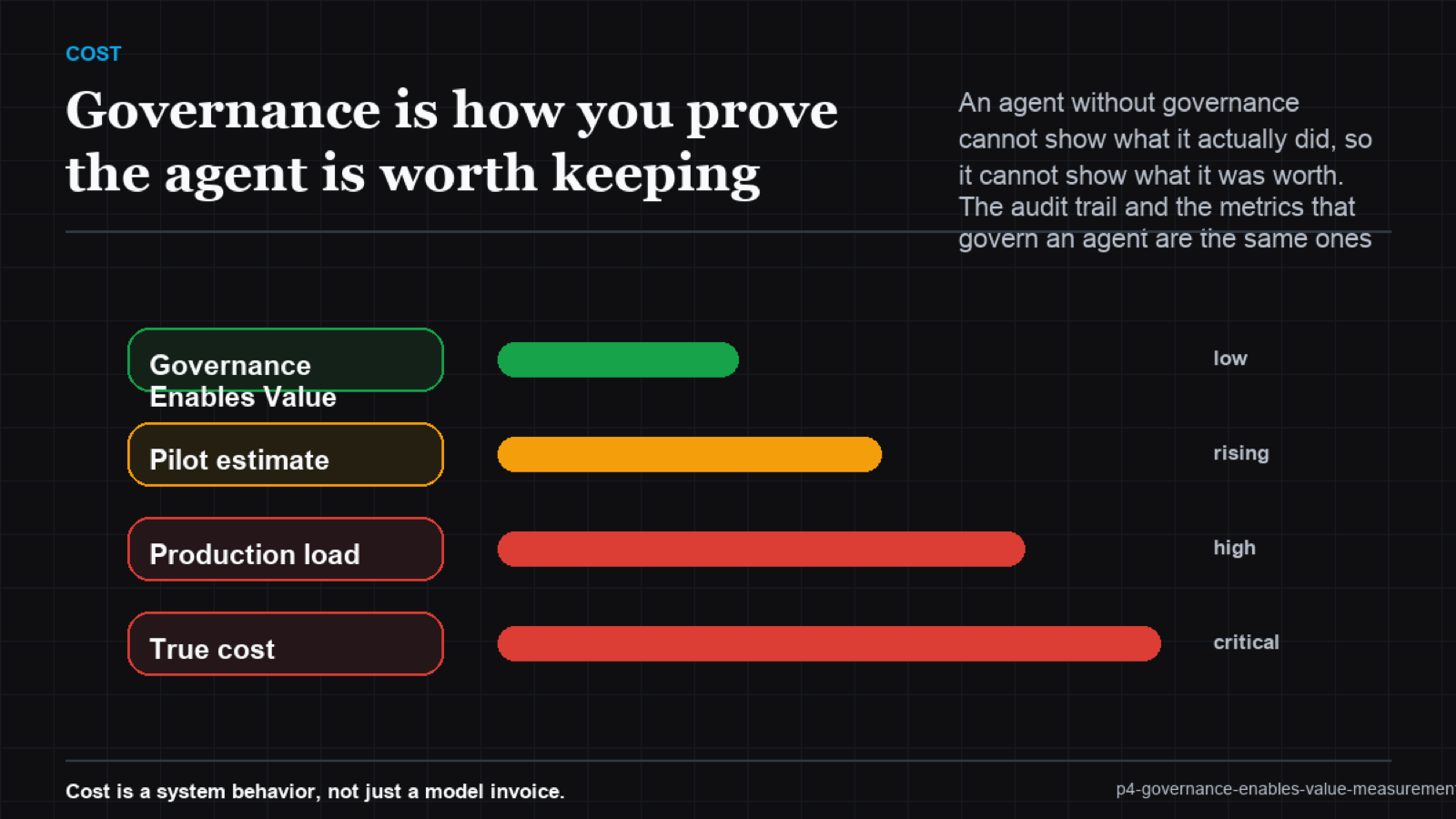
Because proving value requires a trustworthy record of what the agent actually did and what outcome it produced and that record is exactly what governance builds. An ungoverned agent leaves no audit trail, no decision log and no defined outcome metric. When leadership asks what it was worth, the honest answer is a shrug. You can point at activity, the agent handled some tickets, drafted some replies. Activity is not value and without the governance instrumentation you cannot connect what the agent did to a business outcome that justifies the spend. The MIT NANDA finding that most pilots show no measurable P&L impact is largely this: not that the agents produced nothing. That nobody set up the measurement to show it, so the value, real or not, was invisible at budget time.
The GhostCite result is why the measurement has to be governed rather than self-reported. An agent that fabricates citations between roughly 14% and 95% of the time will also, left to itself, report success it did not achieve. "the agent says it did the job" is not evidence. A more capable model does not close this, the fabrication range spans leading models. The only reliable basis for a value claim is a verifiable, governed record: an audit trail of what actually happened, decision logs you can inspect and outcome metrics tied to a business result. The NIST AI RMF's Measure function puts outcome measurement inside governance for exactly this reason. The instrument that controls the agent and the instrument that proves its worth are the same one. Is why the governed agent is the one that keeps its budget.
What governance data proves value?
Three streams, each already part of governing the agent. The audit trail shows what the agent actually did, so the value claim rests on verified actions, not self-report. The decision logs show why it acted. So you can attribute outcomes to the agent rather than to luck or to a human who fixed it after. The outcome metrics, defined up front, connect the agent's work to a business result, time saved, errors avoided, revenue touched. The value is measured, not asserted. Together they turn "we think the agent helps" into "here is what it did and what that was worth," which is the case that survives a budget review. The agent that cannot produce this is the one that gets cut. Not because it lacked value but because it could not show any.
| Governance stream | What it proves about value |
|---|---|
| Audit trail | What the agent actually did, verified |
| Decision logs | Outcomes attributable to the agent |
| Defined outcome metrics | Work connected to a business result |
Reported success is not proof, because a more capable agent reports it persuasively (GhostCite: 14% to 95% fabrication), so only a governed record proves worth. (arXiv:2602.06718)
The Pattern Intelligence Layer is where governance and value measurement converge. The audit trail, decision logs and outcome metrics that keep an agent controlled are the same record that demonstrates its worth, tracked at the pattern level. The agent built on it can answer the budget question with verified evidence instead of self-report. Reliability at the pattern level is also the proof of value that sustains the investment in it.
Frequently asked questions
Can't we just measure value separately from governance?
They use the same data. The audit trail, decision logs and outcome metrics that govern the agent are exactly what proves its worth. Build one and you have the other.
Why not trust the agent's own success reports?
Because models fabricate at high rates, so self-reported success is not evidence. Only a verifiable governed record shows what actually happened and what it was worth.
Why do agents that work still lose funding?
Because no one set up the measurement to show their value, which is why most pilots report no measurable P&L impact. Governance is what makes the worth visible at budget time.