


Key facts.
- Faults compound across steps rather than staying local, the failure mode MAKER addresses with per-step error correction (MAKER, 2025).
- Data pillar feeding coordination: PoisonedRAG injects 5 documents for a 90% attack success rate, and a poisoned fact then propagates through every agent that reads it (PoisonedRAG, USENIX Security 2025).
- Cost pillar: a multi-agent system can run about 15x the tokens of a chat turn, so a coordination loop is also a budget event (Anthropic Engineering).
Why does fixing coordination alone not hold?
A coordination failure is usually the tail of an upstream fault, and it compounds; a stronger model still trips, GAIA's best near 15% versus 92% for humans. (arXiv:2511.09030)
Because the coordination failure was a symptom. Tighten the handoff and the poisoned data still enters; fix the data and the over-broad tool permission still lets a bad action through; lock the tool and the runaway retry still burns the budget. The pillars are coupled, so a fix in one pillar that ignores its upstream cause just moves the failure. The teams that hold reliability treat the system as one connected surface, not five independent checklists.
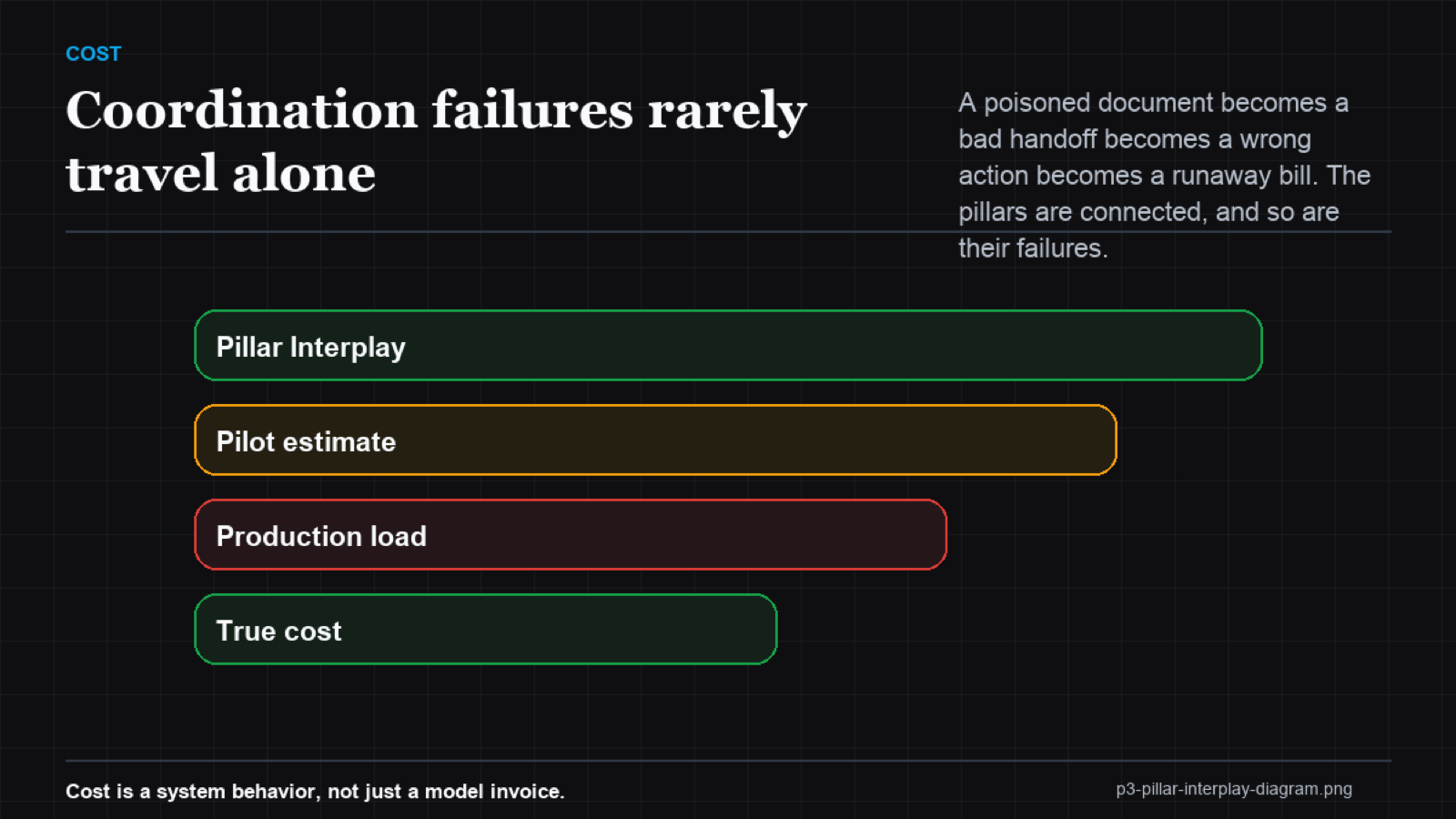
Single-pillar fix vs. connected view
| Single-pillar fix | Connected view |
|---|---|
| Patches the visible symptom | Traces to the upstream cause |
| Failure reappears elsewhere | Failure stopped at its source |
| Five disconnected checklists | One connected reliability surface |
VibeModel's Pattern Intelligence Layer is a connected view by design. We recognize patterns that cross pillars, a poisoned input that becomes a bad handoff that triggers a costly retry, and surface the root rather than the symptom. You keep your per-pillar controls; we tie them together so a fix actually holds.
Frequently asked questions
Where do most cross-pillar chains start?
Often in data or tools, then they surface as a coordination or cost failure. That is why the symptom and the cause sit in different pillars.
Do I need to solve all five pillars at once?
No. You need to see the connections, so when you fix one you are fixing the actual cause and not relocating the failure.