

Key facts.
- LangGraph models agent workflows explicitly as graphs (nodes for agents and steps, edges for control flow and message or state passing), and LangGraph Studio adds interactive visualization, breakpoints, state inspection, and time-travel debugging.source
- AutoGen records every turn of a conversation and exports OpenTelemetry traces (viewable in Jaeger or Langfuse), though multi-threaded sessions quickly overwhelm a plain log without a graph view.source
- CrewAI timestamps each role's task timeline and exports OpenTelemetry to Langfuse, Arize Phoenix, and others, so you can spot which agent lagged or where coordination broke.source
- The MAST taxonomy analyzed 1600-plus execution traces and found inter-agent misalignment (poor information flow, ignored messages, context loss) is about 37% of multi-agent failures, the second-largest category.source
Why does a flat log fail for multi-agent debugging?
A dropped handoff a flat log buries needs the communication graph, and a stronger model doesn't remove the need, since in MAST inter-agent misalignment is 37% of failures, a standing cost across a fleet. (arXiv:2503.13657)
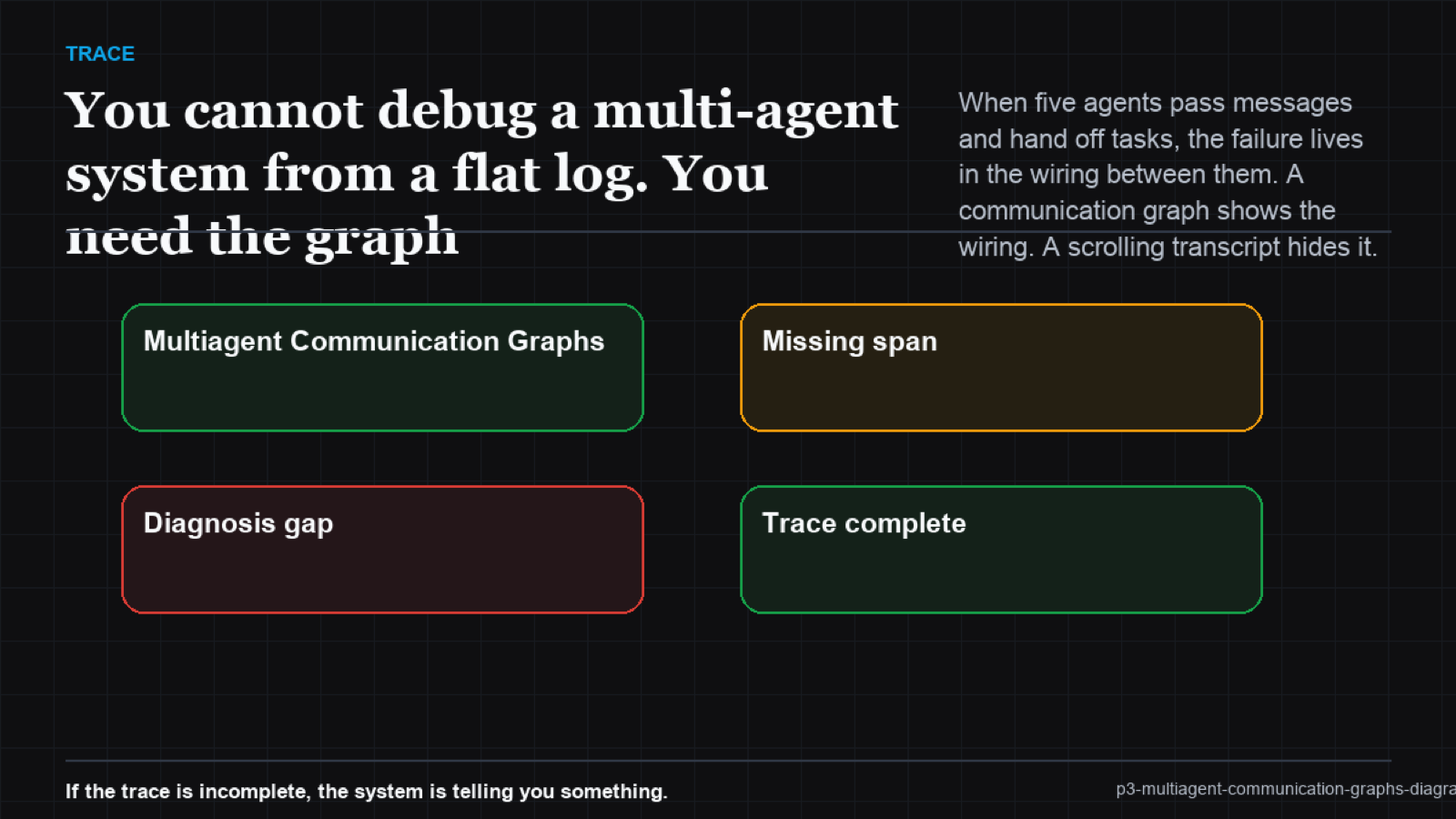
Because a log is one-dimensional and the failure is two-dimensional. The log gives you a single ordered stream of events: agent A said this, then agent B said that, then a tool ran. What it doesn't give you is the relationship between those events, which agent's message agent B was actually responding to, whether agent C's output was ever consumed by anyone, where the dependency chain forked or broke. In a two-agent system you can hold that in your head. At five agents with branching handoffs, the transcript becomes an undifferentiated wall, and the one edge that failed (the message that got ignored, the handoff that lost context) is indistinguishable from the dozens that worked.
The graph fixes this by making structure visible. Agents are nodes, messages and handoffs are edges, and a broken interaction shows up as a missing edge, a wrong-direction edge, or a node whose output no edge ever leaves. MAST's finding that inter-agent misalignment drives a large share of failures is precisely a finding about edges, so a view that renders edges is the view that finds these failures.
What does graph-based multi-agent debugging give you?
Three things a transcript can't. Topology: who's connected to whom, so you see the intended communication structure and the actual one side by side. Replay: step through the interaction, rewind to any node, and inspect the state at that point, which LangGraph Studio supports as time-travel debugging. And isolation: when an interaction breaks, you can point at the specific edge or node where it went wrong instead of scrolling a transcript hoping to spot the moment. Frameworks differ in how graph-native they're (LangGraph is graph-first, AutoGen and CrewAI lean on traces exported to observability platforms), but the direction is the same: render the structure, don't just stream the events.
| Question | Flat log answer | Communication graph answer |
|---|---|---|
| Who talked to whom? | Inferred by scrolling | Shown as edges |
| Whose output was ignored? | Nearly invisible | A node with no outgoing edge consumed |
| Where did context drop? | Hard to localize | The handoff edge that lost state |
| Can I replay the break? | Re-read the stream | Rewind to the node, inspect state |
this is multi-agent observability as a pattern-level property, which is what a Pattern Intelligence Layer provides. Reliability at the pattern level means the communication structure between agents is captured and rendered as a graph on every run, so an inter-agent failure is a visible broken edge instead of a needle in a transcript. The model can change and the agent count can grow, and the graph still shows you the wiring, which is the only view that keeps multi-agent debugging tractable as the system scales.
Frequently asked questions
Is LangGraph the only option?
No. LangGraph is graph-native, but AutoGen and CrewAI export OpenTelemetry traces to platforms like Langfuse and Arize Phoenix that reconstruct agent flows. The principle, render the structure, applies across frameworks.
What failure does the graph catch that logs miss most often?
An ignored message: one agent produces output that no other agent ever consumes. On a graph it's a dangling node. In a log it's invisible.
Does a better model reduce inter-agent failures?
No. MAST attributes about 37% of multi-agent failures to inter-agent misalignment regardless of model strength. The fix is visibility into the wiring, not a bigger model.