


Key facts.
- Tran and Kiela ground the failure at the boundary: information is lost at each handoff, so the defect is between agents, not inside one (Tran and Kiela, 2026).
- Distributed tracing standards now cover agent interactions; OpenTelemetry has GenAI semantic conventions for spans across tool and agent calls (OpenTelemetry GenAI).
- A green per-agent dashboard can sit on top of a failing handoff chain indefinitely, which is how silent multi-agent failures persist.
What should an interaction-first view actually trace?
Trace the edges. Every message between agents, every shared-state write, every handoff with its input and its accepted output. Plot the conversation graph, not the agent list. When a handoff produces an output the next agent silently misreads, you want that visible as a broken edge, not buried inside two separately healthy nodes. This is distributed tracing applied to a system whose nodes happen to be language models.
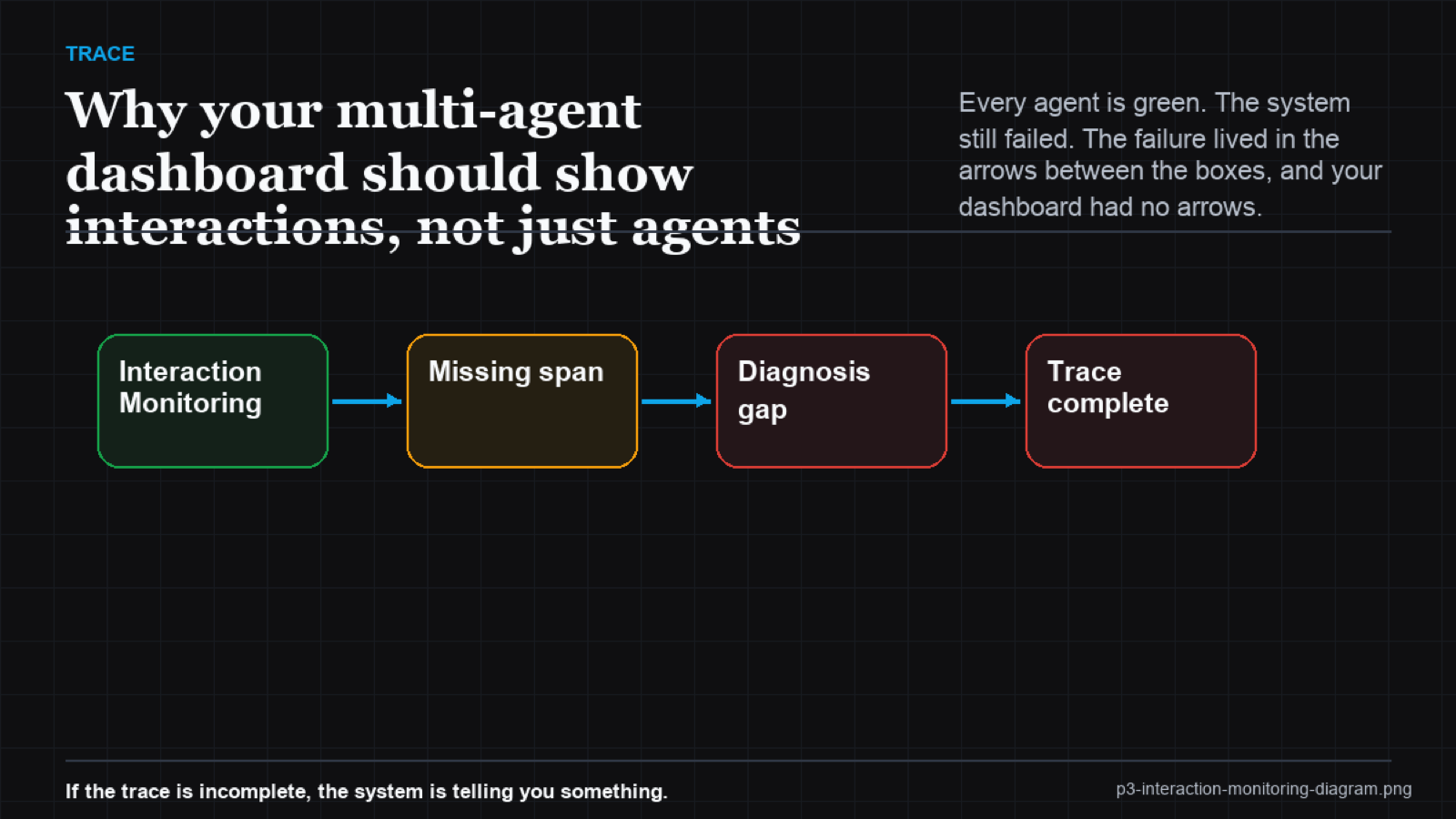
Per-agent view vs. interaction view
| Per-agent dashboard | Interaction dashboard |
|---|---|
| Shows each agent's success rate | Shows handoff success between agents |
| Misses cross-agent misalignment | Surfaces misalignment as a broken edge |
| Green while the system fails | Red where the system actually broke |
The Pattern Intelligence Layer is interaction-first by design. VibeModel watches the patterns across agent boundaries, the handoffs and shared writes, so a failing edge shows up as a recognizable pattern rather than an invisible one. You keep your per-agent metrics; we add the view that catches the failures they miss.
Frequently asked questions
Can I get this from standard APM?
Partly. Distributed tracing gives you the spans; you still need agent-aware semantics to read a handoff as a handoff rather than a generic call.
Is this overkill for two agents?
No. Even two agents have a handoff, and that handoff is the most common failure point. Trace it from day one.