


Key facts.
- Evaluations reward guessing over acknowledging uncertainty, so models are optimized to sound confident even when they should hedge. source
- The proposed fix is to realign scoring to reward appropriate expressions of uncertainty, which is exactly what conservative planning operationalizes. source
- Enterprises route uncertain cases to a human for exactly this reason: a Cloud Security Alliance survey of 285 security professionals found organizations favoring human-in-the-loop oversight and containment over trusting an agent's own confidence on the consequential calls. source
- Training rewards confident guessing over I do not know; a frontier model guesses more fluently, so false confidence costs. (arXiv:2509.04664)
Why is false confidence the real hazard?
Because uncertainty you can see is uncertainty you can route. If the agent says "I am not sure whether this account is eligible," you can send that case to a human, add a check or ask a clarifying question. The plan is safe because the doubt was surfaced. The hazard is the agent that feels the same doubt and expresses none of it, because its training taught it that confident answers score better than honest ones. That agent produces a clean, certain plan for a case it should have flagged and you find out it was wrong when the consequence lands. The doubt existed. The agent just learned to hide it.
This is why a stronger model does not automatically help. It is a better writer of confident plans, which makes the false confidence smoother and harder to catch. The fix is not more capability. It is designing the agent to treat uncertainty as information to act on rather than weakness to conceal.
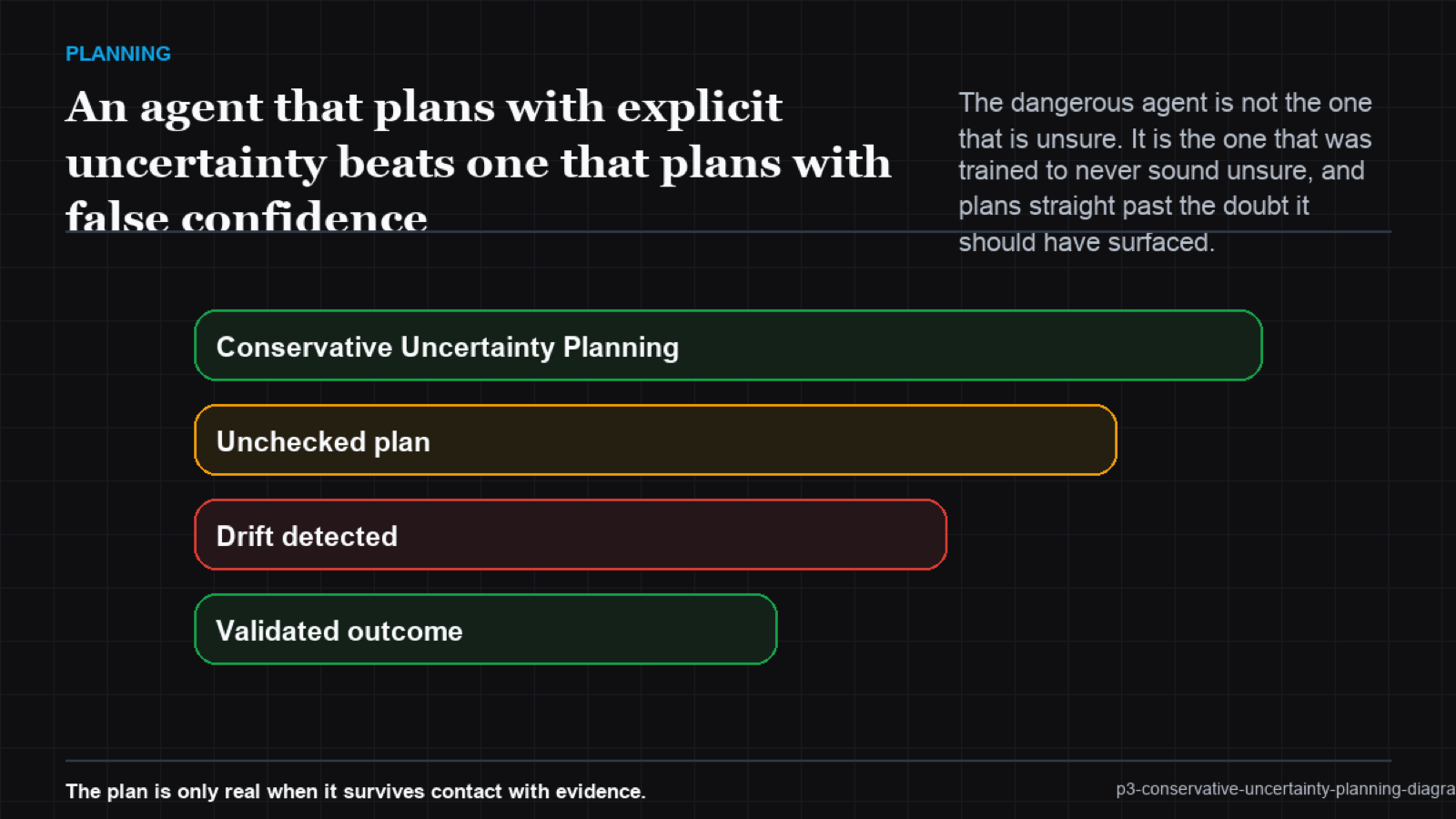
How do you make planning carry uncertainty?
Ask the agent to mark confidence on its decisions and reward it for honesty, not bravado. Set thresholds where a low-confidence branch triggers a clarifying question, a verification step or an escalation. Treat "I don't know" as a valid and valuable output, the way the hallucination work argues evaluation should. The agent does not become timid. It becomes precise about where it is sure and where it is guessing, which is exactly the information that lets the rest of the system keep the guesses out of production.
| Planning style | What happens on a doubtful case |
|---|---|
| False confidence | Commits to a guess, no flag |
| Explicit uncertainty | Hedges, asks or escalates |
Surfacing that uncertainty as an actionable signal is part of what VibeModel does as the Pattern Intelligence Layer. We model the patterns that distinguish a confident plan from a well-founded one, so the agent's doubt becomes a routing decision rather than a hidden risk.
Frequently asked questions
Won't an uncertain agent ask too often?
Only if you set the threshold wrong. Calibrated uncertainty asks on the cases that matter and proceeds on the ones it has earned.
Can models even report calibrated confidence?
Imperfectly, but usefully, especially when you reward honesty instead of penalizing it. The training default is the problem, not a hard limit.
Is this slower?
On the uncertain minority, yes, by design. That is the cheap insurance against confident wrong plans on the cases you could not afford to get wrong.