


Key facts.
- AppWorld shows interactive tasks spanning multiple apps and steps have low agent success, exposing how interdependence and shared state break reliability.source
- CRMArena-Pro shows enterprise agent performance dropping from roughly 58% single-turn to lower in multi-turn, a shared-state and interdependency effect.source
Why does shared state corrupt multi-agent systems?
On AppWorld multi-turn success drops sharply, so interdependent agents diverge on shared state; a more capable one writes the bad value sooner. (arXiv:2407.18901)
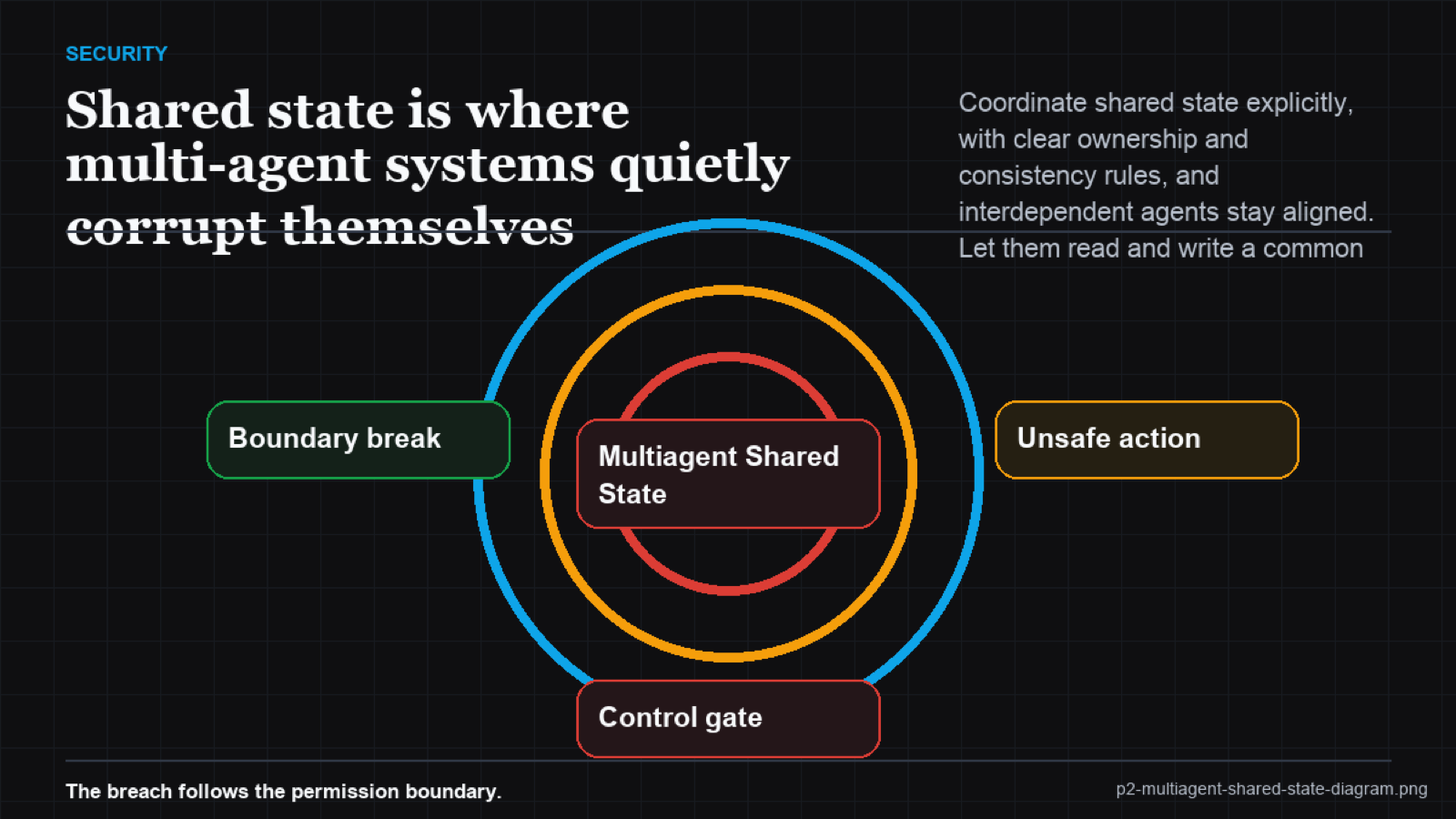
When several agents collaborate, they need to share information, the current plan, intermediate results. The state of the task and that shared state is the system's biggest reliability risk. Each agent reads the state, acts and writes back and if two agents hold divergent views or one acts on a stale copy. The inconsistency propagates: a downstream agent reasons confidently on a premise an upstream agent already invalidated. The CRMArena-Pro drop from single-turn to multi-turn is the measurable shadow of this. Performance falling as interactions and shared context accumulate and the AppWorld results show how quickly multi-component, multi-step tasks degrade. The agents do not announce the corruption; they just build on each other's stale or wrong state until the output is wrong.
The fix is to treat shared state as the critical resource it is. Give each piece of state a clear owner responsible for its consistency. Define If agents read and write and validate handoffs so an agent cannot act on a state another has invalidated. Where possible, reduce shared mutable state in favor of explicit, validated messages. The way well-designed distributed systems prefer message passing over shared memory. The goal is that no agent ever acts on a view of the world that another agent has already made false. Is exactly the failure that unmanaged shared state produces.
What keeps shared state consistent?
| Aspect | Free shared state | Coordinated state |
|---|---|---|
| Ownership | None | An owner per piece of state |
| Reads/writes | Anytime, anywhere | Defined, validated |
| Handoffs | Stale views propagate | Validated before use |
| Failure | One view poisons all | Contained |
Coordinating shared state well depends on knowing which state each interaction actually relies on. Is what the Pattern Intelligence Layer makes explicit. VibeModel ties each agent's behavior to the patterns it depends on. The shared state that matters is identified, owned and validated at the handoffs and the multi-agent system stays aligned instead of quietly corrupting itself through views that drifted apart.
Frequently asked questions
Why do multi-agent systems fail at shared state?
Because agents read and write common state asynchronously, so divergent or stale views propagate and one agent builds on a premise another already invalidated.
What does the multi-turn drop tell us?
That performance degrades as shared context accumulates, as CRMArena-Pro shows from single-turn to multi-turn, a direct symptom of interdependency risk.
How do you reduce the risk?
Owned state, defined read/write rules, validated handoffs and favoring explicit validated messages over free shared mutable state.