


Key facts.
- MINJA shows an agent's stored memory can be corrupted through injection, so persisted state has integrity risks, not just consistency ones. source
- Mix-of-Granularity shows managing what context to hold is non-trivial even in one place, compounding when state is spread across components. source
Why does distributed state break agents?
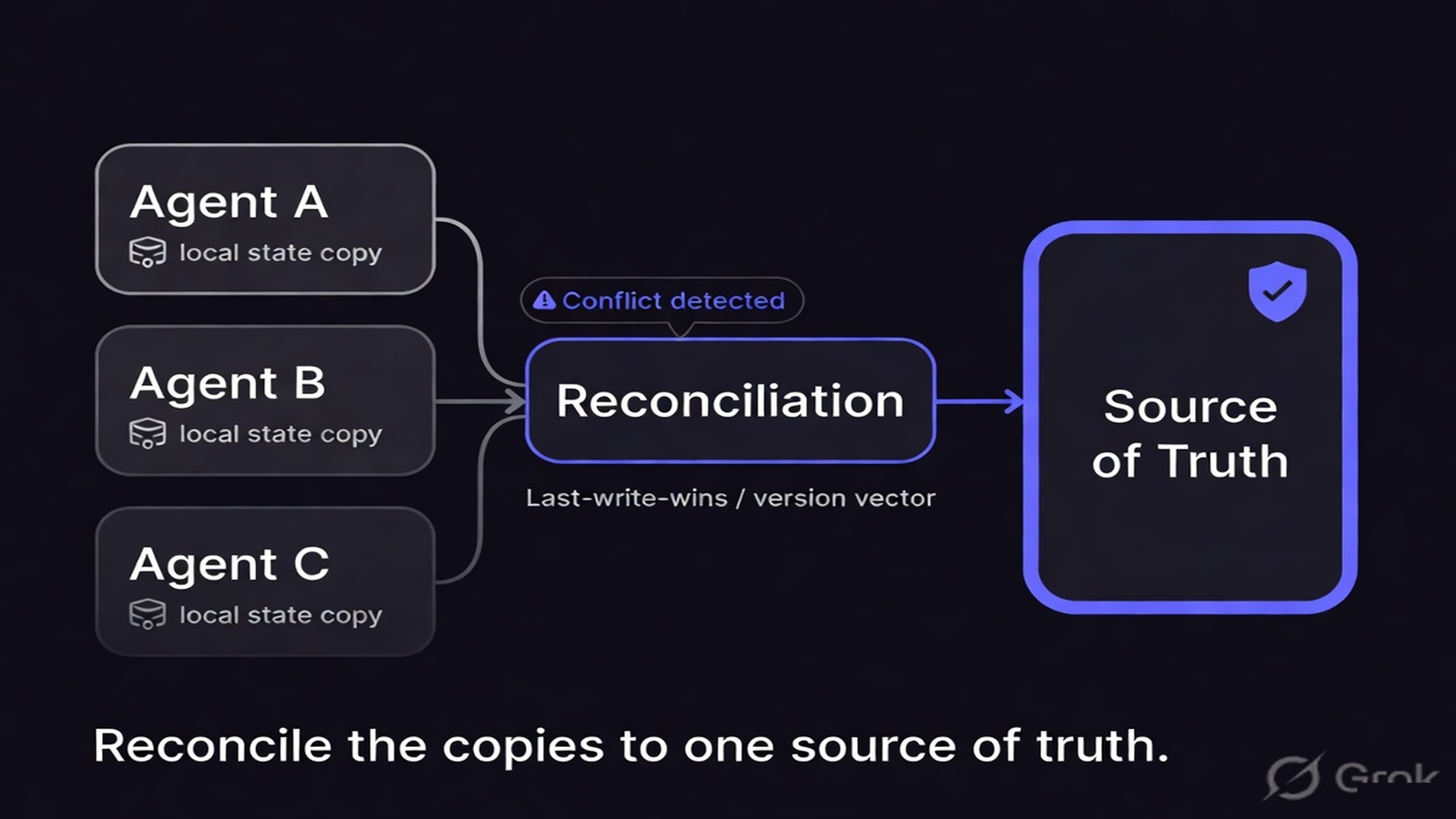
The moment an agent spans more than a single in-memory run, its state can live in several places: the context window, a memory store, a database the tools write to, a cache, the state held by another agent it coordinates with. Each is a copy and copies drift. The agent reads from one, a tool updates another, a restart reloads a third and now the agent is reasoning over a version of reality that no longer matches what is actually true. It then acts confidently on the stale copy, producing the classic distributed-systems failure of an action that made sense against the state the agent saw and is wrong against the state that exists.
Two things make this harder for agents than for ordinary distributed systems. The state can be corrupted, not just stale: MINJA shows an agent's memory can be poisoned, so consistency is not enough; you also need integrity. And managing the content of agent context is itself non-trivial, as Mix-of-Granularity shows even for a single retrieval step, so spreading it across components multiplies an already hard problem. The discipline is the familiar one from distributed systems, applied deliberately: designate a single source of truth, reconcile copies on read or on a schedule, protect the integrity of stored state and make restarts reload from the authoritative source rather than from whatever fragment survived.
What does consistent agent state require?
| Aspect | Scattered state | Reconciled state |
|---|---|---|
| Source of truth | Several, disagreeing | One authoritative store |
| On restart | Reloads a fragment | Reloads from authority |
| Integrity | Assumed | Protected and checked |
| Agent's view | Stale or wrong copy | Current and consistent |
Keeping state consistent is easier when you know which state actually matters for the task, which the Pattern Intelligence Layer helps make clear. VibeModel ties the agent's behavior to the pattern that defines the task, so the state worth treating as authoritative is the state that pattern depends on and the agent reconciles around what matters rather than trying and failing to keep every scattered copy in sync.
Frequently asked questions
Does a smarter model trust the right copy of its own state?
Scattered state disagrees with itself and injected memory worse; a more capable agent acts on the stale copy faster, so the incident still lands. (arXiv:2503.03704)
Why is agent state worse than normal app state?
It can be corrupted, not just stale. MINJA shows memory can be poisoned, so agents need integrity protection on top of normal consistency.
What is the core fix?
A single source of truth that copies reconcile to, with restarts reloading from it, so the agent never reasons over a fragment that drifted.
Is this just standard distributed systems?
The discipline is, but agents add memory-integrity and context-management problems that make applying it deliberately even more important.