


Key facts.
- ISO/IEC 42001 establishes an AI management system covering the lifecycle of AI, the kind of discipline a long-running agent architecture requires.source
- Nasr's scalable extraction work underlines that persistent, high-access agents have a wider failure and attack surface over time, so their architecture must differ from short transactional ones.source
Why is long-running a different architecture?
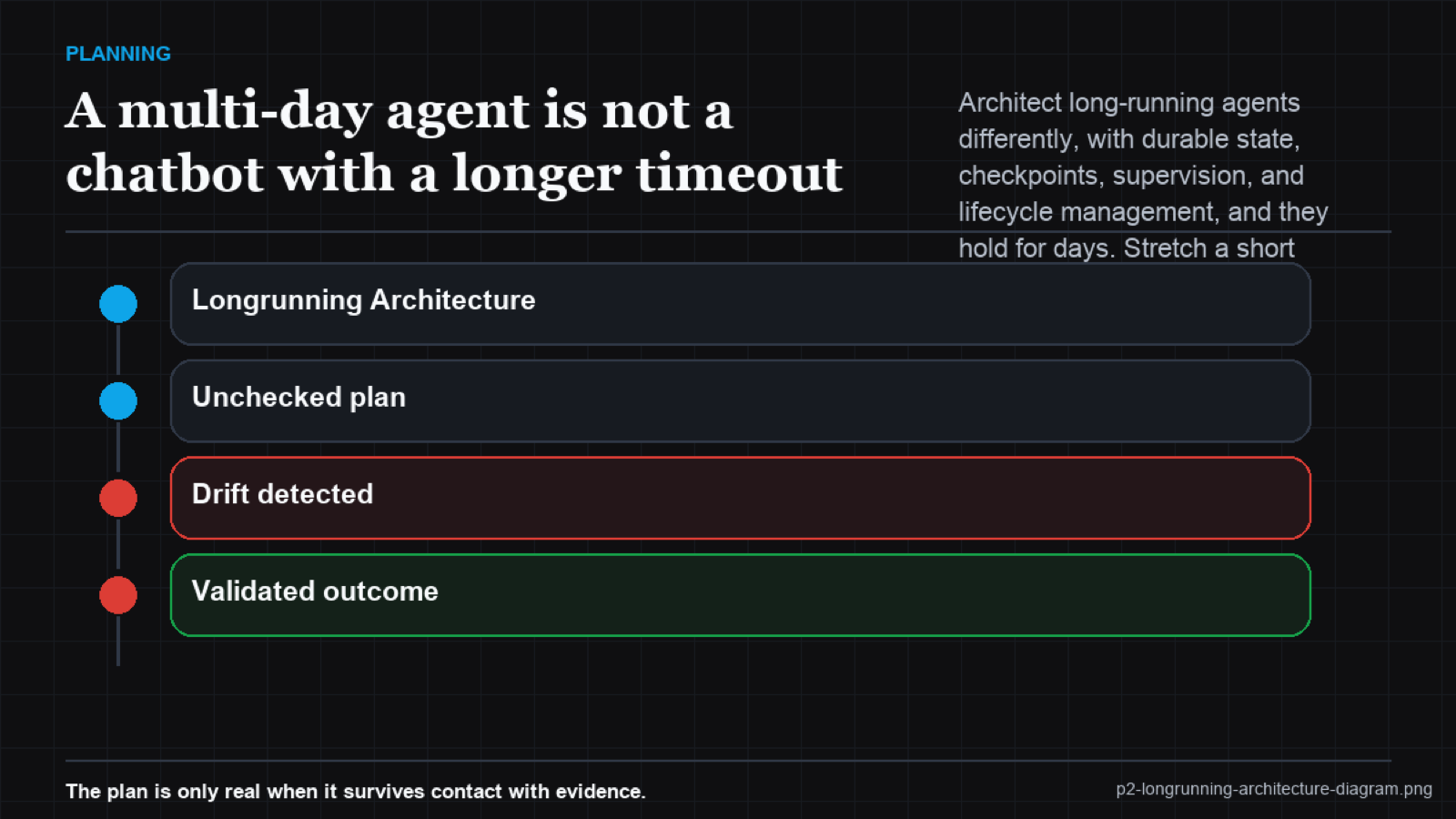
A short transactional agent starts, does a bounded task and finishes before much can go wrong. Its state lives in memory, failures mean a quick retry and the whole thing is over in seconds. A long-running agent violates every one of those assumptions. It runs across crashes, restarts, model and tool updates and changing conditions. Its state must survive all of them; its failures accumulate; and it must be supervised, paused, resumed and eventually retired. Stretching the short design to this horizon, just raising the timeout. Produces a system that breaks in ways the short version never showed: lost state on a restart, drift over time, runaway cost and an unmanaged lifecycle. The long-running agent needs the management discipline that ISO/IEC 42001 formalizes. An AI system is governed across its whole life, not just its happy-path run.
The longer horizon also changes the risk profile. A persistent agent with standing access accumulates exposure that a short-lived one never has. Is part of why scalable extraction and similar adversarial work matters more for long-lived, high-access systems. So the architecture has to add what the short design omits: durable external state with a clear source of truth, checkpoints for resumability. Supervision and health management for the running agent, bounded resource use and a defined lifecycle from deployment through update to retirement. These are not features you bolt onto the short agent. They are the skeleton of a different kind of system and treating a multi-day agent as a chatbot with a longer timeout is how that system fails.
What does a long-running architecture add?
| Concern | Short transactional | Long-running |
|---|---|---|
| State | In memory | Durable, external, authoritative |
| Recovery | Quick retry | Checkpoints and resume |
| Operation | Fire and forget | Supervised, health-managed |
| Lifecycle | None | Deploy, update, retire |
Designing the long-running architecture around what actually matters. State is authoritative, which steps are checkpoint-worthy, requires understanding the agent's behavior at the pattern level, which is what VibeModel provides as the Pattern Intelligence Layer. By making the task's success pattern and consequential steps explicit, it grounds the durable state, the checkpoints and the supervision in what the agent genuinely depends on. A multi-day agent is built as the distinct system it is rather than a short one running on borrowed time.
Frequently asked questions
Can't I just raise the timeout?
No. A long horizon breaks the short design's assumptions about state, recovery and lifecycle. It needs durable state, checkpoints, supervision and lifecycle management.
Why does the risk profile change?
A persistent, high-access agent accumulates exposure over time, so its failure and attack surface is wider than a short-lived one's, demanding a different architecture.
What standard frames this?
ISO/IEC 42001 formalizes managing an AI system across its lifecycle, which is exactly the discipline a long-running agent needs.