


Key facts.
- Durable execution (LangGraph) lets an agent persist through failures and run for extended periods, pausing at any step and resuming days later with full state intact.source
- A checkpointer saves state at every node to a durable backend (Postgres or MongoDB in production), separating short-term thread-scoped state from long-term cross-thread memory held in a store.source
- Google's Agent Development Kit handles session persistence and Cloud Trace integration out of the box, so a paused agent resumes without losing context.source
- Instrumenting every LLM call, tool invocation, and state operation as OpenTelemetry spans in the session's trace means the trace persists alongside the state and post-hoc debugging works after a restart.source
Why does an in-memory trace leave you blind?
Because volatile memory doesn't survive the events that matter most. A restart or crash wipes it. Gone with it: the full history of reasoning steps, tool calls, and decisions leading up to the failure, exactly what you needed to inspect. Long pauses are just as bad, quietly. Agent waiting for human approval, then resumes, the new fragment has no link to what came before. Two halves of a story with no thread connecting them. No durable checkpoints means you can't replay the run. "What went wrong before the restart" becomes unanswerable.
The fix is to treat the trace as state. If the agent's state is checkpointed to a durable store at every step so it can resume, the trace has to be checkpointed the same way and keyed to the same session, so resuming the work also resumes the record of the work.
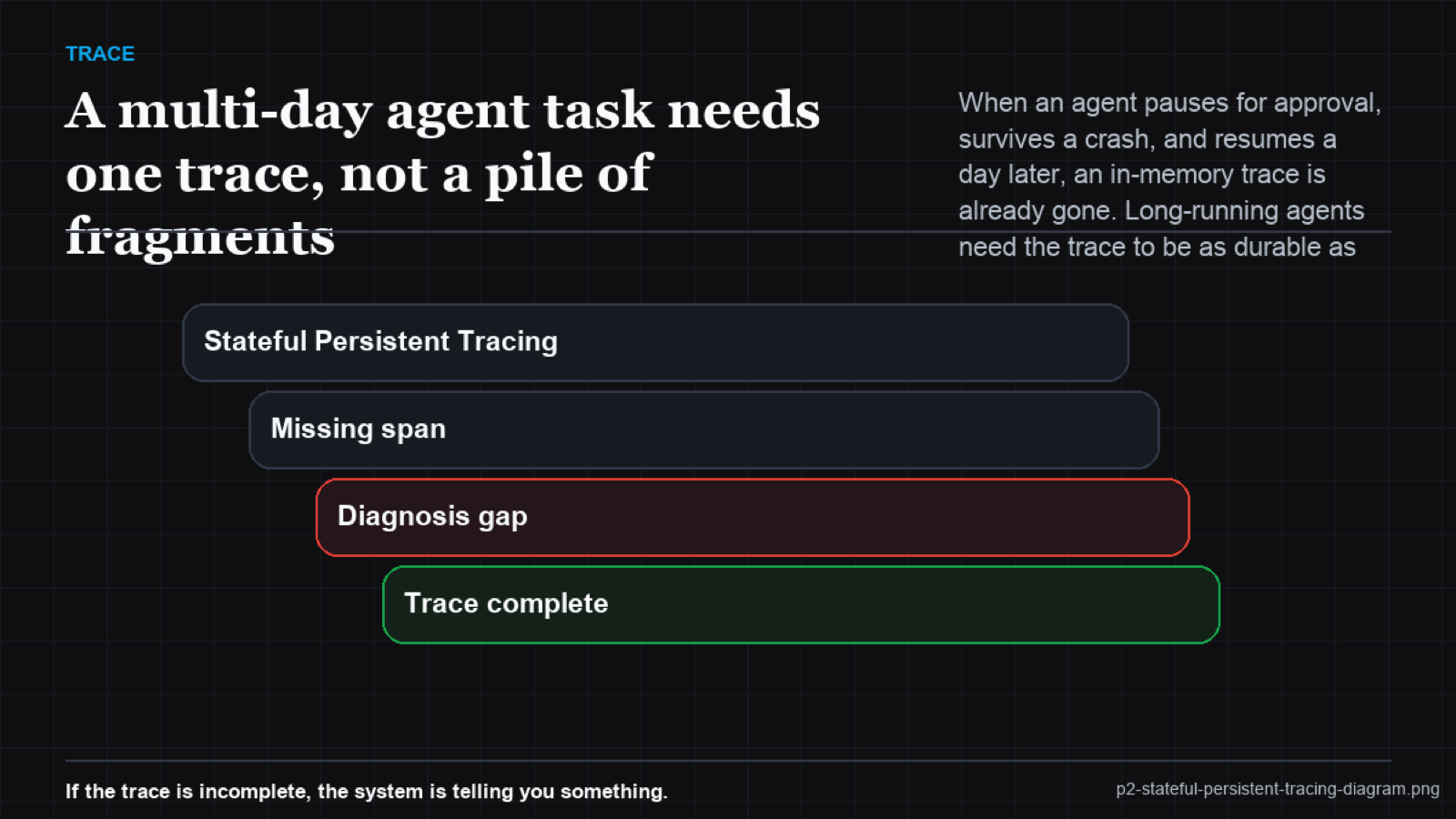
How do you keep one coherent trace across a resume?
Share the identity and persist the spans. Give the whole task a stable session or thread ID. Propagate it through every span, before and after any interruption, so a resumed run appends to the same trace, not a new one. Checkpoint trace data to the same durable backend that holds agent state; restart reloads both together. Thread-scoped state (working context for this run) vs. cross-thread memory (what carries across sessions), different lifetimes, both visible in the trace. Frameworks like LangGraph provide the checkpointer and the durable store; tools like LangSmith and Cloud Trace render the result. Treat vendor "never lose context" claims as the goal, not a guarantee: the continuity is only as good as your session-id propagation and your checkpoint discipline.
| Event | In-memory trace | Persistent trace |
|---|---|---|
| Process restart | History before the restart is gone | Reloaded from the durable checkpoint |
| Pause for approval | Resume starts a disconnected fragment | Resume appends to the same session trace |
| Crash mid-task | Cannot replay what led up to it | Replay from the last checkpoint |
| Multi-day task | Scattered fragments | One coherent trace, end to end |
Persistent, session-spanning traces are foundational to a Pattern Intelligence Layer. Reliability at the pattern level means the agent's behavior over an entire long-running task is captured as one continuous record, so the patterns that only show up across a pause or a restart (the assumption that drifts after a resume, the state that corrupts between sessions) become visible instead of vanishing with the process. The trace outlives the run, which is the only way to debug a task that outlives a single session.
Frequently asked questions
Why not just reconstruct the history from logs after a restart?
Volatile logs are gone with the process, and a resumed run with no shared id produces a disconnected fragment. You need durable checkpoints keyed to the session to reassemble the task.
what's the difference between short-term and long-term memory here?
Short-term is thread-scoped working state for this run; long-term is cross-thread memory the agent keeps across sessions. they've different lifetimes, and the trace should reflect both.
Do durable-execution frameworks solve this for me?
They provide the checkpointer and store. The continuity still depends on propagating a stable session id and checkpointing the trace, not just the state.