


Key facts.
- METR measures the reliably-completed task length for frontier agents and finds it doubling roughly every seven months, so the reliable horizon is bounded and grows slowly. source
- Past that horizon, coherence degrades, which is why a single long run accumulates error faster than the sum of its parts. source
- Decomposing a long task into checkpointed stretches is the structural workaround, the same principle that let extreme-decomposition systems reach very long horizons. source
Why is the long run worse than its parts?
Reliable task length doubles every seven months; a bigger model extends it slightly, so one long pass costs. (arXiv:2503.14499)
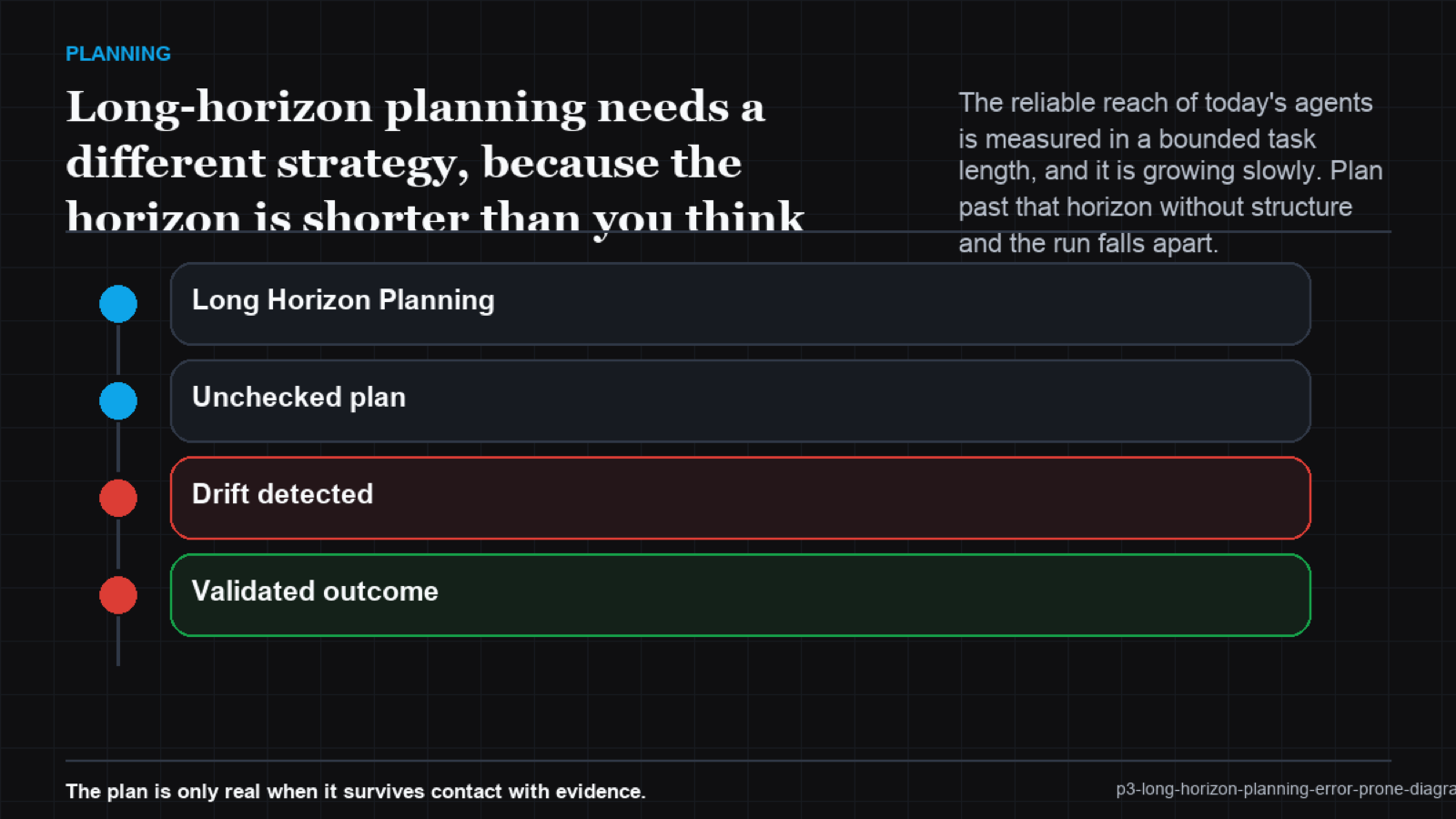
Because errors compound and context degrades the further the run goes and both effects accelerate past the reliable horizon. Early in a task the agent holds the goal, the constraints and the state cleanly. Deep into a long run, the goal has drifted, the context has filled with history the model uses poorly and small errors from earlier steps have propagated. The METR horizon is the practical line where this turns from manageable to unreliable and it is shorter than the ambitions people bring to long-horizon agents. Ask one run to plan and execute a task well past that line and you are not testing the model's planning, you are testing how it fails.
The horizon growing slowly, doubling on the order of months, matters because it tells you not to wait for the model to absorb the problem. Whatever the reliable reach is today, a long enough task exceeds it and it will for a long while yet.
What strategy actually works past the horizon?
Decompose and checkpoint. Break the long task into stretches that each sit inside the reliable horizon, with a verified checkpoint between them that re-grounds the goal, confirms the state and hands a clean context to the next stretch. The agent never has to hold the whole task at once, so it never has to plan past where it stays coherent. This is the same principle that let extreme-decomposition systems run extraordinarily long: not a longer single thread, but many short ones stitched together with checks.
| Approach to a long task | What you are relying on | Outcome |
|---|---|---|
| One unbroken run | Coherence past the horizon | Degrades and compounds error |
| Decompose and checkpoint | Many runs inside the horizon | Each stretch stays reliable |
Designing that decomposition is part of what VibeModel does as the Pattern Intelligence Layer. We model the patterns of a task that exceeds the reliable horizon and where to place the checkpoints, so a long job runs as a sequence of reliable stretches instead of one run that frays.
Frequently asked questions
How do I know my task exceeds the horizon?
If reliability drops as the run gets longer, you are past it. The METR framing says assume most ambitious long tasks exceed today's reach.
Doesn't checkpointing add overhead?
Some and it replaces a degrading long run with reliable short ones, which is almost always the better trade.
Will a future model remove the need?
The horizon grows, but slowly. Decomposition stays the safe strategy for tasks longer than the current reach.