


Key facts.
- Natural Plan shows frontier models struggle to hold a realistic multi-step plan to completion, so long-horizon goal fidelity is not a given. source
- Premise Order Matters shows reasoning is sensitive to how information is ordered, so an accumulating, reordering context can shift the agent's working goal. source
Why does the goal drift over a long plan?
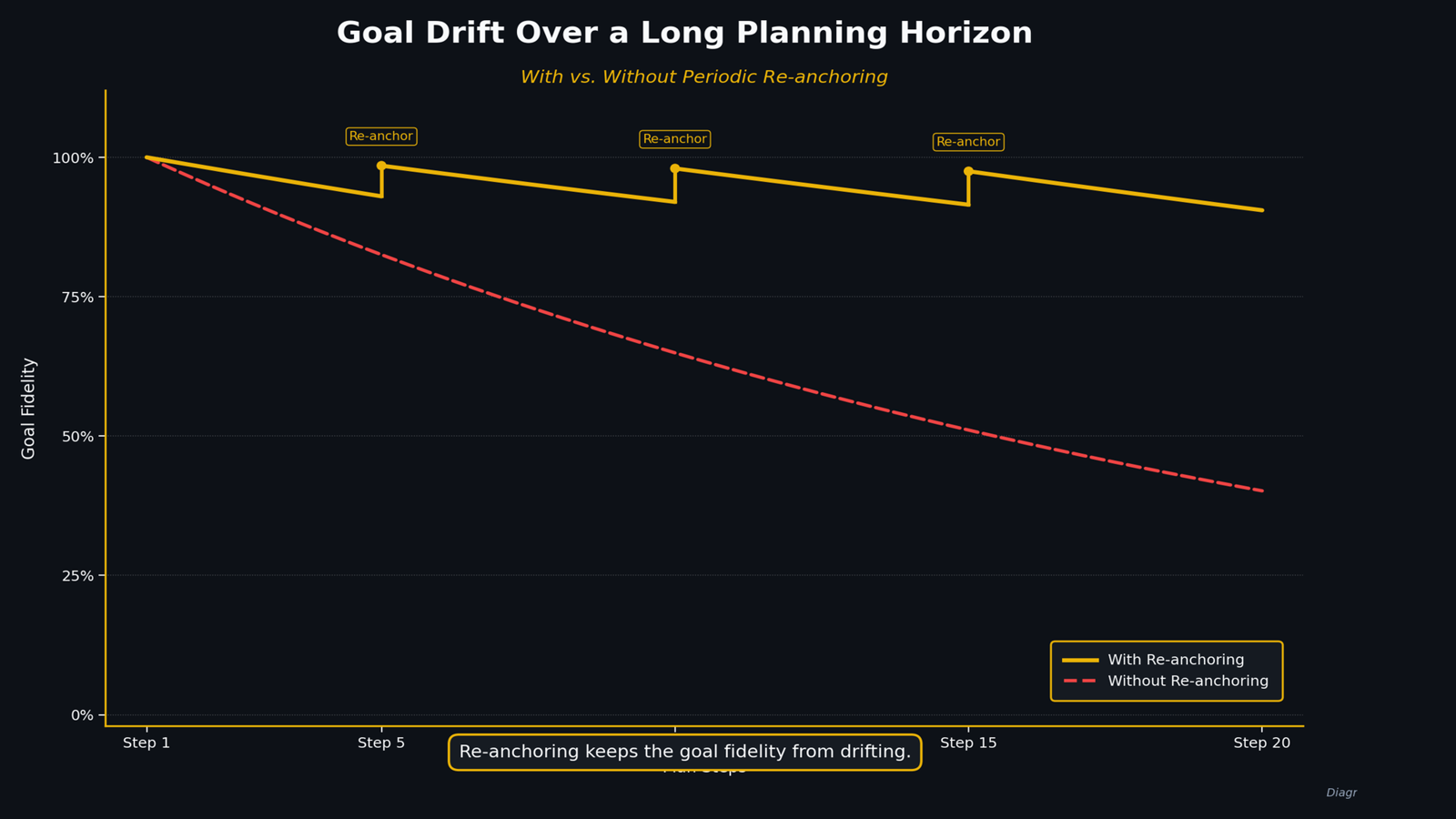
Each step of a long plan involves a small reinterpretation of what to do next given the state so far. Individually these are reasonable; cumulatively they move. The agent optimizes the immediate subtask, then the next and the original objective recedes into an old entry under a growing pile of recent context. Natural Plan shows models already struggle to carry a multi-step plan to its end, and Premise Order Matters shows reasoning shifts with how information is ordered, so a long workflow that keeps reordering and accumulating context is a recipe for the agent's working goal to drift from the one you set. The drift is invisible step to step and obvious only in hindsight, when the finished work solves a goal nobody asked for.
The countermeasure is re-anchoring. At intervals through the plan, restate the original goal explicitly, compare the current trajectory against it and correct or escalate if they have diverged. This is the planning analog of re-reading the brief partway through a long project and it is precisely what an agent will not do unprompted. The re-anchoring turns an unbounded drift into a series of bounded segments, each realigned to the goal, so the agent that completes a thirty-step plan is still solving the objective you gave it rather than the mutated version it wandered into around step twelve.
How do you hold the goal?
| Practice | Run uninterrupted | Re-anchored plan |
|---|---|---|
| The goal | Recedes under context | Restated at intervals |
| Trajectory | Never compared to goal | Checked against it |
| On divergence | Drifts further | Corrected or escalated |
| At the end | Solves a drifted goal | Solves the real goal |
Goal drift is structural: a frontier model held to step thirty optimizes a goal you never set and the rework lands late. (arXiv:2406.04520)
Re-anchoring needs a precise, stable statement of the goal to anchor to, which is what VibeModel provides as the Pattern Intelligence Layer. By making the success pattern explicit and persistent, it gives the agent a fixed reference to compare its trajectory against at each interval, so a long plan stays aligned to the objective you set instead of drifting into one the agent improvised across thirty steps.
Frequently asked questions
Why does a long plan drift?
Small per-step reinterpretations accumulate and models struggle to hold a multi-step plan to completion, so the original goal recedes under recent context.
What is re-anchoring?
Restating the original goal at intervals, comparing the agent's trajectory to it and correcting on divergence, the planning analog of re-reading the brief.
How often should you re-anchor?
Often enough that drift cannot compound far between checks, tuned to the plan's length and how consequential it is.