


Key facts.
- WebShop shows agents post low success on realistic shopping tasks, where conditions and available options shift mid-task.source
- Mind2Web shows generalist web agents post low success on real, dynamic tasks, reinforcing the need to adapt to changing conditions.source
Why does a rigid plan fail on dynamic goals?
A plan is a snapshot of how to reach a goal given the conditions at planning time. Enterprise reality rarely holds still for the length of a task: a constraint changes. New information arrives, the goal itself gets revised, an option the plan depended on disappears. An agent that treats its initial plan as fixed keeps executing it against conditions that no longer match. Producing competent actions toward a stale objective. The WebShop and Mind2Web results show agents already struggle on realistic, dynamic tasks even without deliberate goal changes. A rigid agent meeting a genuinely shifting goal is well outside where it can succeed. The failure is not that the agent cannot plan; it is that it cannot tell its plan has gone stale.
The capability to add is detect-and-replan. The agent needs to recognize when conditions or the goal have changed, by monitoring for new information, checking whether its assumptions still hold. Noticing when an expected option is gone and to replan when they have, rather than pushing the old plan forward. This is more than error handling; it is treating the plan as a living artifact that is revisited as reality changes. With checkpoints where the agent asks whether the current plan still fits the current goal. An agent built this way turns a mid-task goal change from a silent failure into a handled event. Is what real enterprise work, full of moving targets, actually requires.
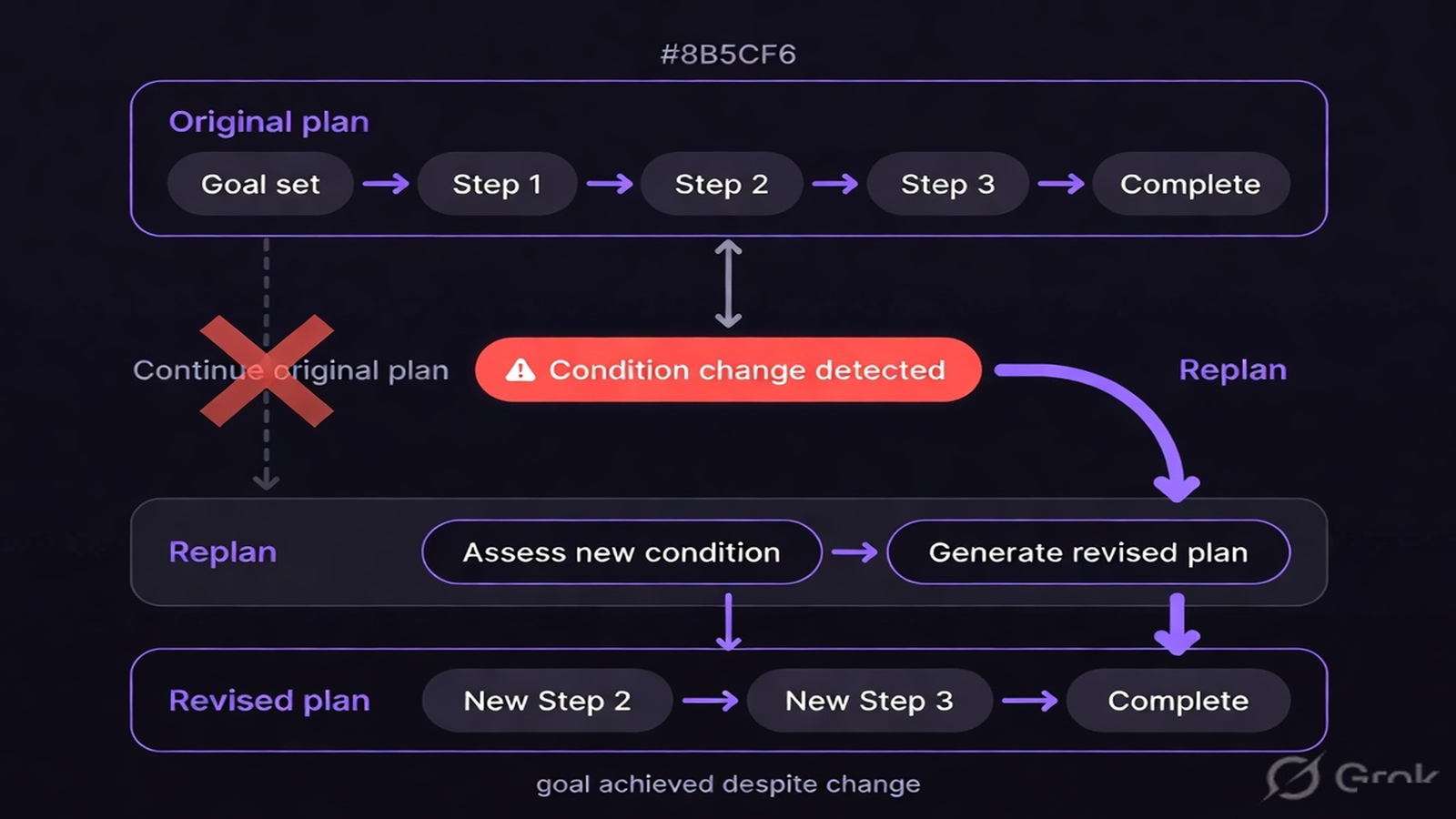
What does adapting to change require?
| Capability | Rigid plan | Detect and replan |
|---|---|---|
| Conditions | Assumed fixed | Monitored for change |
| Assumptions | Never rechecked | Re-validated as work proceeds |
| On a change | Executes stale plan | Replans to fit |
| The plan | A fixed snapshot | A living artifact |
WebShop and Mind2Web post low success when goals move; a more capable model runs a stale plan while reality shifts and the rework is yours. (arXiv:2207.01206)
Knowing when the goal or conditions have changed enough to replan requires a clear, current definition of the goal to compare against. Is what VibeModel provides as the Pattern Intelligence Layer. By keeping the success pattern explicit and current, it lets the agent recognize when reality has diverged from the plan's assumptions and trigger a replan. A dynamic goal is met by an agent that adapts rather than one confidently executing a plan the world has already passed by.
Frequently asked questions
Why not just make a good initial plan?
Because conditions and goals change mid-task. A perfect initial plan still goes stale and a rigid agent executes it against a reality that moved.
What is detect-and-replan?
The agent monitors for changed conditions or goals, re-validates its assumptions as it works and replans when reality has diverged from the original plan.
Is this just error handling?
It is broader. It treats the plan as a living artifact revisited as conditions change, not just a recovery path for when a step fails.