


Key facts.
- On WebShop, agents generate plausible-looking action sequences that fail the real task, showing plausible is not feasible. source
- Mind2Web shows generalist agents posting low success because plausible plans hit real constraints they did not account for. source
Why does a plausible plan fail?
A model produces fluent, sensible-looking plans because fluency is what it is good at and that is exactly what makes plausibility a poor proxy for feasibility. The plan assumes a tool that does not exist, a permission the agent does not have, a data field that is not there or a step the environment does not actually allow and none of that shows up in how the plan reads. The WebShop and Mind2Web results are this gap measured: agents produce reasonable action sequences and still post low success, because the plans collide with real constraints when executed. An agent that acts on a plan because it sounds right is acting out a fiction and the fiction only reveals itself when an action fails or, worse, does the wrong thing.
The defense is a feasibility check against the real environment before execution. Confirm the tools the plan calls exist and support what it assumes; confirm the agent has the permissions the plan requires; confirm the data and conditions the plan depends on actually hold; confirm each step is something the environment allows. This is dry-running the plan against reality rather than against its own coherence and it catches the plausible-but-impossible plan on paper, where the cost is nothing, instead of mid-execution, where the cost is a failed or harmful action and a plan that has to be redone. The plan reading well is the trap; testing it against the environment's real constraints is the way out.
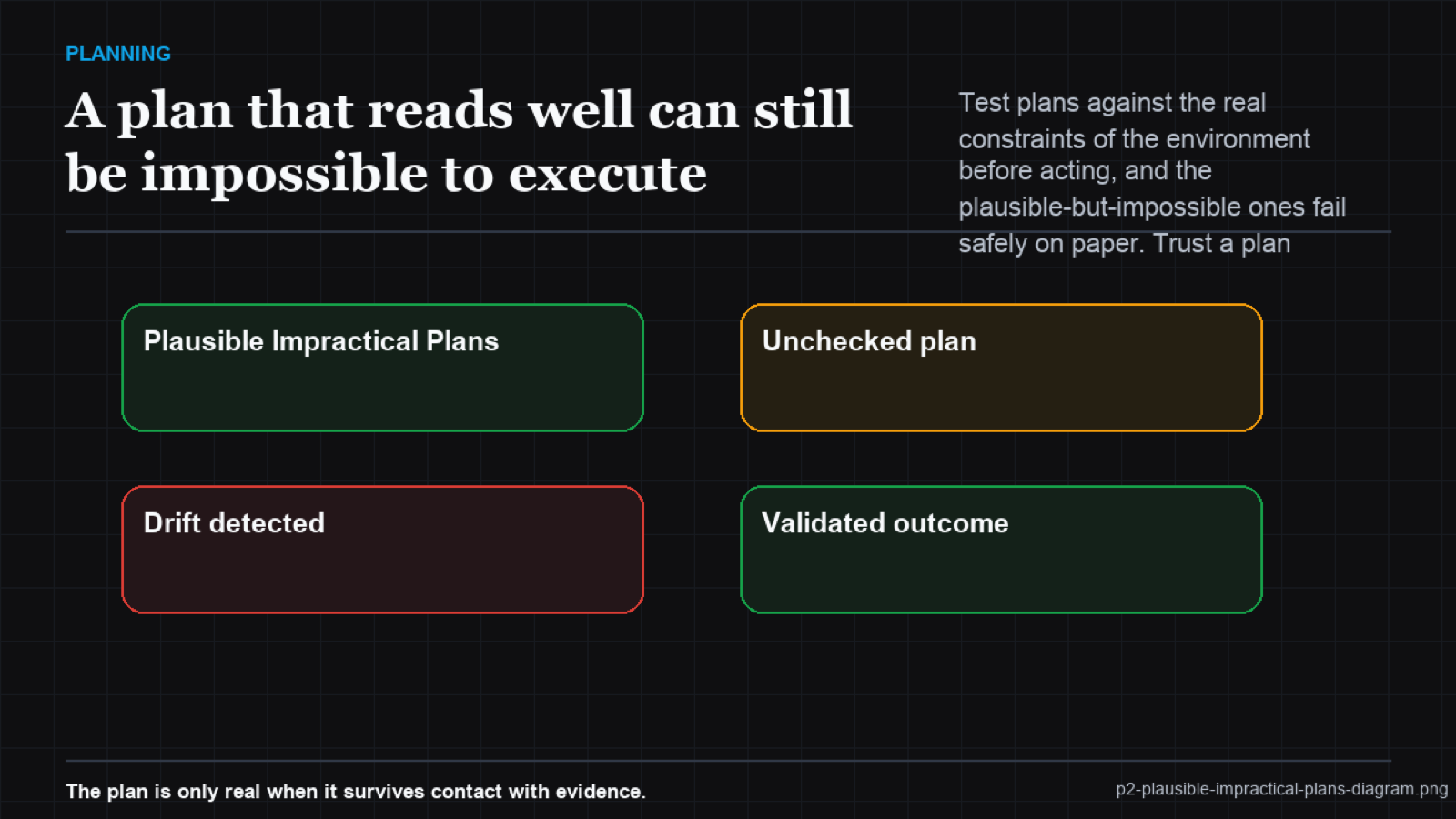
What does a feasibility check confirm?
| Check | Trust plausibility | Test feasibility |
|---|---|---|
| Tools | Assumed to exist | Confirmed and capable |
| Permissions | Assumed granted | Verified |
| Data and conditions | Assumed present | Checked to hold |
| An impossible plan | Acted out as fiction | Caught on paper |
Testing feasibility requires knowing the real constraints a valid plan must satisfy, which is what VibeModel makes explicit as the Pattern Intelligence Layer. By defining the conditions, tools and permissions a workable plan depends on, it gives the feasibility check a concrete standard, so a plan that reads well but violates the environment's real constraints is caught before execution rather than acted out as a confident fiction.
Frequently asked questions
Why isn't a coherent plan a feasible one?
Because models produce coherent text regardless of feasibility. The plan can assume tools, permissions or data that do not exist, none of which shows in how it reads.
What does a feasibility check do?
Dry-runs the plan against the real environment, confirming tools, permissions, data and allowed steps before execution, catching impossible plans on paper.
How big is the plausible-feasible gap?
Wide. WebShop and Mind2Web show agents generating sensible plans yet posting low real success because the plans hit constraints they did not account for.