


Key facts.
- WorkBench shows agents post low success on realistic workplace tasks, so the model alone is not what separates scaled agents from stalled ones.source
- Self-Refine shows iterative self-critique can improve outputs, one technique scaled agents combine with external verification not relying on the model alone.source
What did the scaled agents build?
Look at agents that actually reached reliable production scale and the common thread is not a special model; everyone has access to similar models and the WorkBench-style results show the baseline is shaky for all of them. The difference is the scaffolding the scaled agents wrapped around the model. They verify outputs before acting, so a wrong answer is caught rather than executed. They have recovery for failures, so a bad step does not become a bad outcome. They keep scope narrow and well-defined, so the agent operates where it is reliable. And they put human checks on the consequential decisions, so the high-stakes cases get oversight. Techniques like Self-Refine's iterative self-critique appear in the mix, but as one component combined with external verification, never as the whole answer, because self-critique alone is not enough.
The encouraging part is that scaffolding is copyable. The stalled agents are not stuck because they lack a secret model; they are stuck because they shipped the model without the reliability layer and hit the failures the scaffolding prevents. A team that adopts the same components, verification, recovery, scope discipline, human checks on the consequential, skips the painful rediscovery of why each one is needed. The lesson from the agents that scaled is not aspirational and vague; it is a concrete, repeatable set of reliability practices and the gap between the agents that made it and the ones that did not is exactly that practice, not the model underneath.
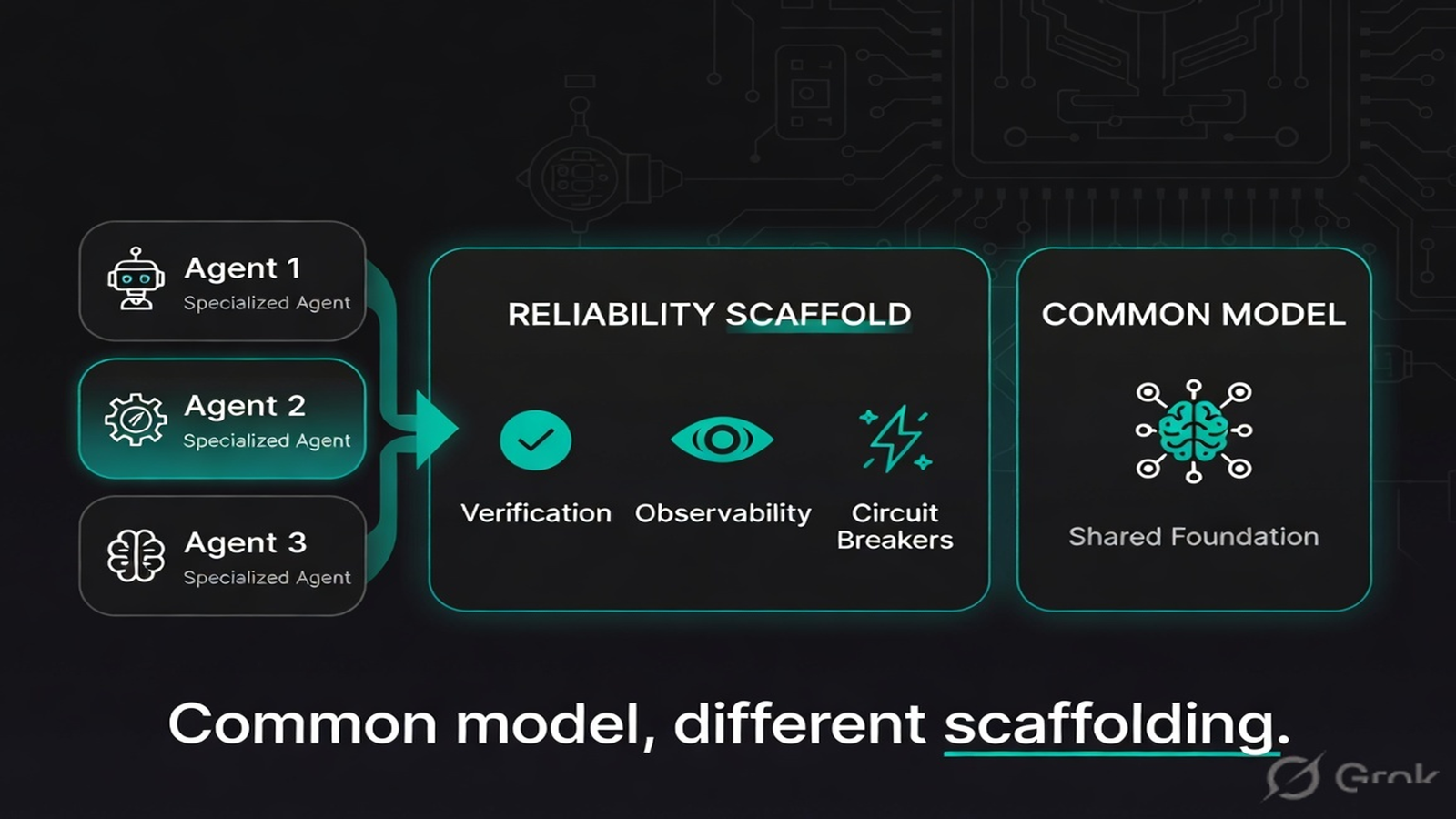
What is the scaffolding?
| Component | Stalled agent | Scaled agent |
|---|---|---|
| Outputs | Acted on directly | Verified first |
| Failures | Propagate | Recovery paths |
| Scope | Broad, ambitious | Narrow, well-defined |
| Consequential decisions | Unchecked | Human-checked |
Copying the scaffolding efficiently means placing each component where it actually matters, which is what the Pattern Intelligence Layer makes possible. VibeModel surfaces where the agent is reliable and which decisions carry consequence, so verification, recovery and human checks land exactly where the scaled agents learned they were needed, letting you reproduce their reliability without rediscovering each failure the hard way.
Frequently asked questions
Is the scaled agents' advantage their model?
No. Models are broadly similar and baseline success is low. The advantage is the reliability scaffolding wrapped around the model.
Is self-critique enough?
No. Techniques like Self-Refine help as one component but must be combined with external verification; self-critique alone does not make an agent reliable.
Can the scaffolding be copied?
Yes. Verification, recovery, scope discipline and human checks are concrete, repeatable practices, which is why the lesson generalizes.