


Key facts.
- Barnett Seven Failure Points (arXiv:2401.05856, 2024): silent degradation averages 14 days to detection versus 2 days for loud failures, a 7x longer exposure window.
- The root cause of silent failure: the default execution path treats all non-exception outcomes as success, including partial completions, ambiguous results, and low-confidence outputs.
- Fail-loudly design requires three things: verification failures can't reach the success path, all failed verifications route to a human-visible escalation, and escalation queues are monitored with SLA alerts.
- This fails to get implemented not out of neglect but because developers test the happy path first, last, and most. The verification failure handler ends up either missing or writing to a log nobody reads.
The architecture of silent failure
Barnett puts silent degradation at 14 days to detect; a stronger model degrades quieter, so design alerts before rework. (arXiv:2401.05856)
Most agent systems have an implicit success default: no exception raised means the output is valid. A verification check can fail to raise, because the developer forgot the raise statement, because the check returned False instead of raising, because an unexpected error in the check got swallowed by a broad except clause, and silently return to the success path. No alert fires. No queue gets an entry. The failure is invisible.
This pattern is pervasive because developers test the happy path first, last, and most thoroughly. The verification failure path, what happens when the check returns False, gets the least test coverage, the least operational monitoring, and the least thought about escalation. When it fails, it fails silently, because that's what the default code path produces.
The architecture of loud failure
Fail-loudly design inverts the default. Successful completion isn't the default outcome, it's an explicitly certified outcome that requires a verification gate to pass first. Any path that doesn't pass the gate routes to escalation, not to success.
Three implementation changes make this happen. First, the verification result is explicitly typed: not a boolean but a typed object that must be pattern-matched to reach the success branch. Second, the escalation path gets implemented and tested before the success path is validated. Third, the escalation queue has an SLA monitor with an alert that fires when items age past the SLA, making queue abandonment itself a loud failure.
# Fail-loudly pattern: success requires explicit certification
class VerificationGate:
 def run(self, output, criteria) -> VerificationCertificate | EscalationRequired:
 # Returns typed result - no implicit success
 if criteria.evaluate(output):
 return VerificationCertificate(output=output, gate=self)
 return EscalationRequired(output=output, reason=criteria.failure_reason)def agent_task(input):
 result = agent.run(input)
 gate_result = VerificationGate().run(result, task_criteria)
Pattern match - no path to success without certificate
 match gate_result:
 case VerificationCertificate():
 return commit_to_system(gate_result.output)
 case EscalationRequired():
 return route_to_escalation_queue(gate_result)
No default case: uncovered outcomes are compile-time errors
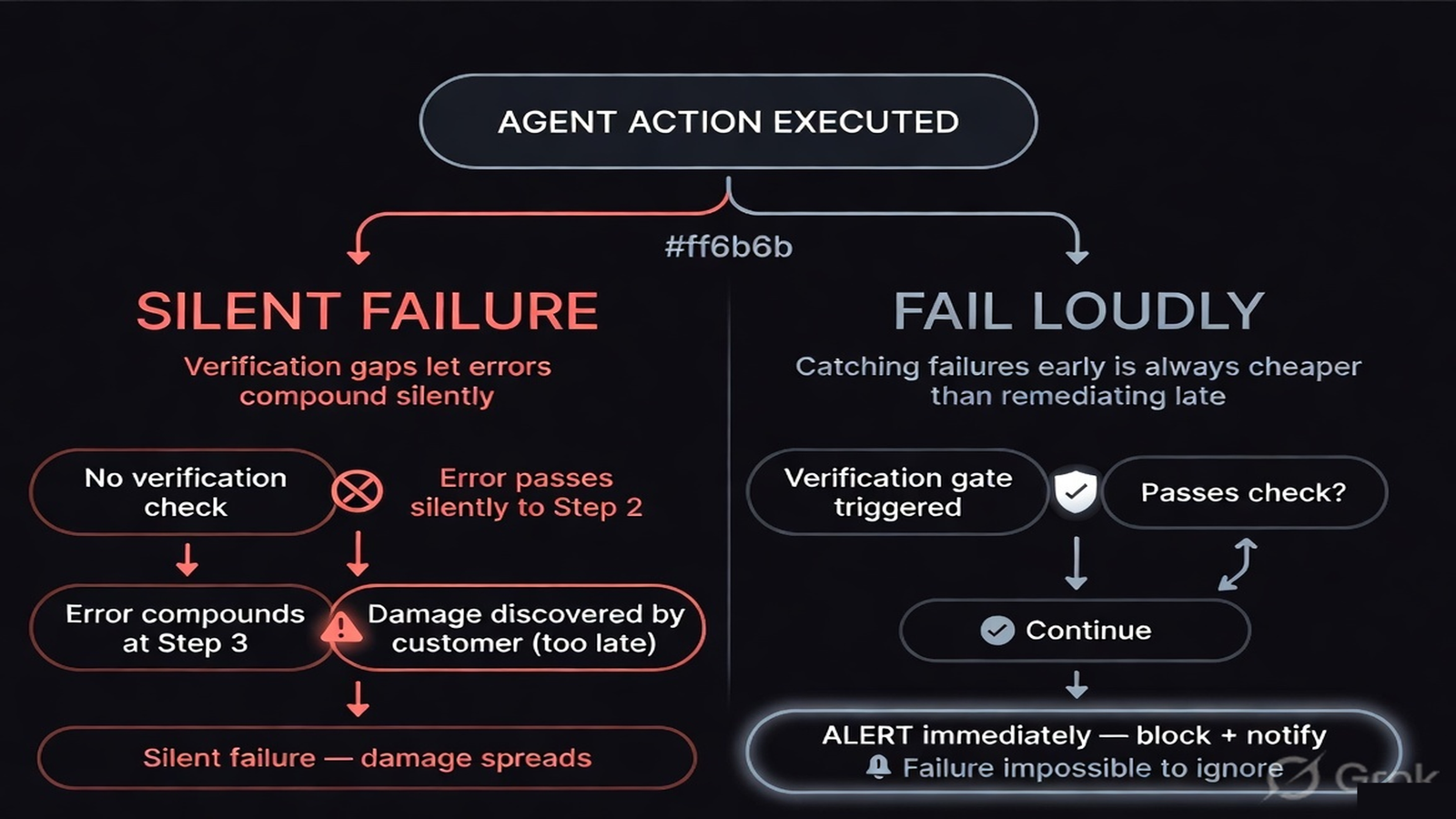
Fail-loudly design properties
| Property | Silent failure (default) | Fail-loudly design |
|---|---|---|
| Verification failure routing | Returns to success path (no raise) | Typed escalation object, cannot reach success path |
| Escalation queue monitoring | None (or unmonitored log) | SLA alert fires when queue ages past threshold |
| Verification path test coverage | Low (happy path focus) | Required: escalation path tested before success path |
| Average time to detection | 14 days (Barnett data) | Hours (SLA alert window) |
The Pattern Intelligence Layer specifies the fail-loudly contract as part of every pattern: the escalation queue, the SLA threshold, the alert channel, and the typed verification result that can't silently return to the success path. Teams building on patterns don't design this from scratch, they inherit it from the pattern and configure their domain-specific escalation routing on top.