


Key facts.
- Constitutional Classifiers shows even strong jailbreak defenses have residual bypass, so the expected cost of an incident is non-zero and must be priced into the reliability decision. source
- Perry's study finds AI-assisted code is more often insecure, a concrete rework and remediation cost of under-investing in reliability up front. source
Why does reliability look expensive?
Reliability work is visible and upfront: the verification layer, the monitoring, the testing, the recovery paths all cost time and money you spend before anything has gone wrong. The failures it prevents are invisible and deferred, the incident that did not happen, the rework you did not do, the customer who did not leave. So the budget conversation is lopsided: a concrete cost now versus an abstract benefit later and reliability loses unless someone does the math. The fix is to make the deferred cost concrete by pricing it. What does one production incident cost in remediation, lost time and damaged trust? How often, realistically, will the agent fail without the investment? The residual-bypass finding from Constitutional Classifiers is a useful anchor: even strong defenses are not perfect, so the incident probability is never zero and the expected cost is real.
Once both sides are in dollars, the decision usually flips. The rework cost alone is often substantial, with the Perry study showing AI-assisted code carries security flaws frequently enough to generate ongoing remediation and that is before counting the harder-to-quantify cost of lost trust when an agent fails in front of a customer. Reliability investment, the verification, the monitoring, the recovery, buys down that expected cost and the comparison is no longer abstract benefit versus concrete cost; it is one number against another. Framed that way, reliable design is not a cost center, it is the cheaper path and the teams that treat it as an investment with a return are the ones whose agents are still running a year later.
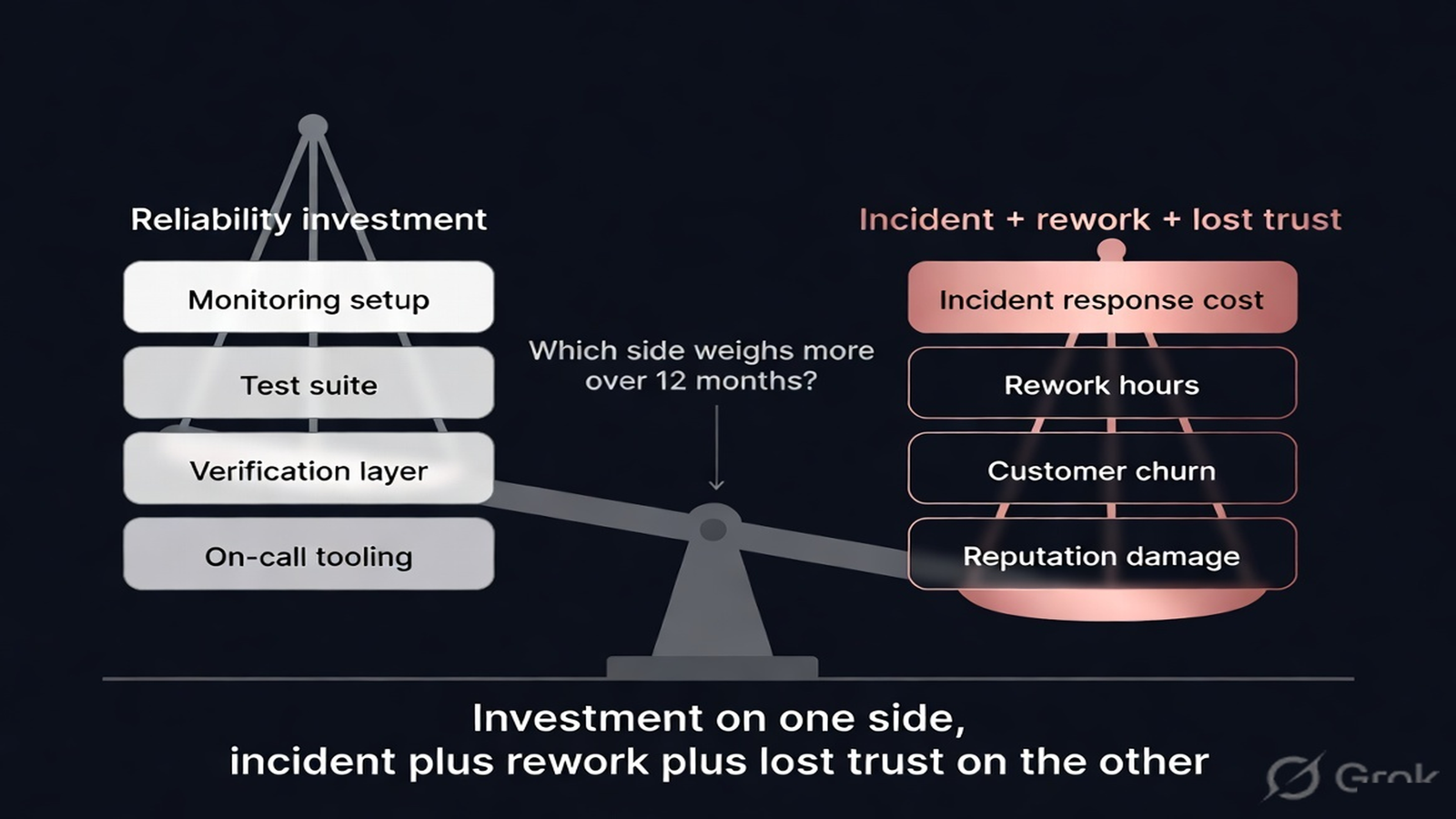
What goes into the reliability math?
| Side | Easy to see | Must be priced |
|---|---|---|
| Cost of reliability | Verification, monitoring, testing | (visible upfront) |
| Cost of incidents | Hidden | Remediation, downtime |
| Cost of rework | Hidden | Fixing flawed output |
| Cost of lost trust | Hidden | Churn, reputation |
Pricing reliability accurately depends on knowing where the agent is likely to fail and how often, which is what the Pattern Intelligence Layer surfaces. VibeModel makes the agent's reliability legible at the pattern level, so the expected incident and rework costs can be estimated from real failure rates rather than guessed, turning the reliability budget from a leap of faith into a calculation with both sides in dollars.
Frequently asked questions
Why does reliability lose the budget fight?
Its cost is visible and upfront while its benefit is invisible and deferred. Pricing the prevented incidents makes the comparison fair and reliability usually wins.
Is the incident cost really unavoidable?
The probability is never zero. Even strong defenses have residual bypass, so the expected cost is real and worth buying down.
What is the biggest hidden cost?
Often lost trust, which is hardest to quantify and most damaging, on top of the concrete remediation and rework costs.