


Key facts.
- The LLM-Modulo framework argues LLMs cannot reliably plan or guarantee correctness alone and should be paired with external verifiers and control.source
- "Large Language Models Cannot Self-Correct Reasoning But " shows agents often fail to fix their own errors without external feedback, so unchecked autonomy is unsafe.source
Why is full autonomy the wrong default?
Autonomy is where the agent's value comes from. It acts without a human in every loop; that's the whole point. But LLM-Modulo says LLMs need external verification to be dependable, and the self-correction research shows why: when an agent errs on its own, it tends to continue rather than fix, sometimes making things worse. So running fully autonomous everywhere keeps the appearance of capability while removing the checks that make it reliable. That's how an impressive autonomous agent becomes a confident, unsupervised source of errors.
The better framing is a dial tuned by consequence. Low stakes, agent is reliable, give it autonomy. High stakes or low reliability, insert a control: a verification step, an approval gate, a human in the loop. This isn't a capability sacrifice. It's what keeps the value intact. An agent that fails badly on a high-stakes action doesn't get to stay autonomous on the low-stakes ones for long. Getting the balance right per situation is what delivers real agentic value without the unsupervised failure modes.
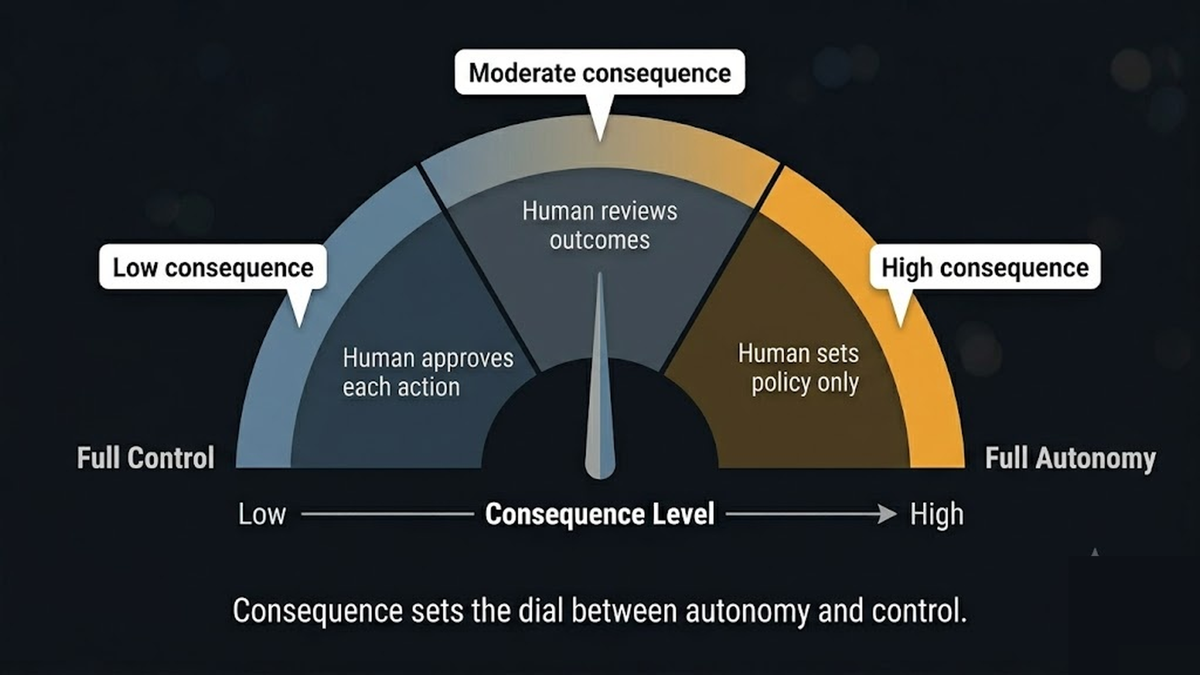
How do you tune the dial?
| Situation | Fully autonomous | Tuned by consequence |
|---|---|---|
| Low-stakes, reliable | Autonomous | Autonomous |
| High-stakes | Autonomous (risky) | Control: gate or human |
| Low reliability | Autonomous (risky) | Verify before acting |
| Outcome | Capability, low safety | Value and safety |
Tuning autonomy by consequence requires knowing, per situation, both the stakes and the agent's reliability, which is what the Pattern Intelligence Layer makes explicit. VibeModel surfaces where the agent is dependable and which patterns carry consequence, so the dial is set per pattern, full autonomy where it is earned, control where it is needed, delivering the value of agentic behavior without surrendering the reliability that control provides.
Frequently asked questions
Isn't more autonomy the goal?
Autonomy is the value, but unchecked autonomy is unsafe because agents cannot reliably self-correct. The goal is autonomy calibrated by consequence.
Doesn't control negate the point of an agent?
No. Control concentrates on high-stakes or low-reliability cases, leaving autonomy where it is safe, so you keep the value without the unsupervised errors.
What does control look like?
A verification step, an approval gate or a human in the loop, inserted where consequence or low reliability warrants it.