


Key facts.
- The LLM-Modulo work argues even strong models cannot plan or guarantee correctness alone and need external verification and structure. source
- Self-Refine shows model-wrapping techniques like iterative self-critique help, but as part of a verification system rather than a standalone fix. source
Why will better models not be enough?
Strong models cannot plan without external structure, the LLM-Modulo case, so an upgrade helps at the margin while the cost stays in engineering. (arXiv:2402.01817)
It is tempting to assume the reliability problem is temporary, that the next model will be good enough to make the scaffolding unnecessary. Models do keep improving and that helps. But capability and reliable autonomy are not the same axis. The LLM-Modulo argument is that even strong models cannot reliably plan or guarantee their own correctness, which is why pairing them with external verifiers works where the model alone does not. A more capable model raises the floor; it does not provide the verification, recovery, observability and control that turn a capable component into a dependable system. Waiting for the model that needs none of that is waiting for something the trajectory of the research does not promise.
So the productive bet is the system around the model. Verification that checks outputs independently, because the model cannot be trusted to check itself, as the limits of self-critique techniques like Self-Refine show. Observability that reveals what the agent did. Control that bounds and routes consequential actions. These investments compound and they are model-agnostic: they make today's model more reliable and they will make the next one more reliable too. The future of reliable agents belongs to teams who build that system now, not to those who defer it in hope of a model that makes engineering optional.
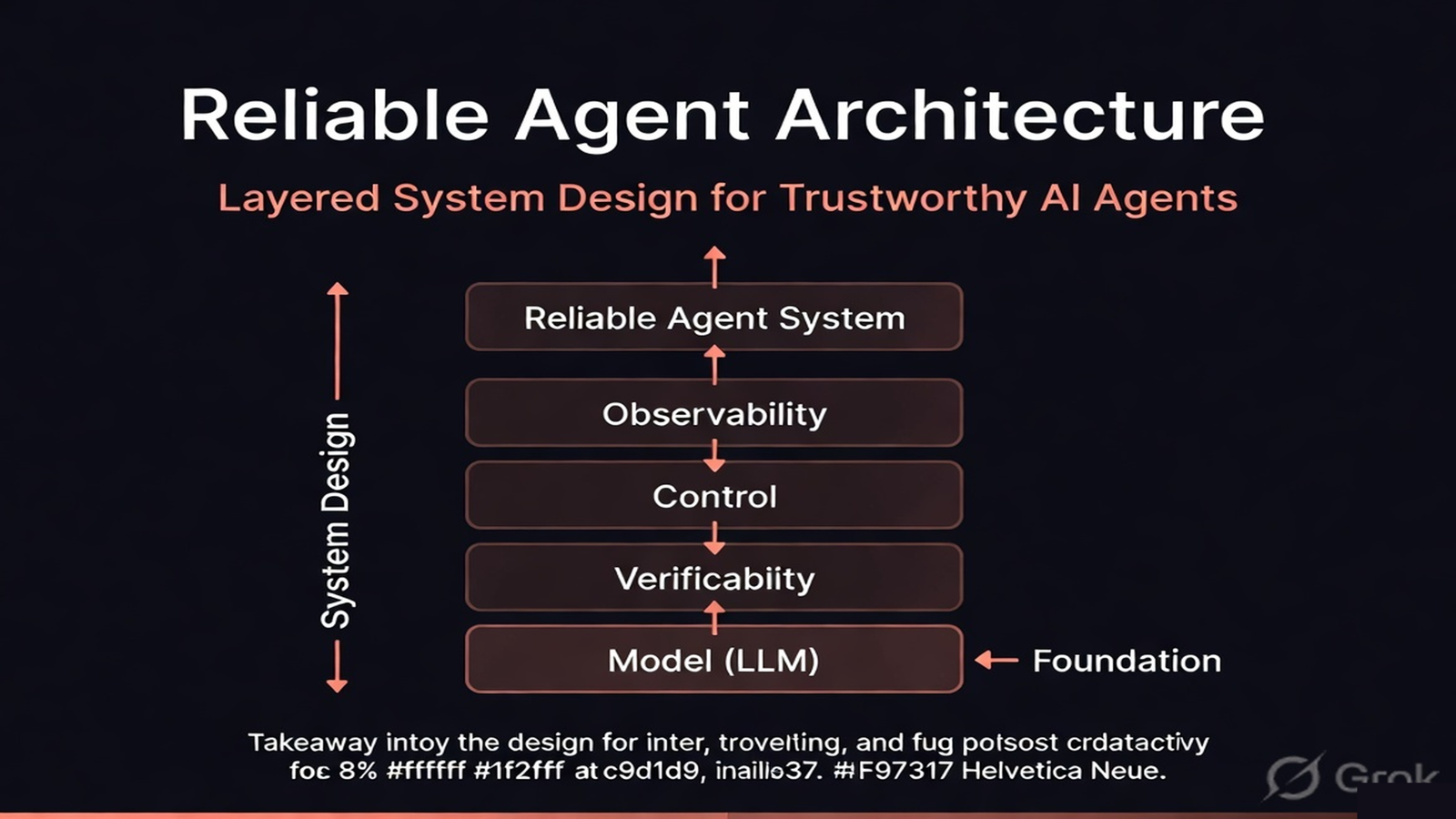
Where should the investment go?
| Bet | Wait for the model | Build the system |
|---|---|---|
| Assumption | Next model fixes it | System makes any model reliable |
| Verification | Deferred | Independent, now |
| Observability | Deferred | Built in |
| Payoff | Misses deadlines | Compounds across models |
Building the system that makes any model reliable is exactly what VibeModel is, the Pattern Intelligence Layer. By making reliability a managed property at the pattern level, independent of which model sits underneath, it captures the system-design value that better models do not provide, so reliability improves with every model upgrade and does not wait on one.
Frequently asked questions
Won't the next model solve reliability?
It will help, not solve. Capability and reliable autonomy differ; even strong models cannot plan dependably alone, so the system around the model remains necessary.
Is self-critique enough as the model improves?
No. Techniques like Self-Refine help only within a verification system, because a model checking itself has blind spots a better model does not remove.
Why is system investment the better bet?
It is model-agnostic. Verification, observability and control make today's model and tomorrow's more reliable, compounding across upgrades.