

A speech model that scores 95%+ on clean audio can fall to around 70% on real calls.Word-error-rate degrades roughly 2-3x from benchmark to production, worse on phone lines and accents, so models that ace clean datasets stumble on live callers (Back to Basics: Revisiting ASR in the Age of Voice Agents, arXiv:2603.25727, 2026). Your agent acts on that degraded transcript, not the audio.
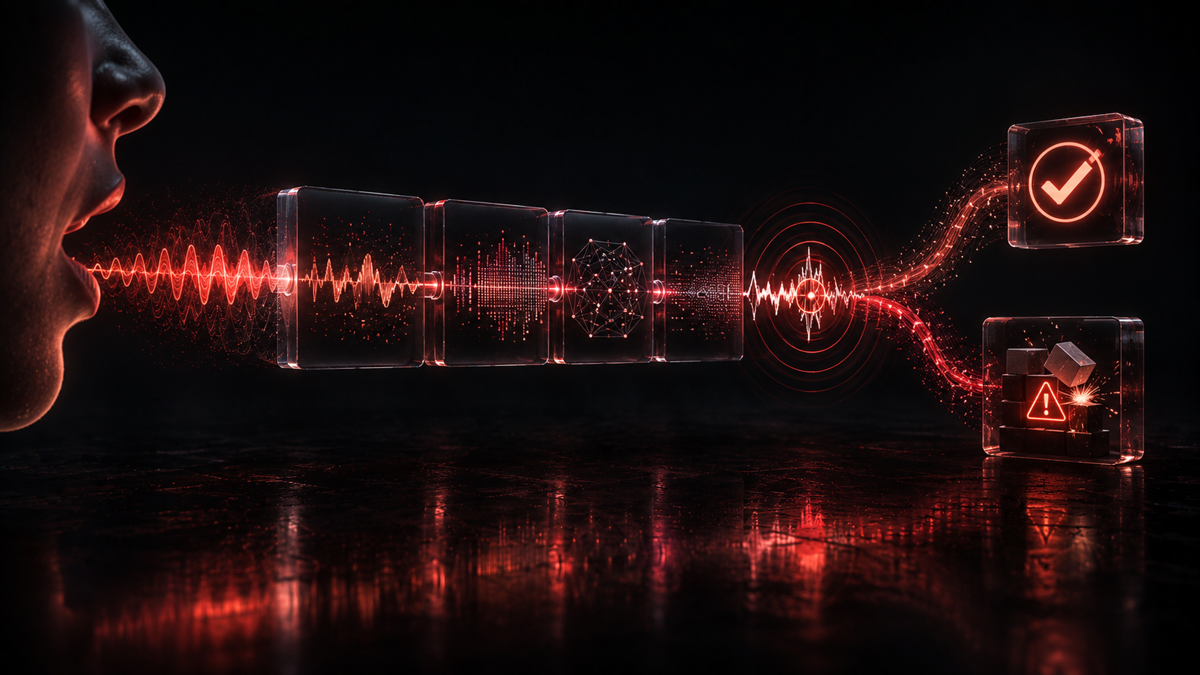
Key facts.
- Speech recognition degrades 2-3x from benchmark to production: a model above 95% on clean audio can drop to about 70% on noisy, accented, or telephony audio, and the agent inherits that error (Back to Basics: Revisiting ASR in the Age of Voice Agents, arXiv:2603.25727, 2026).
- Humans expect conversational turns to arrive fast: cross-linguistic study puts the typical gap between turns near 200 milliseconds, so a multi-second voice pipeline reads as broken (Stivers et al., PNAS, 2009).
- Real calls bring out-of-distribution conditions, telephony compression, overlapping speech, accents, code-switching, that the agent can't re-hear, so a garbled input becomes a confident wrong action (ASR in the Age of Voice Agents, 2026).
Why transcription is the ceiling
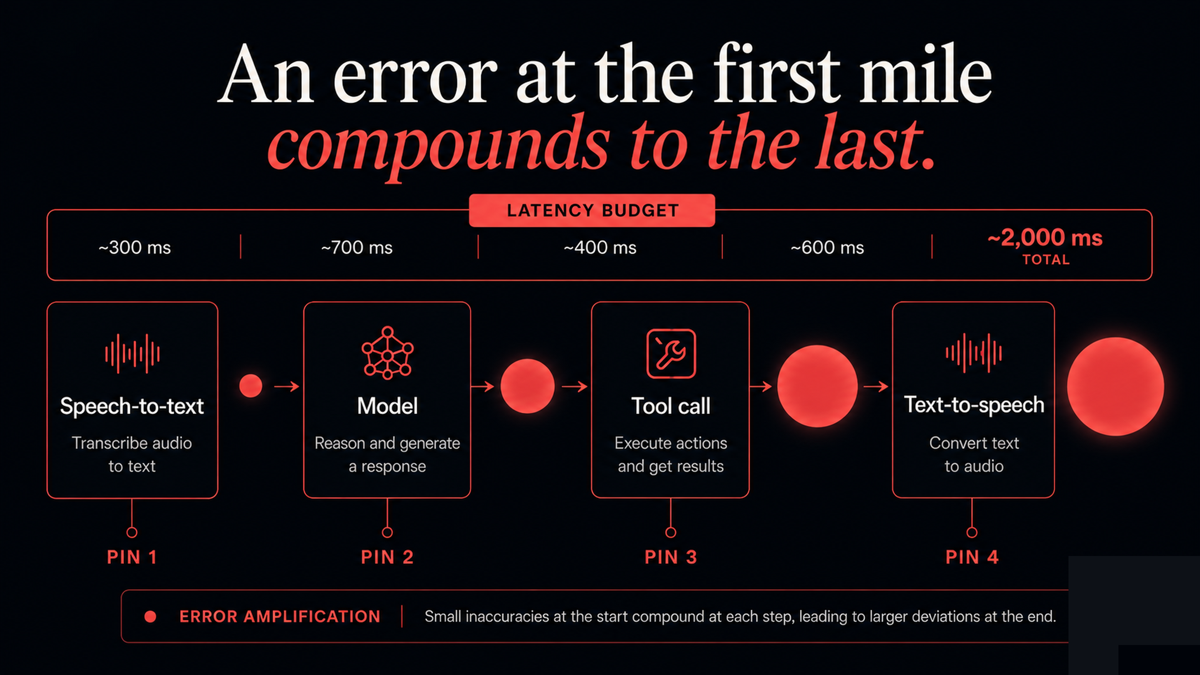
Every step downstream runs on the transcript, not the audio. Speech-to-text turns sound into text. The agent picks an intent from that text. If the text is wrong, nothing downstream corrects it, intent is wrong, tool argument is wrong, action is wrong. On clean demo audio the model sounds excellent. On a real call with a regional accent, traffic noise, or a dropped packet, a single misheard word changes the meaning. A refill date heard as the wrong day books the wrong pickup. Cancel heard as schedule reverses what the caller asked for. The model did its job on the words it got. The words were wrong.
What production adds that the demo never had
Three pressures. Noise and variety: accents, dialects, crosstalk, poor phone lines, the real error rate runs well above the controlled benchmark, and failures are subtle substitutions, not obvious gaps. Latency: the stack is speech-to-text, model, tool call, text-to-speech, and humans expect a reply in under a few hundred milliseconds (Stivers et al.). A pipeline that drifts to multiple seconds under load leaves the caller hearing dead air. Interruption: a real caller talks over the agent, and barge-in detection has to distinguish speech from noise and stop, or the conversation collapses. None of this shows up with one tester on a good headset.
How do you make a voice agent hold up?
Treat the transcript as untrusted input and confirm what matters. For any critical field, a date, an account number, an irreversible action, read it back and get confirmation before the tool fires, so a single mishearing can't book the wrong thing. Test against noise-injected and accent-diverse audio, pin baselines, and watch parse-failure and per-accent escalation rates so a silent vendor regression surfaces in metrics, not in complaints. Budget latency end to end and monitor the tail, the slow 5% of turns destroys the experience that the average hides, so track p95, not the mean. Make barge-in explicit, and route low-confidence transcriptions to a clarifying question or a human rather than a guessed action. The agent then degrades into asking, not into acting wrongly.
Where voice agents break and how to hold the line
| Production condition | Failure | Guardrail |
|---|---|---|
| Accent / noise / dropped audio | Misheard word, wrong intent | Read-back confirmation on critical fields |
| Latency under load | Dead air, caller hangs up | End-to-end budget, monitor p95 not average |
| Caller interrupts | Agent talks over the user | Explicit barge-in detection and stop |
| Silent ASR vendor regression | Quality drops unseen | Pinned baselines + parse-failure metrics |
| Low-confidence transcript | Confident wrong action | Clarify or escalate instead of acting |
A voice agent is only as good as the transcript it acts on. Production attacks that transcript with noise, latency, and interruption the demo never had. Confirm the fields that matter, watch tail latency, and let low confidence route to a question instead of a guessed action, and the agent stays trustworthy on real calls. Verifying input before acting on it is reliability at the pattern level, and that's what VibeModel builds as the Pattern Intelligence Layer.
Frequently asked questions
Won't a better ASR model solve this?
A better model raises the ceiling. It doesn't remove it. Real calls produce noise, accents, and dropped audio regardless of which model you use. You still need read-back confirmation and confidence-aware escalation on anything that matters.
Why monitor p95 latency instead of average?
Because the average hides the slow tail, and it's the slow turns that make callers think the agent is broken. The tail is where the experience is won or lost.
what's the single highest-value guardrail?
Read-back confirmation on critical fields. It stops a single mishearing from booking the wrong date or triggering the wrong irreversible action.