

Even GPT-4o completes only about half of routine multi-app API tasks, and roughly a third of the hard ones. On AppWorld's benchmark of 457 real-style APIs, the strongest model solves ~49% of normal tasks and ~30% of challenge tasks (AppWorld, arXiv:2407.18901, 2024). Point that same agent at your messy supplier and logistics feeds and the gap only widens.

Key facts.
- Even the strongest models clear only about half of routine multi-app, multi-API tasks and roughly a third of hard ones, scored on real end state across 457 APIs (AppWorld, arXiv:2407.18901, 2024).
- Supply-chain feeds use structured but quirky standards, EDI (ANSI X12, EDIFACT), CSV dialects, partial XML, that an agent expecting clean JSON parses wrong; the integration boundary, not model IQ, is where it breaks (enterprise EDI and API integration practice, 2025-2026).
- The reliable fix is a canonical internal model behind per-supplier adapters with strict response validation, so the agent only ever sees normalized data (agent integration engineering practice, 2025-2026).
Why do supplier APIs break agents specifically?
Because supply-chain integrations are the messiest APIs in the building. A carrier feed is EDI. A supplier sends CSV with its own quoting rules. An ERP returns XML with optional nesting that appears only for certain order types. Regional partners omit fields for compliance, or add their own. None of it is the single clean JSON your tool schema assumes. The agent's parser or the model reads that variance, and instead of failing loudly it often drops a field, coerces a type, or invents the structure it expected. The demo worked because it ran on a small, clean sample. Production runs on every supplier's dialect at once, and the variance is the failure.
What does the wrong parse actually cause?
Corrupted state that propagates with confidence. A dropped status field becomes an order marked ready that never shipped. A misread quantity becomes an inventory number that is wrong everywhere downstream. A partial response, half the shipments because the rest were filtered for residency, becomes a routing plan that strands deliveries. Because there is no validation checkpoint between the tool result and the next action, the agent reasons forward on bad data: it assigns the same driver to routes hundreds of kilometers apart, or notifies the wrong customer, and then repeats the error after a human corrects it. The model never sees a problem. The data was wrong before it reasoned.
How do you make the integration resilient?
Stop letting raw supplier formats reach the agent. Define a canonical internal model and put a per-supplier adapter in front of every feed, an EDI parser, a tolerant XML or CSV reader, an explicit field mapping, so the agent only ever sees normalized data. Validate every tool response against a strict schema with constrained decoding or a typed validator, and reject or route to a fallback on mismatch instead of guessing. Add a validation checkpoint before any high-stakes action, and degrade gracefully on partial data rather than acting on half of it. Fault-inject real supplier sample files, EDI variants, missing fields, odd encodings, in testing, and monitor for schema drift over time. The agent then acts on a clean contract you control.
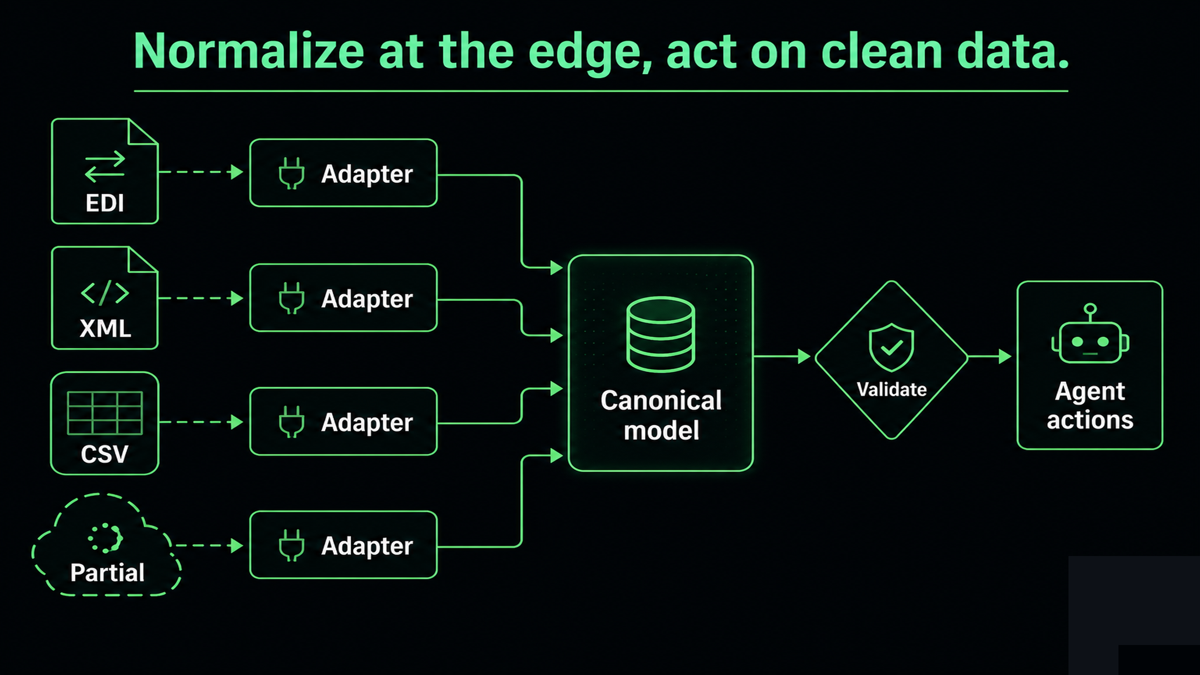
Where the variance bites and what fixes it
| Supplier reality | What breaks | Fix |
|---|---|---|
| EDI / odd XML / CSV dialect | Parser drops or mangles fields | Per-supplier adapter to a canonical model |
| Optional / supplier-specific fields | Hallucinated structure | Strict schema validation, reject on mismatch |
| Partial data (compliance filters) | Acts on half the picture | Completeness check + graceful degradation |
| Silent format change | Yesterday's parser fails today | Schema-drift monitoring + versioned contracts |
| Edge encodings / nulls | Type coercion errors | Fault-injection tests with real sample files |
One EDI feed shifts a field, the agent invents structure, and a stronger model misparses the same variance. (arXiv:2407.18901)
The pattern is that supply-chain APIs are variable, versioned, half-documented artifacts, and an agent that treats them as clean contracts turns one bad parse into a routing or inventory incident. Normalize every feed through adapters into a canonical model, validate before you act, and the agent reasons over data you trust while the messiness stays at the edge. Owning that boundary, the agent acting on verified, normalized state rather than raw supplier output, is reliability at the pattern level, which is what VibeModel builds as the Pattern Intelligence Layer.
Frequently asked questions
Why not just prompt the model to handle any format?
Because a model handed unexpected structure tends to guess rather than fail, and a confident guess on a shipment quantity is worse than an error. Normalize and validate in code, then let the model reason over clean data.
What is the highest-value first step?
A strict schema validator on every tool response that rejects mismatches. It converts silent field drops into loud, catchable failures at the boundary.
How do I catch a supplier changing their format?
Diff responses over time and alert on schema drift, and keep a fault-injection suite of real supplier samples that runs in CI so a new variant fails a test, not a delivery.