


Key facts.
- California Management Review's 2025 analysis frames adoption as a path where organizational and technical challenges compound rather than sitting in separate lanes. source
- Even LLM-judge verification carries systematic biases, with "Justice or Prejudice" quantifying twelve of them, so verification is hard enough that under-investing in it fails fast. source
- Resistance and fragility feed each other; a frontier model does not save under-funded verification, so failure funds rework. (arXiv:2410.02736)
How does the loop form?
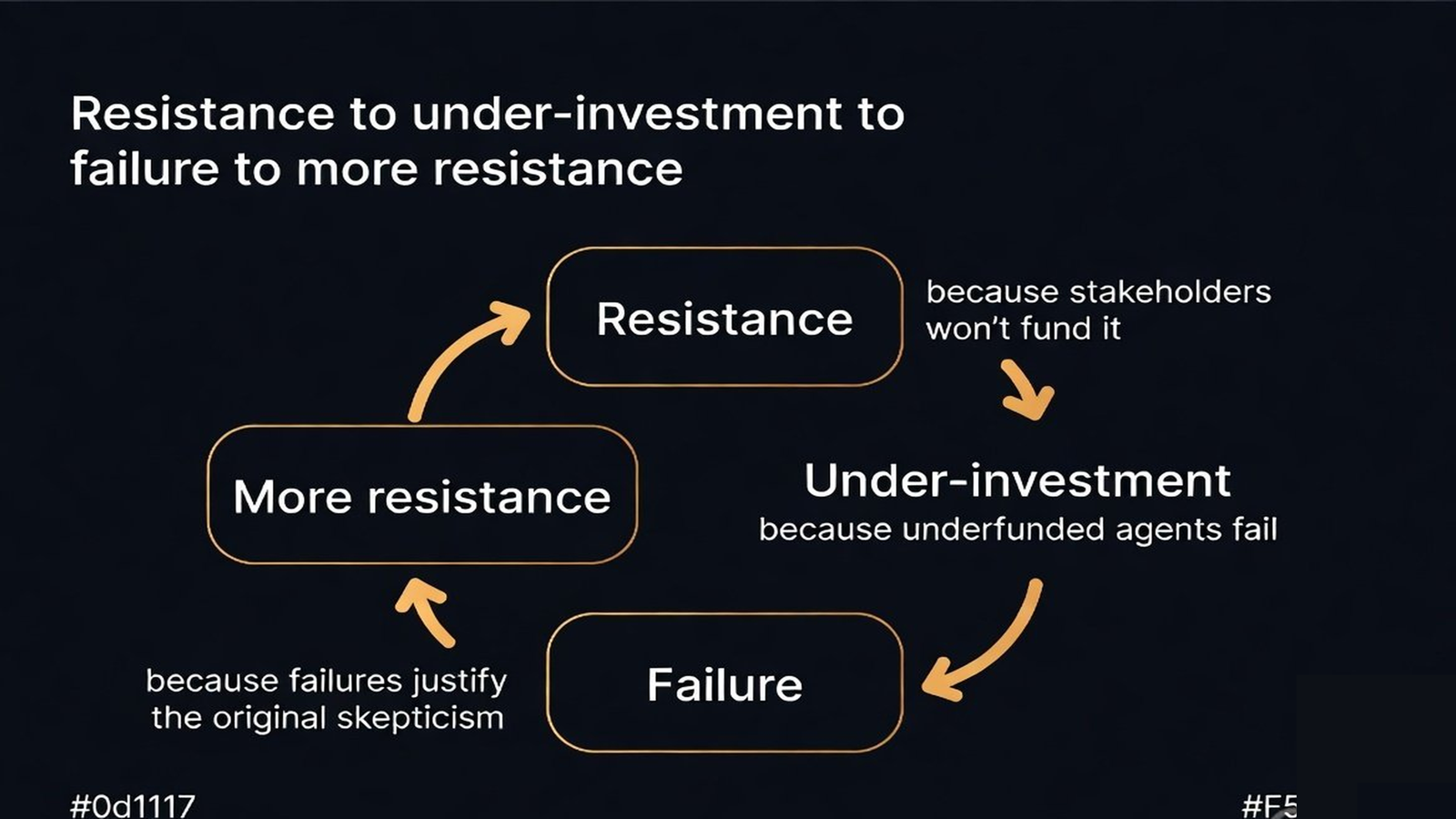
It starts as an organizational problem and becomes a technical one. A team that quietly resists the agent does the minimum: they do not push for the verification layer, the monitoring or the eval set, because investing in the thing they oppose feels pointless. So the agent ships with thin safeguards. Then it fails in the way under-verified agents do, a silent wrong answer, an unnoticed bad action and the failure becomes evidence for the resistance: see, it does not work. The opposition that caused the under-investment is now confirmed by the failure that under-investment produced. That is a loop and treating the org and the engineering as separate problems leaves it spinning.
The verification half is genuinely hard, which is why neglect bites so fast. Even using a model to check a model carries the systematic biases that the "Justice or Prejudice" work catalogs, so verification needs real attention to work at all. An organization that under-funds it because of quiet resistance is not skipping an easy step; it is skipping a hard, necessary one and the agent's resulting unreliability hands the resisters their proof. Breaking the loop means addressing both ends: engage the resistance directly and fund the verification regardless, so neither half can keep feeding the other.
Where do you break the chain?
| Link | Left alone | Broken |
|---|---|---|
| Resistance | Dismissed | Engaged directly |
| Verification | Under-funded | Funded regardless |
| Failure | Confirms opposition | Prevented or caught |
| Cycle | Spins | Broken at both ends |
Funding verification well is easier when you can see which patterns most need checking, which is what the Pattern Intelligence Layer provides. VibeModel surfaces where the agent is reliable and where it is not at the pattern level, so verification goes where it matters and the agent behaves consistently enough that the early failures, which would have fed the resistance, do not happen in the first place.
Frequently asked questions
Is this an org problem or a technical one?
Both, linked. Resistance defunds verification, weak verification causes failures, failures justify resistance. You have to break both ends, not pick one.
Why is verification so easy to under-fund?
Because it is invisible until it is missing and it is genuinely hard, even model-based checking carries systematic biases. Quiet resistance makes skipping it feel reasonable.
How do you break the loop?
Engage the resistance honestly and fund the verification regardless, so the failures that would confirm the opposition never occur.