


Key facts.
- The IMF note states payment systems depend on deterministic, rules-based execution for trust and legal finality, while agentic AI is probabilistic and may produce different outcomes from identical inputs. source
- It warns of errors, fraud and liability disputes if systems initiate irreversible payments without safeguards. source
- Core banking and ledger systems enforce strict schema, state and consistency that an agent's variable output can violate. source
Why is the mismatch structural?
Because the agent and the systems have opposite contracts. A core banking system, a ledger, a payment rail is built on determinism: the same input produces the same output, every entry is exact and a settled transaction is final and legally binding. An agent is built on probability: the same input can produce different outputs, the reasoning is approximate and the result is a best guess rather than a guaranteed value. The IMF note frames this as the central risk of agentic AI in payments, because wiring a system that varies into a system that demands exactness means the agent can produce a slightly different instruction each time, violate a ledger constraint, or, worst, initiate an irreversible payment based on a probabilistic decision that turns out wrong. Once a payment settles, it is final, so an erroneous agent-initiated transfer is not a bug you roll back, it is money gone and a liability dispute.
This is why direct integration is the wrong pattern. The agent's value is in interpretation and decision, but its output cannot be trusted to meet the deterministic contract of the financial system directly, so something has to stand between them that enforces exactness and finality on the agent's behalf.
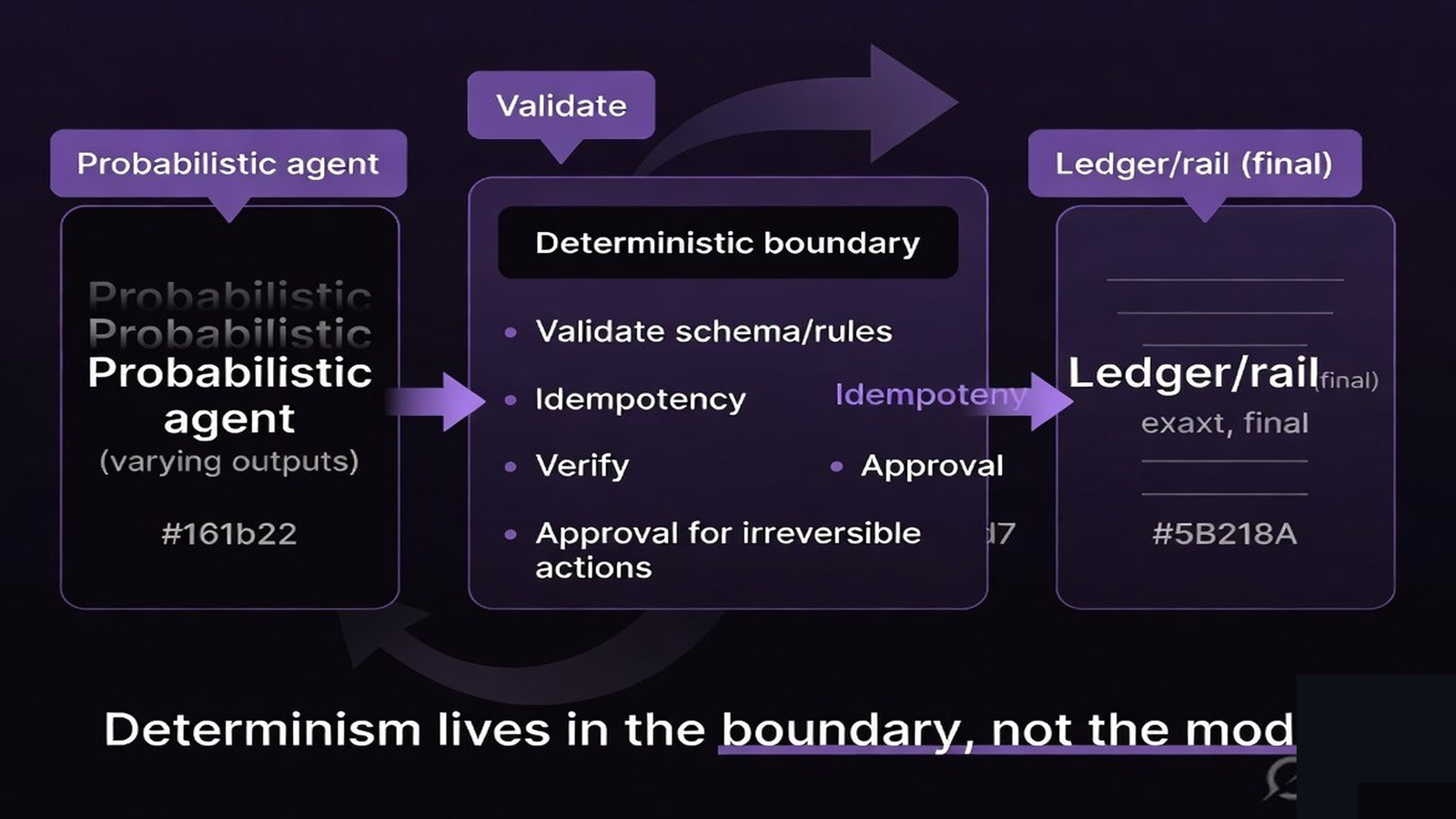
What does the boundary look like?
A deterministic layer that validates, verifies and gates every agent instruction before it touches the core system. The agent proposes a decision; the boundary checks it against schema, business rules and consistency constraints, confirms it is exact and requires approval for irreversible actions before executing against the ledger. Idempotency and verification ensure a retry does not double-post and a settled action is confirmed. The agent never speaks directly to the rail; it speaks to a deterministic intermediary that enforces the exactness and finality the agent cannot guarantee. That boundary is what makes a probabilistic agent safe to connect to a deterministic financial system.
| Integration pattern | Risk |
|---|---|
| Agent wired directly to the ledger | Variance and irreversible errors reach core systems |
| Deterministic verified boundary | Exact, gated actions; finality respected |
Building that deterministic boundary is part of what VibeModel does as the Pattern Intelligence Layer. We model the patterns an agent instruction must satisfy before it touches a core financial system, so a probabilistic agent connects to a deterministic ledger through a layer that enforces the exactness and finality it cannot.
Frequently asked questions
Can't I just make the agent deterministic?
No. Agents are probabilistic by nature and can vary even at temperature zero. The determinism has to live in the boundary, not the model.
Why is finality the key concern?
A settled payment is legally final. An erroneous irreversible transfer is money gone, so the boundary must gate irreversible actions behind approval and verification.
What does the boundary enforce?
Schema and consistency validation, business rules, idempotency, verification and approval for irreversible actions, before anything touches the ledger.