


Key facts.
- SWE-bench Verified: leading systems leave roughly one in five real software issues unresolved, and adversarial testing shows reported rates are often inflated. The fear of being wrong is justified.source
- IMF staff note 2026/004: unclear value and weak controls leave adopters exposed to cascading cost. That's exactly what clear governance removes.source
- Cloud Security Alliance's agentic identity guidance: visible controls make agents trustworthy enough to actually use. Trust is what adoption runs on.source
Why does the "governance slows adoption" intuition get it backwards?
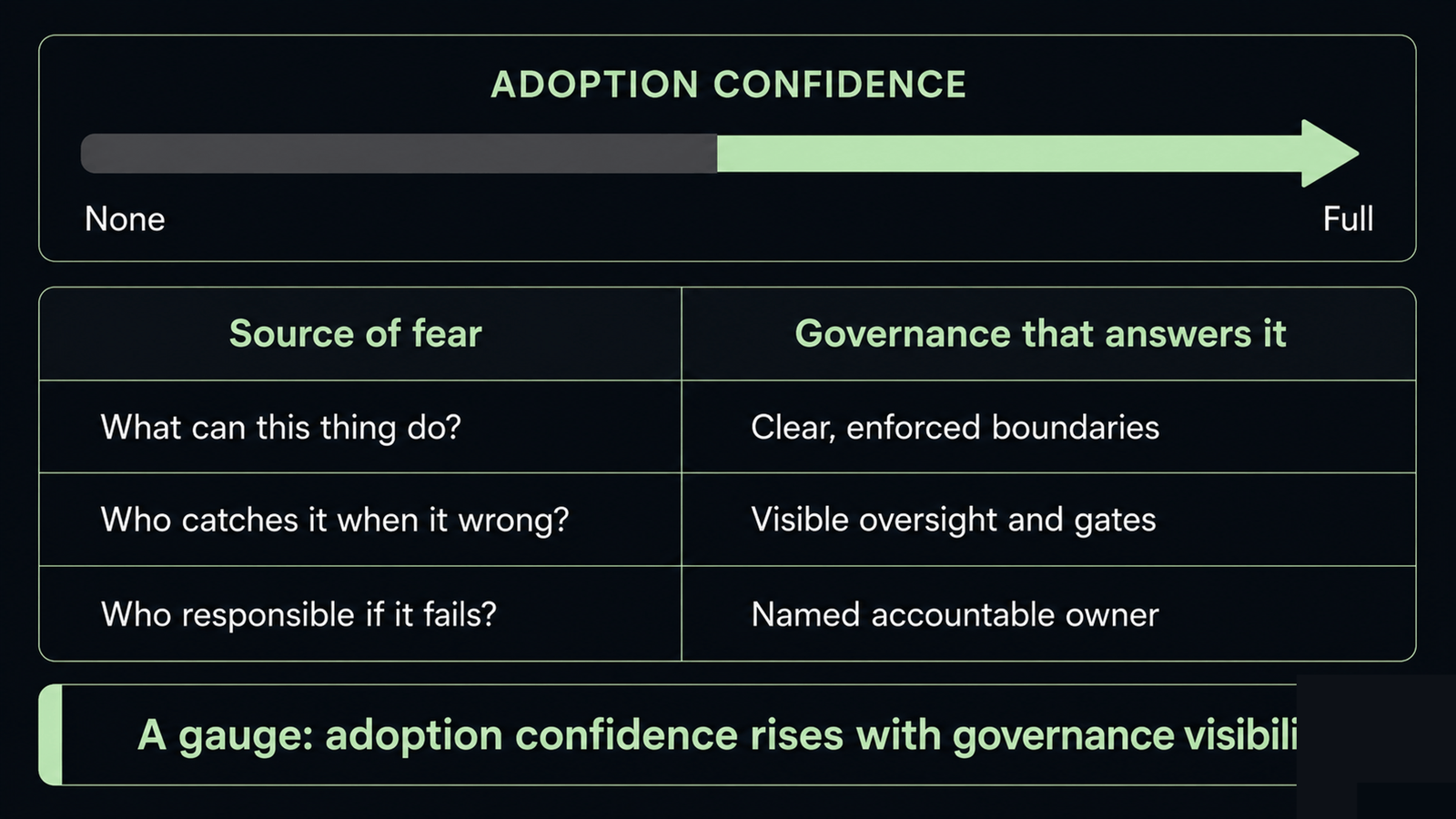
The default isn't frictionless adoption. It's hesitation. The operator who'll be blamed if the agent errs, the reviewer signing off, the leader holding the budget. They all have the same unspoken question: what happens when this thing is wrong? Without governance, there's no answer. So the rational move is to withhold trust, restrict the agent to low-stakes tasks, or skip adoption entirely. Clear governance answers the question directly. Here are the specific things the agent can and can't do. Here's who watches it. Here's who owns the failure when it happens. Once those are visible and real, the fear has somewhere to land. Adoption follows, because the agent is no longer an unbounded unknown.
Expecting failures isn't paranoia. SWE-bench Verified: top systems miss one in five real issues. Independent testing shows headline rates are often inflated further. Anyone being asked to stake their reputation on this agent is right to be cautious. A better model narrows the gap but doesn't close it. The IMF puts the same concern at the organizational level: unclear value and weak controls mean cascading cost exposure. The thing that resolves the caution, at both scales, is showing exactly how failures are bounded, caught and owned. That's governance. That's what moves the adoption dial.
What specifically reduces the fear?
Three things, all visible. Boundaries: a clear, enforced statement of what the agent can and can't do. People know the limits are real, not aspirational. Oversight: actual monitoring and human gates on high-stakes actions, not just a policy that says they exist. Accountability: a named owner. So people know who answers when something goes wrong and that it won't be quietly absorbed by whoever's nearby. Each one converts a specific fear into something workable. The agent that gets adopted is not the one nobody could fail with. It's the one whose governance is visible enough that people are willing to depend on it anyway.
| Source of fear | Governance that answers it |
|---|---|
| "What can this thing do?" | Clear, enforced boundaries |
| "Who catches it when it's wrong?" | Visible oversight and gates |
| "Who's responsible if it fails?" | Named accountable owner |
VibeModel's Pattern Intelligence Layer is where boundaries. Oversight and accountability get enforced at the pattern level, not described in a governance deck. The people who need to trust the agent can see directly how its failures are bounded and who owns them. That visibility is what moves adoption from hesitation to actual use.
Frequently asked questions
Doesn't adding governance make people more wary, not less?
The opposite. Without it, the rational response to a fallible agent is to withhold trust. Visible boundaries, oversight and accountability are what let people depend on it.
Why doesn't a better model just fix adoption?
Because even top systems leave about one in five real issues unresolved, so the fear of being wrong persists. Governance, not capability, is what tells people how failures are bounded and owned.
What's the fastest way to build adoption confidence?
Make three things visible: what the agent can and cannot do, how it is overseen and who is accountable. Each converts a specific fear into confidence.