


Key facts.
- EY's AI Anxiety in Business Survey (2023) found roughly 75% of employees worried AI would make certain jobs obsolete, the exact fear that vague messaging amplifies. source
- Deloitte's State of AI in the Enterprise (2025) found only about one in five organizations has mature agent governance, so most lack the structure to define and enforce an augmentation boundary. source
- GAIA reports GPT-4 with tools at about 15% versus roughly 92% for humans, evidence that the realistic design is the agent handling parts while people keep the judgment. source
Why does ambiguity cost you?
People do not resist agents in the abstract. They resist the version they imagine and absent a clear statement, they imagine the one that takes their job. The EY number shows how primed that fear already is. When leadership announces an agent without naming what it does and does not do, every employee fills the gap with the worst reading and the resistance that follows is rational given the story they were left to write themselves.
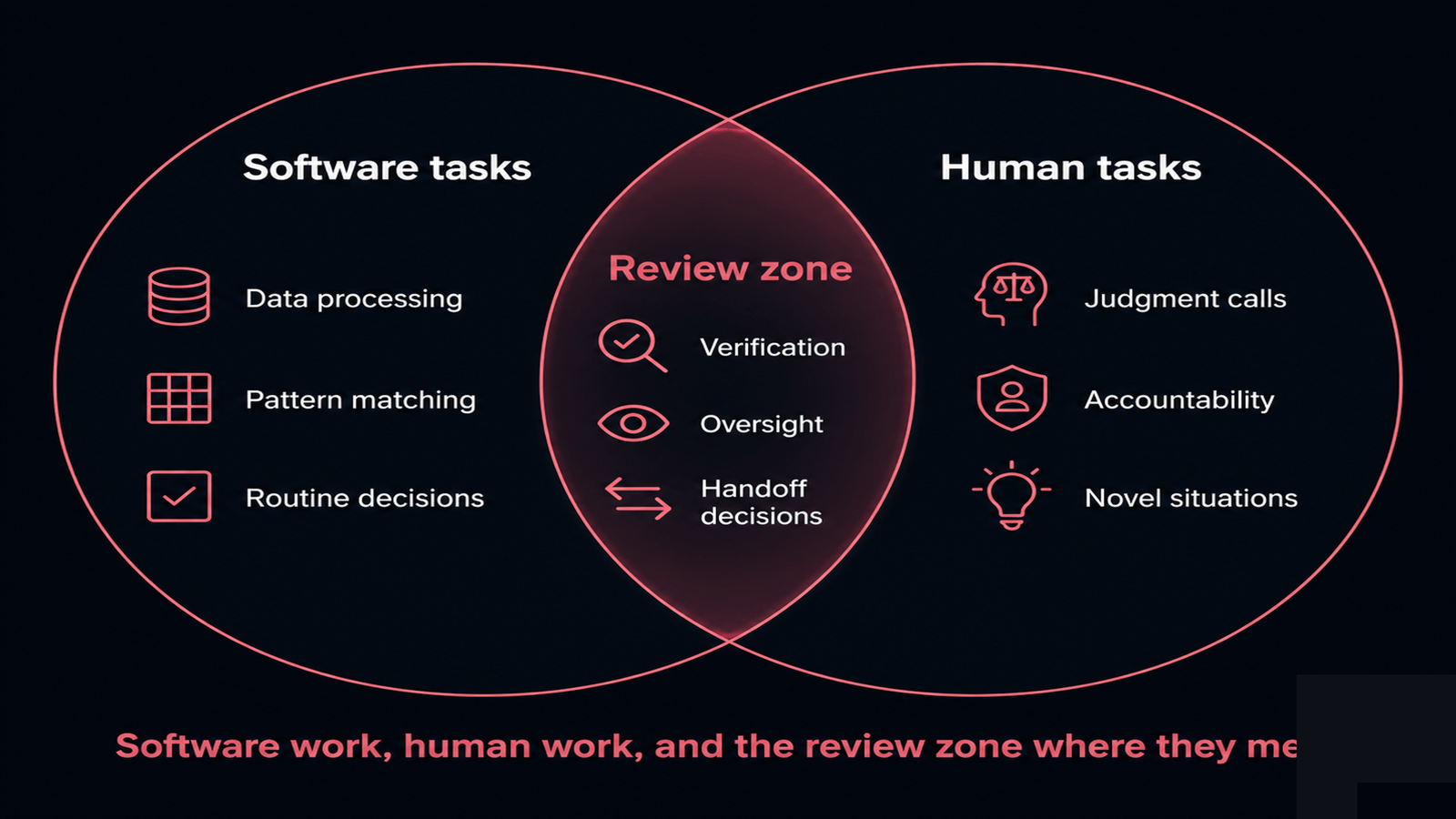
The fix is unglamorous and specific. Name the tasks the agent owns. Name the tasks the person keeps. Name the judgment calls that always route to a human. Say it in the language of the actual job, not a slogan about empowerment. The clarity does the work, because it replaces an imagined replacement with a concrete partnership people can evaluate and, usually, accept.
What does a clear boundary look like?
| Dimension | Vague positioning | Named boundary |
|---|---|---|
| What the agent does | Helps with your work | Drafts, sorts and flags, specifically |
| What the person keeps | Unstated | Judgment, exceptions, final call |
| What employees assume | Replacement | A defined partnership |
| Response | Resistance | Cooperation |
A boundary is only credible if the system actually holds it. An agent that quietly expands past its stated role teaches people the clarity was theater. VibeModel is the Pattern Intelligence Layer because it makes the boundary a pattern the system enforces, the agent does the parts it was scoped for and routes the rest, every time, so the augmentation story you told stays true in production.
Frequently asked questions
What if the honest answer is partial replacement?
Say so and say what changes for the people affected. A clear hard message beats a vague reassuring one, which people see through and resent.
Why name specific tasks?
Because slogans about empowerment do not tell anyone what their day looks like. Task-level clarity is what lets a person picture the after state and judge it.
How do you keep the boundary real?
Enforce it in the system, not just the prompt, so the agent cannot drift past its scope without a human in the loop.