


Key facts.
- Anthropic reported its multi-agent system used about 15x the tokens of chat and that token usage explained roughly 80% of performance variance, so the architecture decision, not the per-token price, drives most of the cost (reported). source
- HammerBench found parameter-name errors a primary cause of multi-turn function-calling failure, an example of the fragility that turns every tool or schema change into a re-validation and maintenance cost. source
- The IMF's 2026 staff note "How Agentic AI Will Reshape Payments" stresses that the economic exposure of autonomous agents extends well beyond their direct compute, into oversight, controls, settlement, and accountability, exactly the ownership costs an inference-only estimate omits. source
- Inference is the smallest piece; architecture, oversight, and re-validation are larger. Anthropic's design used ~15x the tokens and ~80% of variance, and a stronger model leaves HammerBench's fragility intact. (arXiv:2412.16516)
What belongs in an agent's TCO besides inference?
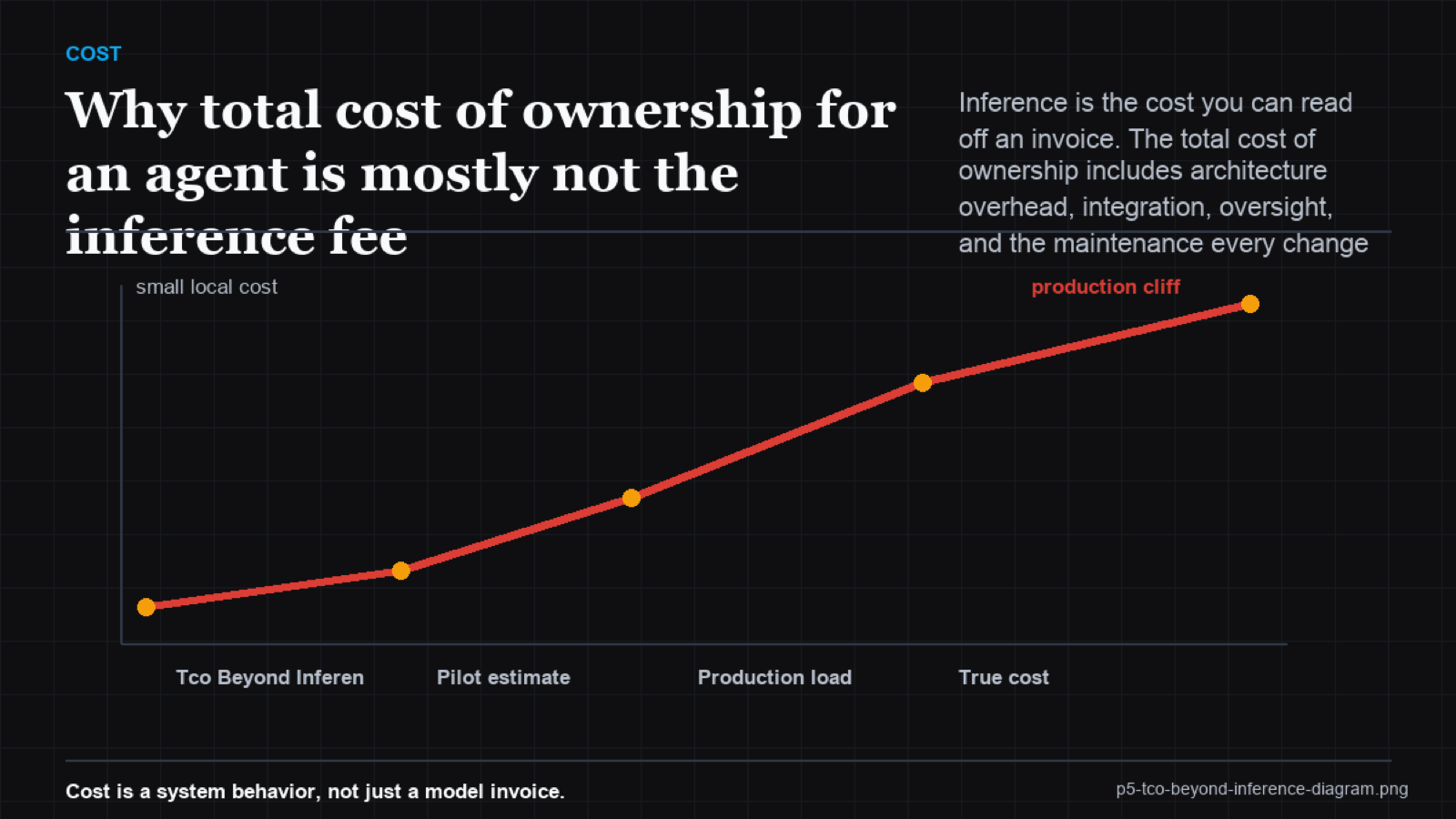
Four categories, each recurring. Architecture overhead, because the design you pick sets the token multiplier, and a multi-agent or heavy-context design can carry an order of magnitude more cost than a lean one, as the Anthropic numbers show. Integration, because connecting the agent to real systems is engineering that has to be built and maintained, not a one-time wire-up. Oversight, because at any failure rate above zero, humans review consequential outputs, which is standing headcount. And maintenance, because the agent needs re-validation every time a model, prompt, or tool changes, and the HammerBench fragility shows how easily a small change breaks it. Inference is the one of these five you can read off an invoice, and it is usually the smallest.
The reason TCO matters more than inference is that the cost that gets a project questioned is driven by the total, not the per-token price, and as the IMF note frames it, the exposure of an autonomous agent lives in oversight and controls as much as in compute. A team that budgeted inference and ignored the other four discovers the real cost after launch, when the architecture overhead, the integration burden, the oversight headcount, and the maintenance churn all land at once. The team that budgeted the total made a decision it can stand behind.
How do you budget the total instead of the invoice?
Price the architecture first, because it sets the token multiplier, and choose the leanest design that meets the quality bar rather than defaulting to a heavy one. Budget integration as ongoing engineering, not a one-time cost. Size oversight from your expected failure rate times the cost per reviewed output. And budget a recurring re-validation pass per model or tool change, informed by how fragile the tool boundary is. Add inference to those four and you have a number that holds. Skip them and you have an invoice estimate that production will correct upward, often past the point the project can absorb.
| TCO component | On the invoice? | Recurring? |
|---|---|---|
| Inference | Yes | Yes, usually smallest |
| Architecture overhead | Indirect (token multiplier) | Yes, set by design |
| Integration | No | Yes, ongoing |
| Oversight | No | Yes, headcount |
| Maintenance | No | Yes, per change |
The Pattern Intelligence Layer is where the four hidden TCO components become measurable alongside inference. Architecture token multiplier, oversight load, and re-validation effort are tracked at the pattern level, so the total cost of ownership is a known number before scale, not a discovery after. Reliability at the pattern level is also the reliability of a TCO figure leadership can fund against.
Frequently asked questions
Is inference really the small part of TCO?
Often, yes. Architecture overhead, integration, oversight, and maintenance are recurring and frequently larger. Anthropic's 15x token multiplier shows how much the design alone can carry.
Why is maintenance a recurring agent cost?
Because the agent is fragile to change. HammerBench shows a small thing like a parameter name can break function calling, so every model or tool change forces re-validation.
What is the biggest TCO lever?
Architecture. It sets the token multiplier that drives most of the cost, so the leanest design that meets the quality bar saves the most.