


Key facts.
- The agent side carries its own reliability cost: on WildToolBench, across 57 models and 1,024 real-world tool-use tasks, no model exceeded about 15% session accuracy, so the adaptability you buy from an agent comes with an error rate and oversight cost a deterministic bot does not have. source
- Industry and analyst estimates commonly put RPA maintenance and exception handling at a large share of the automation budget (often cited in the 30 to 50% range), though these are reported analyst and vendor figures, not peer-reviewed results, so treat them as directional. source
- Agents are probabilistic and add their own cost and reliability concerns: on the Berkeley Function-Calling Leaderboard's multi-turn benchmark a strong model like GPT-4o lands around 47.62%, so adaptability comes with an error rate and oversight cost a deterministic bot does not have. source
What actually decides which one is cheapest?
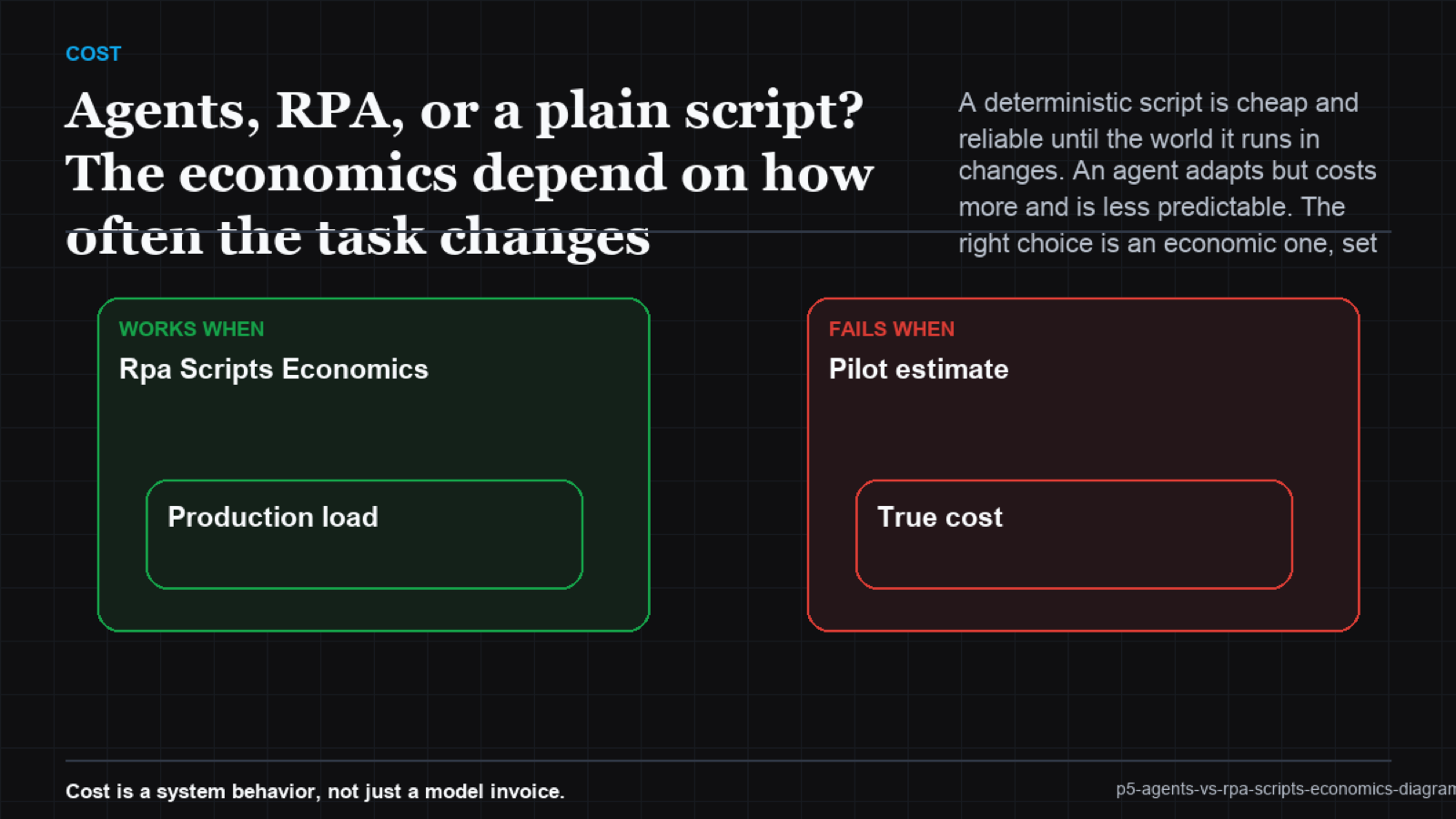
The rate of change of the task and the cost of a wrong output. If the task is stable, the inputs are structured and the interface rarely changes, a script or RPA bot wins on economics: it is cheap per run and reliably correct and there is little change to maintain against. The moment the task changes often, the screen moves, the format varies, the rules evolve, the deterministic approach starts paying a maintenance tax to keep up and an agent that adapts on its own can come out ahead even at a higher per-run cost. The crossover is the rate of change. Below it, determinism is cheaper. Above it, adaptability is.
The cost of being wrong sets the second axis. A deterministic bot is predictable: when it works it is right and when it breaks it usually fails visibly. An agent is probabilistic: it can be wrong in plausible ways that need checking, which is why production teams pair agents with human evaluation. If a wrong output is expensive, the agent's flexibility comes with an oversight cost that has to be in the comparison. A more capable model narrows the error rate but does not make the agent deterministic, so the oversight does not disappear with a bigger model.
How do you make the call without overbuying?
Score the task on the two axes before picking the technology. Low change, structured input, cheap-to-be-wrong: a plain script, the least expensive thing that works. Low change but interacting with brittle UIs: RPA, accepting its maintenance cost as the price of automating a stable but interface-bound process. High change or unstructured input: an agent, because adaptability is what you are paying the premium for and a script would spend that premium on maintenance instead. And many real workflows are hybrids, a deterministic core with an agent only at the steps that vary, which keeps the cheap, reliable parts cheap and reliable and spends the agent's cost only where change demands it.
| Task profile | Best fit | Why |
|---|---|---|
| Stable, structured, cheap-to-be-wrong | Plain script | Cheapest reliable option |
| Stable but brittle UI | RPA | Automates, accepts maintenance cost |
| High change / unstructured | Agent | Adaptability is the value bought |
| Mixed | Hybrid | Agent only where change demands it |
The Pattern Intelligence Layer is where this comparison runs on numbers. Rate of change, error rate and per-outcome cost are tracked at the pattern level for each step, so the choice between a script, RPA and an agent is made where the economics actually favor one and the hybrid boundary lands where it pays. Reliability at the pattern level is what keeps you from paying for an agent's adaptability on a task that never changes or paying RPA's maintenance tax on one that changes every week.
Frequently asked questions
Are agents always better than RPA or scripts?
No. On a stable, structured task a script or RPA bot is cheaper and more reliable. Agents win when the task changes often enough that determinism pays a heavy maintenance cost.
Why is RPA's maintenance cost so often cited?
RPA replays fixed steps and breaks on UI or API changes, so a changing environment forces ongoing fixes. Analyst and vendor estimates put this at a large share of the budget, though those figures are reported, not peer-reviewed.
Does a better model make the agent the default choice?
No. A stronger model lowers the error rate but stays probabilistic and still needs oversight. On stable tasks, deterministic automation remains cheaper and more predictable.