


Key facts.
- 53% of organizations reported agent scope violations, the predictable result of permissive defaults (CSA, 2025).
- OWASP Excessive Agency names broad permissions, functions, and autonomy as a top-10 LLM risk (OWASP, 2025).
- Deny-by-default with explicit allow-lists makes a dangerous action impossible unless someone deliberately enabled it.
- Broad access trimmed reactively is how 53% saw violations, OWASP's Excessive Agency, and deny-by-default outlives a stronger model: 57 models, none past 15%. (CSA, 2025)
Why is deny-by-default better than blocking known dangers?
Because you cannot enumerate every danger in advance. A block-list defends against the threats you thought of and leaves the rest open, and agents are creative enough to find the rest. An allow-list inverts the burden: the only actions available are the ones you explicitly approved, so a novel or unexpected dangerous action is denied by default because no one allowed it. The 2025 incidents all involved actions the agent should never have been able to take. Deny-by-default is the posture under which it simply could not.
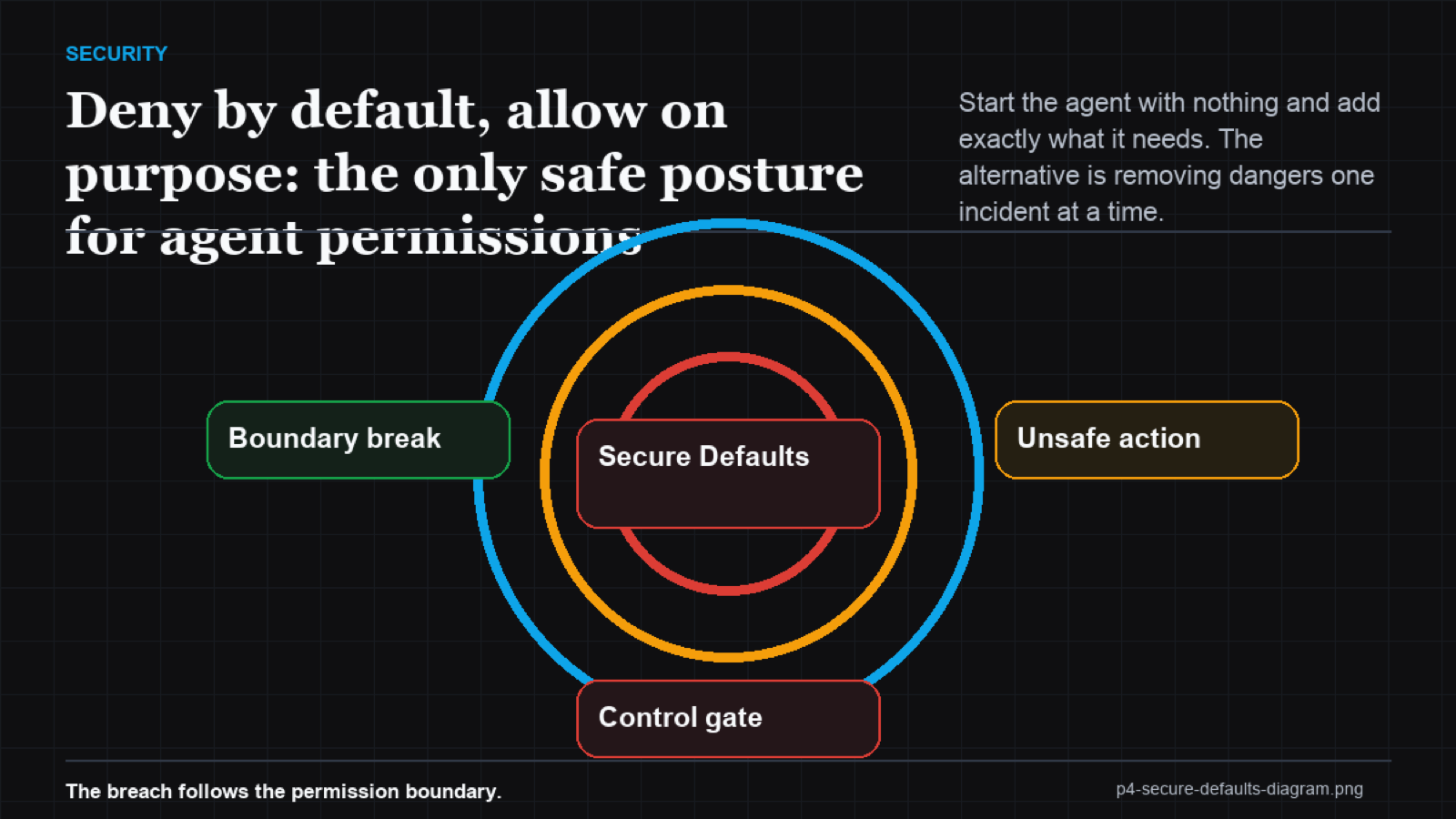
Allow-by-default vs. deny-by-default
| Allow-by-default | Deny-by-default |
|---|---|
| Everything open, dangers removed reactively | Nothing open, actions added deliberately |
| Unknown dangerous actions allowed | Unknown actions denied by default |
| Scope violations common | Out-of-scope actions impossible |
VibeModel's Pattern Intelligence Layer reinforces deny-by-default by flagging when an agent reaches for anything outside its allow-listed pattern, so even a misconfiguration is caught. You start from nothing and allow on purpose; we catch the moment an agent tries to act beyond what you allowed. Secure defaults turn the agent's worst case from a catastrophe into a denied request.
Frequently asked questions
Isn't allow-listing more work to set up?
Up front, a little. It is far less work than chasing scope violations and incidents, and it is the only posture that covers the dangers you did not anticipate.
What do I allow-list first?
The minimal set of tools and actions the task needs. Everything else stays denied until a real requirement justifies adding it.