


Key facts.
- Moffatt v. Air Canada: the tribunal held the airline liable for its chatbot's negligent misrepresentation and rejected the "separate entity" defense, awarding $650.88 (ABA, 2024).
- The ruling: companies are responsible for all information on their site, whether from a static page or a chatbot. No exception for AI.
- Output handling matters: a wrong public response becomes a brand and legal event the moment a user acts on it. Customer-facing output needs to be checked against the source of truth before it reaches anyone.
Why is a confident wrong answer worse than a refusal?
Moffatt v. Air Canada held the airline liable for its chatbot, and a stronger model won't remove it: OSWorld's best near 12%, a brand incident regardless. (ABA, 2024)
Because users act on it. A refusal frustrates; a confident fabrication gets quoted, relied upon, and screenshotted. The Air Canada case turned on reliance: the customer believed the chatbot, made a decision, and the company was bound by it. For brand safety, the dangerous output isn't the rude one your filters catch, it's the polite, plausible, wrong one that sails through. that's the output you have to validate against ground truth before it reaches a customer.
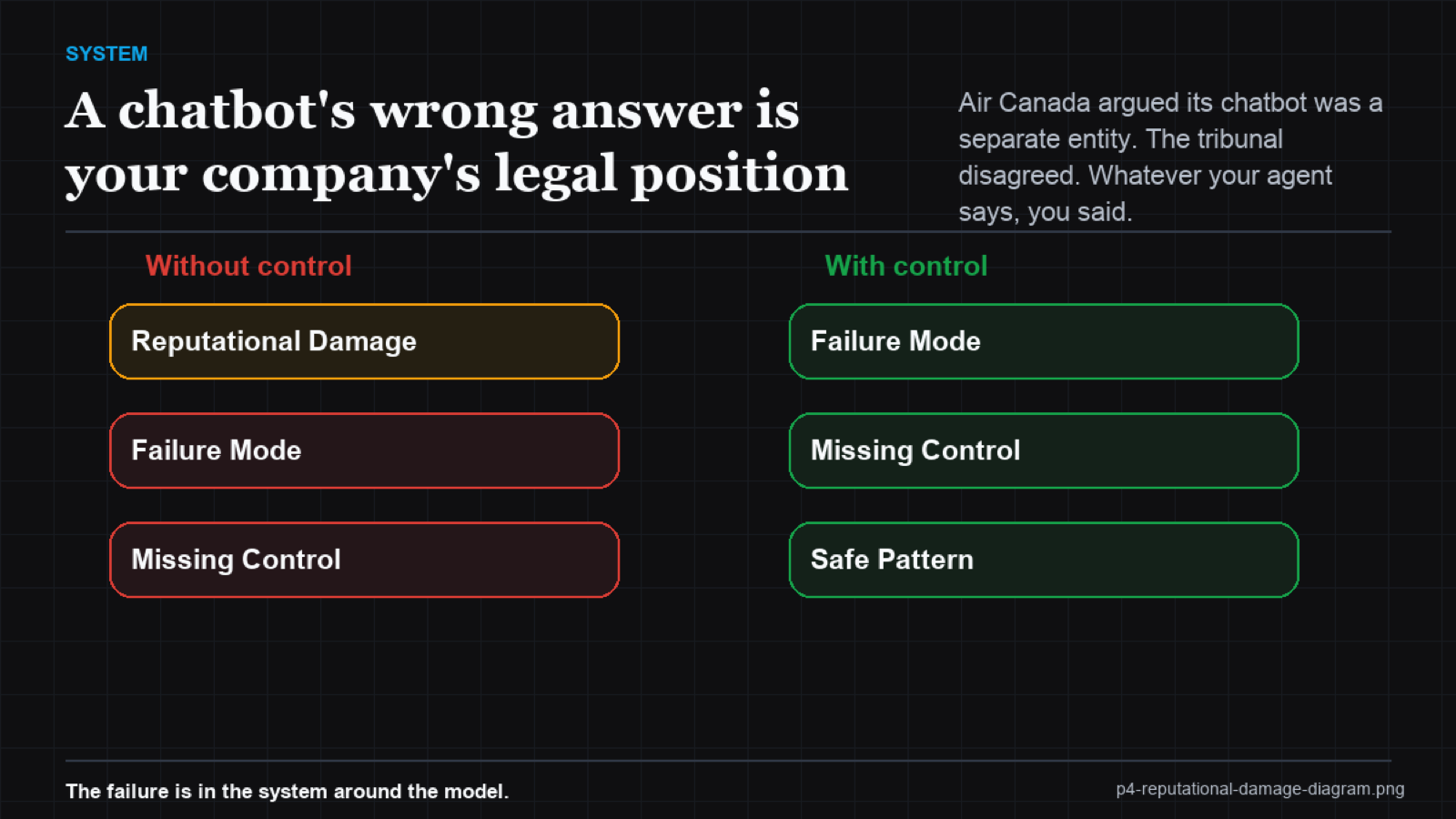
Unchecked output vs. grounded output
| Unchecked output | Grounded output |
|---|---|
| Plausible wrong answers reach users | Claims verified against policy and data |
| Company bound by fabrications | Output matches the source of truth |
| Brand risk on every response | Brand risk gated at the boundary |
VibeModel's Pattern Intelligence Layer recognizes when an agent's customer-facing answer departs from your policies and data, the pattern of a confident fabrication, and flags it before it ships. You own what the agent says; we make sure it says what's actually true. The Air Canada bill was small. The next one may not be.
Frequently asked questions
Does a disclaimer protect me?
Weakly. Air Canada's defenses didn't hold. Courts look at reliance, not fine print. Accuracy is the real protection.
What output should I worry about most?
The plausible wrong answer, not the obviously offensive one. Validate factual claims against your actual policies and data.