


Key facts.
- NIST AI 100-1 (Jan 2023) requires it. Accountability, transparency, explainability, on the trustworthy-AI list. Audit logs and incident-response workflows show up in the Measure and Manage functions, not the governance annex.source
- The EU AI Act (Regulation (EU) 2024/1689, in force 1 August 2024) requires high-risk AI systems to automatically log events for traceability of results (Article 12) and to be transparent enough for deployers to interpret outputs (Article 13).source
- ISO/IEC 42001:2023, the certifiable AI Management System standard, makes logging, traceability, and monitoring explicit operational controls tied to detecting and responding to AI incidents, putting audit evidence on the same footing as any other security control.source
- For agentic systems, the forensic record has to include prompts, reasoning, tool calls, arguments, outputs, and context, because the failure could be an adversarial injection or an internal model error and the trail is how you tell them apart, which is exactly the event logging the EU AI Act's Article 12 makes mandatory for high-risk systems.source
Why does an agent break traditional forensics?
Only a replayable trail tells attack from flaw when an agent acts harmfully, and a frontier model leaves the need, since across 13 systems they invent citations up to 95% of runs. (source)
Traditional software leaves a deterministic trail. The same input runs the same code path, so you retrace an incident through application logs and system calls. An agent doesn't work that way. Its path is probabilistic, it calls tools, it reads external content, and the same prompt can produce different actions. When it causes harm, the log shows the harmful action but not the reasoning that chose it, and reasoning is exactly what separates an attack from a bug. Was the agent injected by a hostile document, or did it hallucinate? Without the decision trail, that question has no answer, and an incident you can't diagnose is one you can't reliably contain or prevent from recurring.
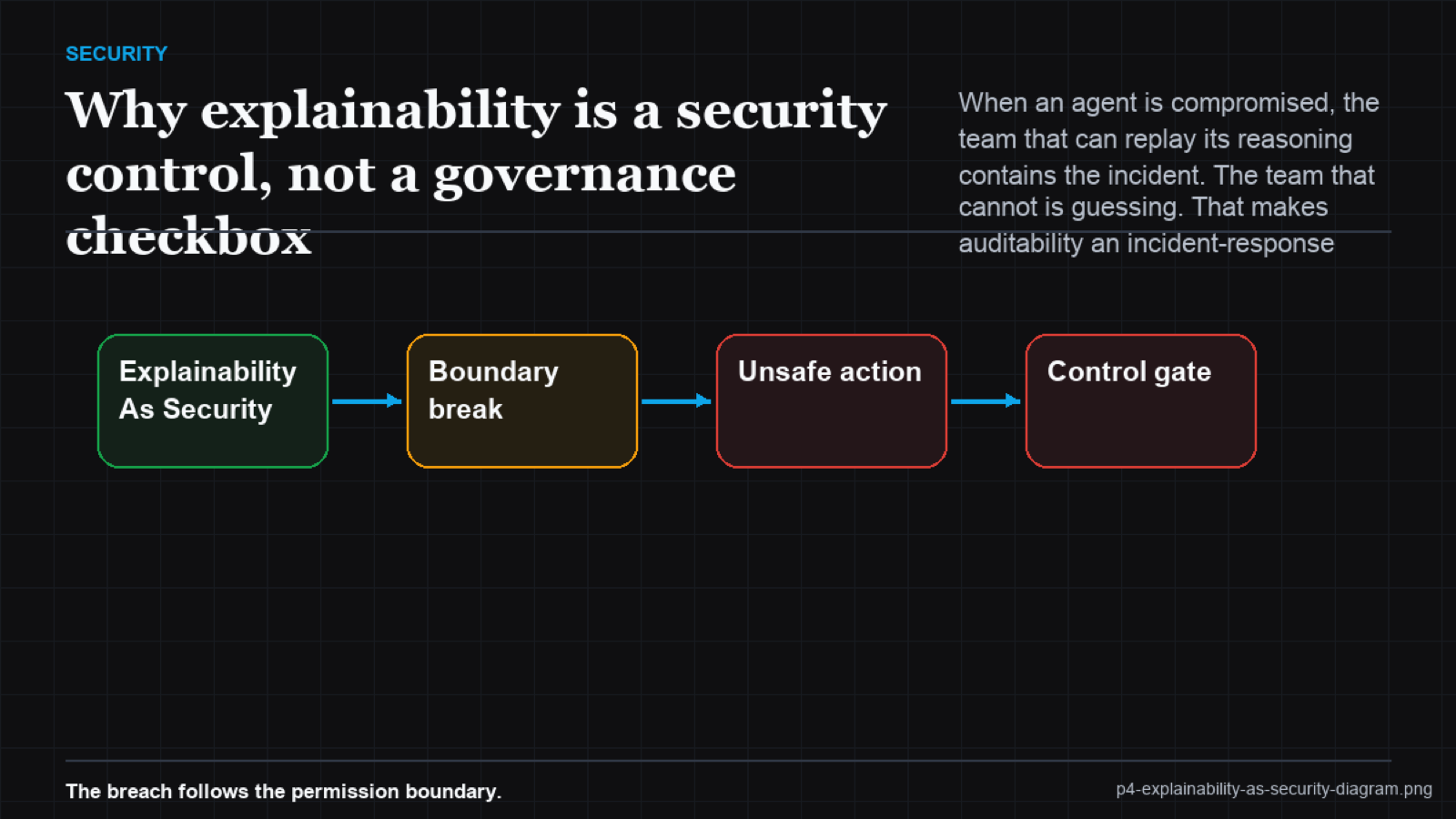
that's why this is a security property, not a governance one. Governance asks whether the system is fair and documented. Security asks whether you can investigate it when it's attacked. For an agent, the explainability that governance wants and the auditability that incident response needs are the same capability, and you build it for the second reason as much as the first.
What does an auditable agent actually capture?
Enough to reconstruct the decision, not just the outcome. The prompt and context the agent acted on. The reasoning or plan it produced. The tools it considered and the one it called, with arguments. The tool's response and the agent's next move. Stored immutably and tied to an identity, so an investigator can replay the run end to end. That record is what the EU AI Act's Article 12 logging is reaching for, what NIST's Measure function asks you to instrument, and what an incident responder needs at 3am when an agent has done something it shouldn't have.
| Incident question | Plain logs answer | Decision trail answers |
|---|---|---|
| Attack or internal flaw? | No | Yes, shows the triggering input |
| What exact sequence? | Partial | Full, reasoning plus tool calls |
| How to contain it? | Guesswork | Targeted, you see the reach |
| How to stop recurrence? | No | Yes, root cause is visible |
A Pattern Intelligence Layer is where this trail lives as a standing security control. Reliability and security at the pattern level mean every decision, tool call, and input is captured and replayable around the agent on every run, so an incident is something you investigate from the record rather than reconstruct from effects. NIST and the EU AI Act point at the requirement. The pattern is how you actually meet it, and it holds when you swap the model underneath.
Frequently asked questions
Isn't this just compliance logging?
Compliance is one reason to keep the trail. Incident response is the other, and it's the one that bites at 3am. The same auditability serves both, but you build it as a security control.
what's the minimum to capture?
The input and context, the reasoning or plan, the tool calls with arguments, the responses, and the next decision, stored immutably and tied to an identity. that's enough to replay the run.
Does a more capable model reduce the need?
No. Frontier models still produce confident, wrong, unexplained actions, including invented citations. The trail is what lets you investigate them, regardless of model.