


Key facts.
- TRAIL (arXiv:2505.08638) introduces a formal error taxonomy for agentic workflows and a dataset of human-annotated traces for localizing where an agent's reasoning failed, the tooling explainability needs. source
- In Moffatt v Air Canada (2024 BCCRT 149), a tribunal held the airline liable for its chatbot's wrong answer, so when an agent's decision harms a customer the organization is the one that must account for it. source
- A Cloud Security Alliance survey of agentic AI adoption reports that organizations widely cite the lack of explainability and traceability of agent decisions as a top barrier to trusting and scaling them. source
Why is explainability the question that comes first?
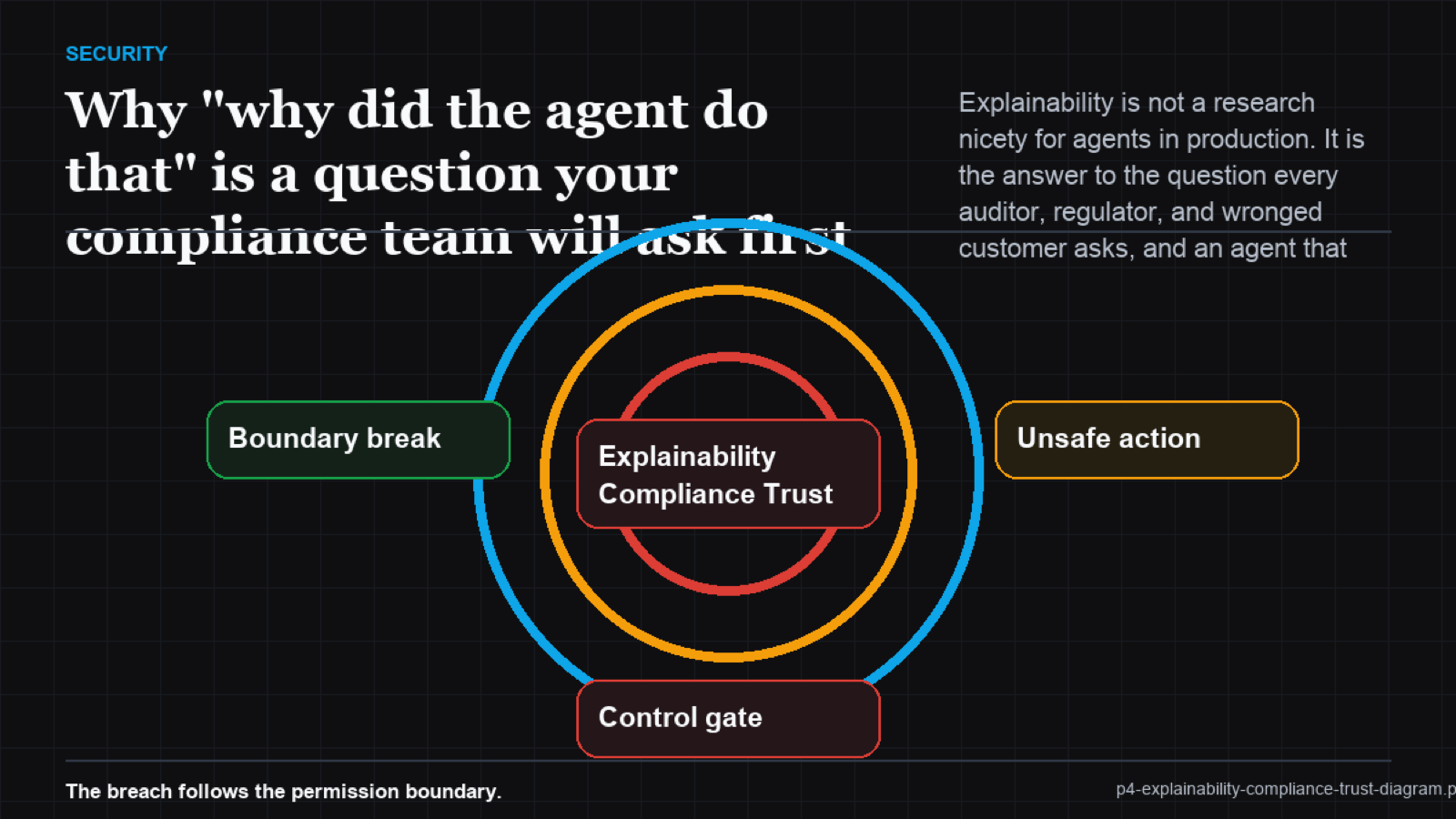
Because a consequential decision invites scrutiny and scrutiny is a request for the reasoning. When an agent denies a claim, flags a transaction or takes an action that affects someone, the immediate question from compliance, a regulator or the affected person is why and the only acceptable answer is an account of the factors the agent weighed. An agent that can produce that account is one its operators can stand behind, correct when it errs and defend when it was right. An agent that cannot is a black box and a black box in production is hard to trust precisely because no one can tell a good decision from a lucky one or a wrong decision from a defensible one. The Moffatt ruling sharpens this: liability for the agent's decision sat with the organization, which makes explainability the difference between defending a decision and absorbing it blind.
A more capable model does not give you the explanation for free. A stronger model may reason better, but unless the system captures that reasoning, the decision factors, the evidence weighed, the path taken, there is nothing to surface when the question comes. TRAIL is the kind of work that makes this tractable, offering a taxonomy and annotated traces to localize where reasoning went wrong, which is explainability turned into a usable artifact. Capability and explainability are separate properties: you can have a brilliant agent whose decisions are unexplainable and in production that is a trust problem the model cannot solve.
How do you make an agent's decisions explainable?
Capture the reasoning as it happens, not reconstruct it afterward. Log the decision factors, the inputs and evidence the agent weighed, so the basis is on record. Keep the reasoning trace, so the path from inputs to action is visible and can be localized when it goes wrong, which is what trace-analysis work like TRAIL is built to support. Surface the explanation in terms a compliance reviewer can read, not raw model internals, so the answer to why is usable by the people who ask it. And tie it to the audit retention the regulation requires, so the explanation survives to the moment it is demanded. Done this way, explainability is a standing capability and it is what lets an organization trust, correct and defend an agent operating on its behalf.
| Property | Black-box agent | Explainable agent |
|---|---|---|
| Answer to "why" | None available | Captured decision factors |
| Reasoning trace | Discarded | Retained and localizable |
| Compliance fit | Fails transparency duty | Meets it |
| Trust basis | Output only | Reasoning behind output |
The Pattern Intelligence Layer is where explainability lives as a capability. Decision factors and reasoning traces are captured at the pattern level, so the why behind any action is available to the people who ask it and the trace can be localized when a decision goes wrong. Reliability at the pattern level is what turns a black box into an agent an organization can trust, correct and defend.
Frequently asked questions
Will a more capable model explain its own decisions for you?
After a consequential action the first question is why did it do that, and Moffatt v Air Canada shows the firm answers; a stronger model does not hand you the explanation, capture the reasoning to keep it. (arXiv:2505.08638)
Is explainability really a compliance requirement?
In consequential settings, effectively yes. Moffatt v Air Canada put liability for a chatbot's wrong answer on the organization, so being able to account for a decision is a defense you need, not just a trust nicety.
Can I add explainability after an incident?
Not reliably. If the reasoning and decision factors were not captured at the time, there is nothing to reconstruct. Explainability has to be instrumented before the decision, not after the question.
Does a more capable model make decisions explainable?
No. A stronger model may reason better, but unless the system captures that reasoning, the decision is still a black box. Tools like TRAIL exist to make captured reasoning analyzable.