


Key facts.
- Anthropic bounds fan-out to 3-5 subagents and reports early failures from unbounded spawning (Anthropic Engineering).
- Fewer agents means fewer interaction channels: the count scales as n(n-1)/2, so each agent you defer removes several boundaries where misalignment could hide.
- Scaling coordination practices (shared state, verification, tracing) before scaling agent count is what keeps reliability flat as the system grows.
What does "earn the third agent" mean in practice?
It means your two-agent system has a verified handoff, an interaction trace you can read, and a measured success distribution you trust. Only then do you add a third, because now you have the coordination machinery to absorb it. Teams that jump straight to ten agents aren't scaling a working system, they're scaling an unproven one, and the failures show up at every new boundary. Small isn't timid. Small is how you keep reliability constant while capability grows.
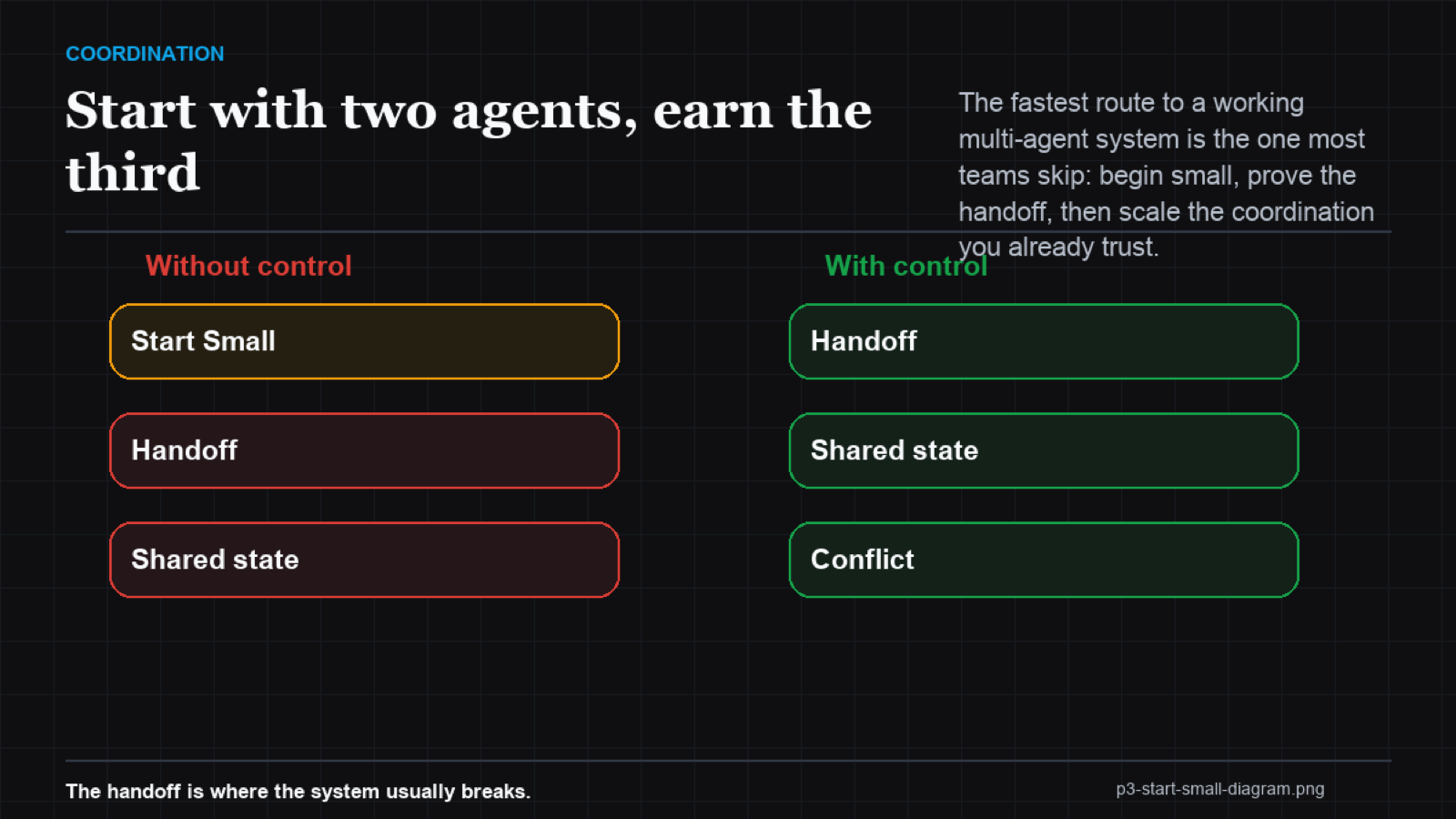
Premature scale vs. earned scale
| Premature scale | Earned scale |
|---|---|
| Ten agents, no proven handoff | Two agents, verified handoff |
| Coordination added later, under fire | Coordination proven before adding agents |
| Reliability drops as you grow | Reliability holds as you grow |
VibeModel's Pattern Intelligence Layer makes "earned scale" measurable. We show whether your current handoffs are reliable enough to support the next agent, so growth is a decision backed by patterns rather than optimism. Prove it small first. Scale what works.
Frequently asked questions
What signals that I'm ready to add a third agent?
When the existing handoffs hold under real load with a verification pass in place and a trace you can read. If you can't see the handoff, you aren't ready.
Isn't starting small slower?
Up front, slightly. Overall, faster, because you aren't rebuilding coordination under a production incident.