


Key facts.
- Multi-agent beat single-agent Opus 4 by 90.2% on open-ended research, where subtasks parallelize cleanly (Anthropic Engineering).
- That same system costs roughly 15x the tokens of a chat interaction, so the value must be high to justify it (reported).
- Every added agent adds coordination channels (n(n-1)/2) and failure surface, so the ROI calculation must include reliability, not just tokens; even top models on BFCL V4 top out near 77% with multi-turn lower (BFCL V4).
How do I tell which side a task falls on?
Ask whether the task decomposes into subtasks that can run independently and whether their combined value is high. Open-ended research, broad search, parallel exploration: multi-agent earns its tokens. A linear workflow with tight dependencies and a modest payoff: a single agent is cheaper, simpler, and more reliable. The mistake is treating multi-agent as the default upgrade. It is a trade, and the task tells you whether the trade is good.
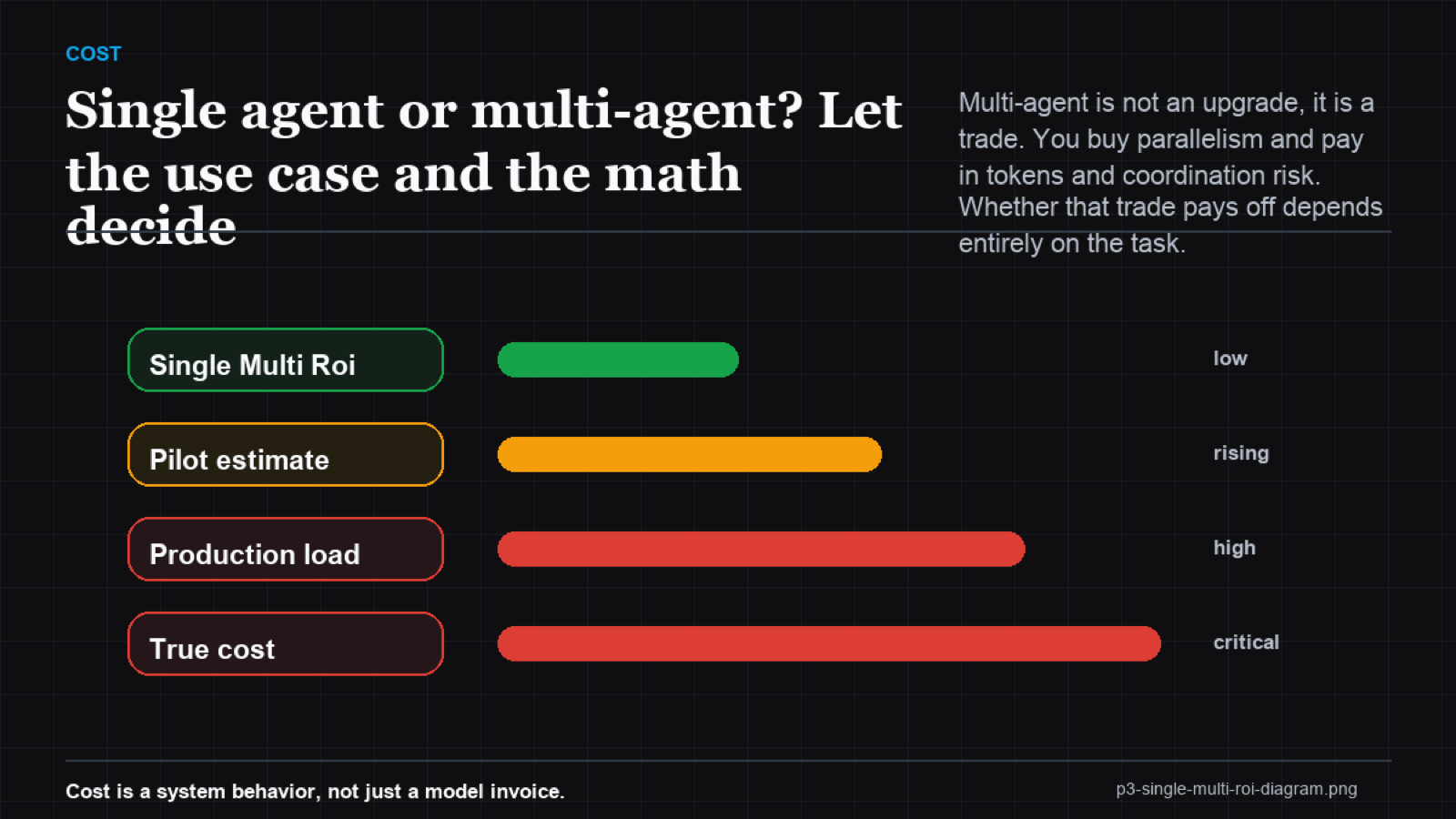
When each architecture wins
| Single agent wins | Multi-agent wins |
|---|---|
| Linear, dependent steps | Independent parallel subtasks |
| Modest task value | High task value |
| Reliability and cost are priorities | Throughput on hard problems is the priority |
VibeModel's Pattern Intelligence Layer helps you make this call with data: it measures the coordination cost and failure rate your multi-agent setup actually incurs, so the ROI question stops being a vibe and becomes a number. Pick the architecture the task justifies, and we keep whichever one you pick reliable.
Frequently asked questions
Can I start single and move to multi later?
Yes, and that is often the right path. Prove value with one agent, then split into many only where parallelism pays.
Is the 15x cost typical?
It is Anthropic's figure for a research-heavy system. Your multiple will differ, but expect multi-agent to cost meaningfully more per task.