


Key facts.
- Self-preference bias research found that LLMs acting as judges prefer their own generated outputs over human-written alternatives 69% of the time, even when the human-written version is objectively higher quality, the same preference mechanism applies when an agent evaluates a peer's recommendation (arXiv 2410.21819, 2024).
- Position bias studies showed that LLMs systematically favor whichever option appears first in a prompt, independent of content quality, when a peer recommendation appears after the agent's own context, it is structurally disadvantaged (arXiv 2406.07791).
- tau2-bench benchmarked agents in dual-control environments (where both agent and user take tool actions in a shared world) and found that agents struggle significantly more when they must incorporate external state changes made by another party, compared to single-control baselines (tau2-bench, arXiv 2506.07982, 2025).
Two mechanisms that discount peer recommendations
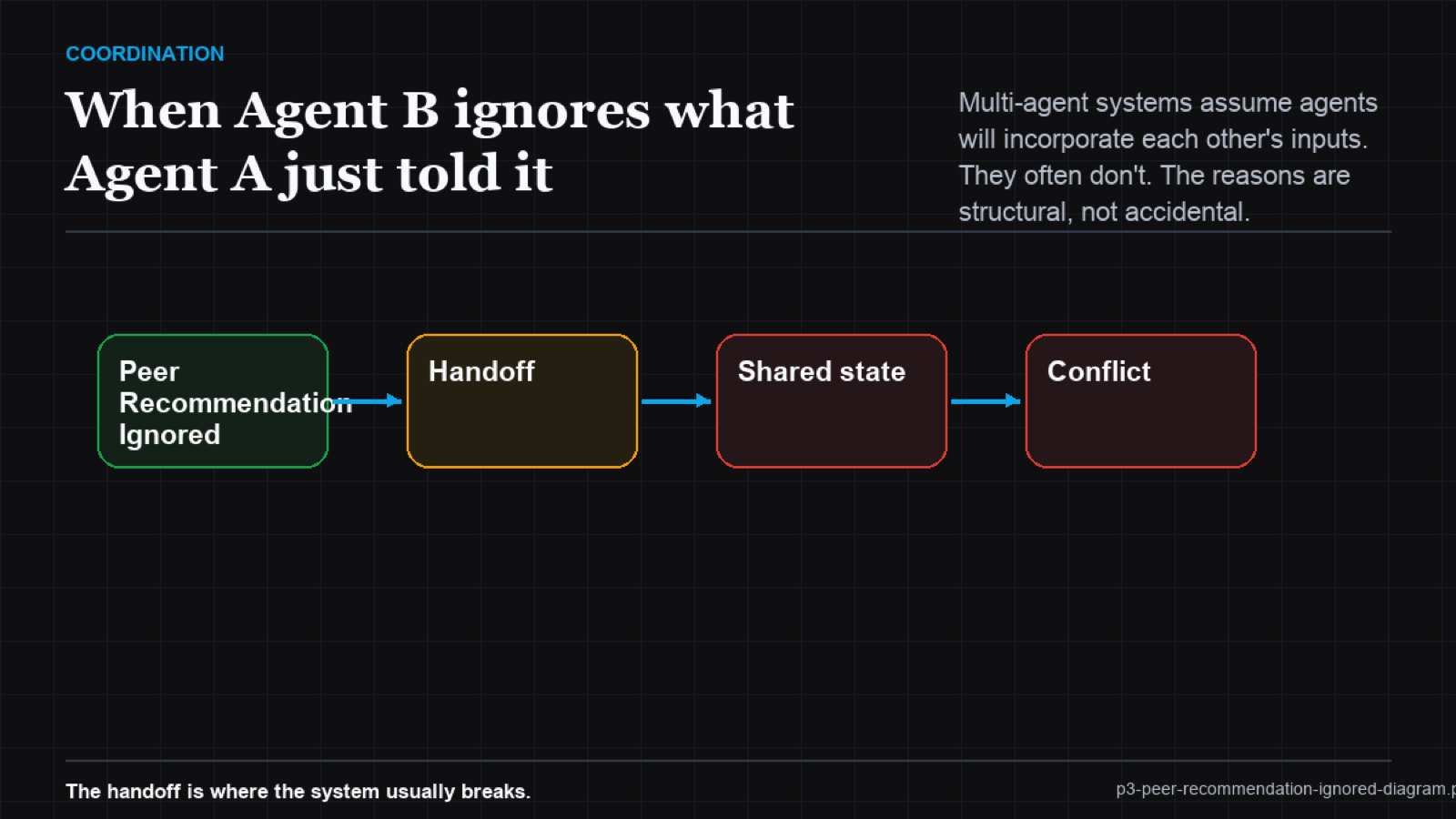
Agents discount a peer's input systemically via self-preference and position bias; a stronger model inherits both, a standing fleet cost. (arXiv:2410.21819)
The first is self-preference. An agent that has already committed a reasoning path in its context, even implicitly, through the framing of its system prompt, will evaluate a contradicting recommendation against that prior. If the peer says "route to Category B" and the agent's context frames this as a Category A problem, the agent will discount the peer's recommendation by finding reasons it does not apply.
The second is positional discounting. A recommendation that arrives late in the agent's context, after its own analysis, will be treated as a footnote rather than a primary input. If the orchestrator sends the agent's own task description first, then appends the peer's recommendation, the agent has already formed a partial answer before it reads the peer's input. The peer's input has to overcome that prior, and structurally, it rarely does.
Designs that actually get agents to use each other's inputs
| Anti-pattern | Works in practice |
|---|---|
| Append peer recommendation at end of context | Place peer recommendation first, before agent's own analysis |
| Peer input in natural language prose | Peer input in structured format with explicit confidence and rationale |
| No acknowledgement required | Agent required to explicitly state how it incorporated peer input |
| One-way recommendation | Structured reconciliation step when agents disagree |
VibeModel monitors the pattern where a peer recommendation is received and then systematically overridden without reconciliation. That pattern is a leading indicator of coordination failure. The Pattern Intelligence Layer detects it before it compounds into a task where two agents have run to completion on conflicting assumptions and neither knows it.
Frequently asked questions
Can I just tell agents in their system prompt to take peer recommendations seriously?
You can, and it helps at the margin. But the bias is structural, not a prompt-level problem. Prompt instructions reduce the effect; they do not eliminate it. The reliable fix is structural: context ordering, explicit reconciliation steps, and output requirements that force the agent to account for peer input.
What if agents genuinely should disagree sometimes?
Structured disagreement is healthy. The failure mode is not disagreement, it is disagreement that is invisible, where one agent proceeds as if the other had not spoken. A reconciliation step makes disagreement explicit and requires it to be resolved before the workflow continues.