


Key facts.
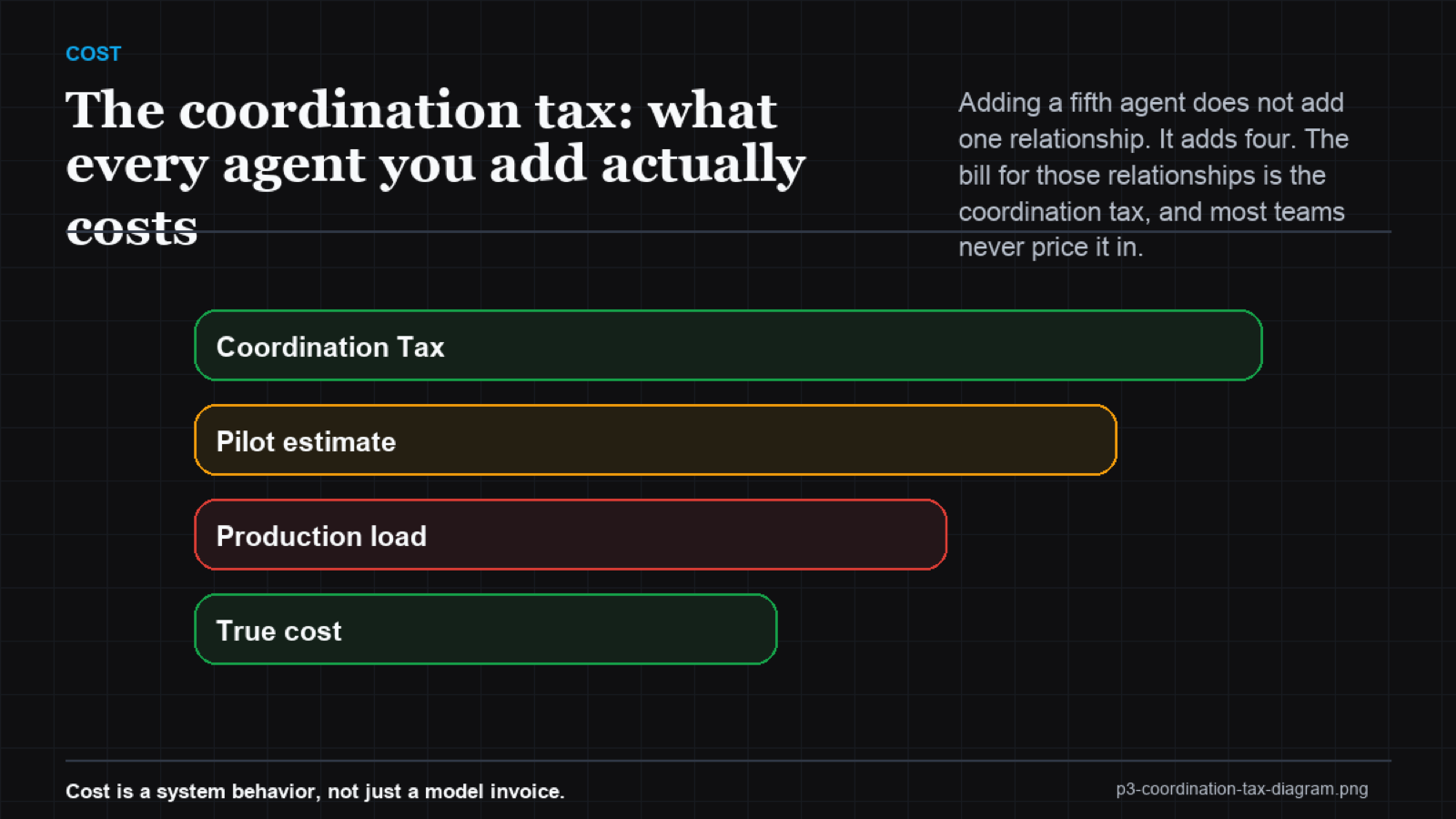
- Interaction channels scale as n(n-1)/2: 3 agents have 3 channels, 6 agents have 15, 10 agents have 45.
- Tran and Kiela find that under matched token budgets a single agent matches or beats multi-agent systems, so the extra channels often add cost without adding value (Tran and Kiela, 2026).
- Anthropic's multi-agent system costs roughly 15x the tokens of a chat interaction, a direct line item on the coordination tax (Anthropic Engineering).
- Gartner reports over 40% of agentic AI projects are at risk of cancellation by 2027, with cost among the drivers (reported).
- Channels grow as n(n-1)/2 at scale, not the pilot; under equal budget a better model inherits no accuracy gain, just 15x tokens and rework. (arXiv:2604.02460)
Why does the tax compound instead of add?
Because coordination is pairwise. A new agent must be reconciled with each existing agent's outputs, assumptions, and timing. The token bill rises, the misalignment surface rises, and the root-cause search space rises, all at once. The value of the new agent, meanwhile, is usually just the work it does. When the curves cross, the next agent makes the system worse. The discipline is to know where that crossing point is before you add the agent.
Pricing the tax in
| Ignoring the tax | Pricing it in |
|---|---|
| Add agents until something breaks | Add agents only past a measured value threshold |
| Token bill surprises finance | Coordination cost modeled up front |
| Misalignment surface untracked | Channel count and failure rate watched together |
VibeModel's Pattern Intelligence Layer makes the tax visible: which channels carry the most misalignment, which handoffs cost the most for the least value. That turns "should we add another agent" from a guess into a measured decision. You set the threshold; we show you where you are against it.
Frequently asked questions
Is more agents ever the right answer?
Yes, when the task genuinely parallelizes and each agent's value clears the coordination cost. The point is to measure, not to assume.
How do I find the crossing point?
Track value-per-agent against channel count and failure rate. When marginal value dips below marginal coordination cost, stop adding.