


Key facts.
- Faith and Fate shows compositional reasoning degrades as steps build on each other, so a flawed upstream input compounds into worse downstream planning. source
- Self-Consistency shows a single sample is unreliable and aggregation helps, evidence that an unverified upstream signal poisons downstream reasoning. source
- Faith and Fate shows reasoning degrades as steps build; a better model inherits it, so one bad retrieval compounds into rework. (arXiv:2305.18654)
Why does upstream error poison the plan?
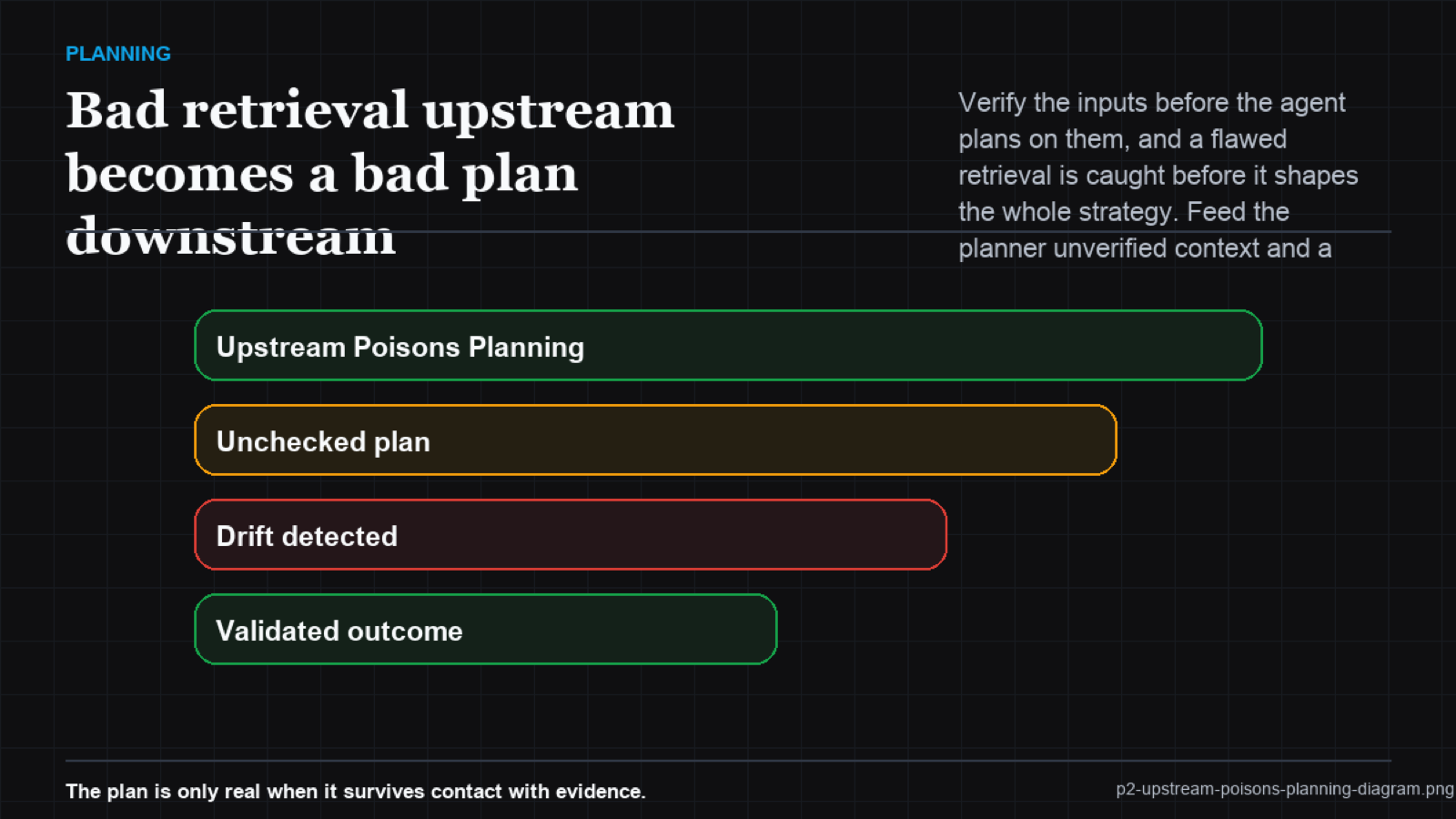
Planning is downstream of inputs: the agent retrieves context, reads intermediate results and reasons over them to form a plan. If those inputs are wrong, a stale document, a misretrieved fact, a bad intermediate conclusion, the plan is built on a false foundation and because planning is compositional, the error does not stay where it entered. Faith and Fate shows compositional reasoning degrading as steps build on each other, which is exactly what happens when a planner reasons step by step from a poisoned premise: each step inherits and often amplifies the upstream mistake. The result is a plan that is internally coherent and entirely wrong, because it faithfully reasoned from a fact that was false.
The defense is to verify upstream before planning, not just to validate the plan after. Check the retrieved context for relevance and freshness, confirm intermediate results before the planner builds on them and where a single retrieval or sample is the basis for a consequential plan, treat its unreliability seriously, which is the lesson self-consistency teaches by aggregating rather than trusting one shot. Catching a bad input at the upstream stage is far cheaper than discovering it after the agent has planned and acted on it, because at that point the error has propagated through every downstream step and the whole plan has to be redone.
What do you verify upstream?
| Input | Unverified | Verified before planning |
|---|---|---|
| Retrieved context | Trusted as-is | Checked for relevance, freshness |
| Intermediate results | Built on directly | Confirmed before use |
| Single sample | Treated as truth | Reliability accounted for |
| A bad input | Poisons the whole plan | Caught upstream |
Knowing which upstream inputs a plan critically depends on requires understanding the plan's structure, which is what VibeModel makes explicit as the Pattern Intelligence Layer. By tying the plan to the patterns and inputs it depends on, it shows where an upstream error would do the most damage, so verification concentrates on the inputs that matter and a flawed retrieval is caught before it poisons every step of the plan built on it.
Frequently asked questions
Isn't validating the final plan enough?
No. By the time the plan exists, an upstream error has already shaped it. Verifying inputs before planning catches the problem at the cheaper, earlier stage.
Why does upstream error amplify?
Planning is compositional and as Faith and Fate shows, reasoning degrades as steps build on each other, so a false premise propagates and worsens downstream.
What about a single retrieval?
Treat its unreliability seriously. Self-consistency shows one sample is shaky, so a consequential plan should not rest on a single unverified input.