


Key facts.
- PlanBench documents significant limitations in LLM planning and reasoning about change, so flawed decomposition is a common failure, not a rare one. source
- Natural Plan shows frontier models struggle on realistic planning tasks, including breaking a goal into the right steps. source
Why does a bad decomposition waste everything after it?
Planning is where agents are weak: PlanBench shows frontier models struggle, so a wrong decomposition wastes every competent step after. (arXiv:2206.10498)
An agent solving a complex task usually breaks it into subtasks and works through them. That first breakdown is load-bearing: if it is wrong, missing a critical step, ordering them badly, solving an adjacent problem instead of the real one, then every step that follows is competent work on the wrong plan. The agent will retrieve, reason and call tools impeccably and still deliver a result that does not meet the objective, because the objective was mis-decomposed at the start. The PlanBench and Natural Plan results show this is exactly where models are unreliable: planning and decomposition are among their weakest abilities, so the most consequential step is also the one most likely to be wrong.
The high-impact move is therefore to validate the plan before executing it. Have the agent produce its decomposition explicitly, then check it, against the goal, against constraints, ideally with a critique or an alternative plan, before any step runs. This catches the flawed breakdown at step zero, when fixing it is cheap, rather than after the agent has spent effort and cost executing it. The instinct to let the agent plan and act in one motion is what makes flawed decompositions expensive; separating plan from execution and validating the plan, is what makes them cheap to catch.
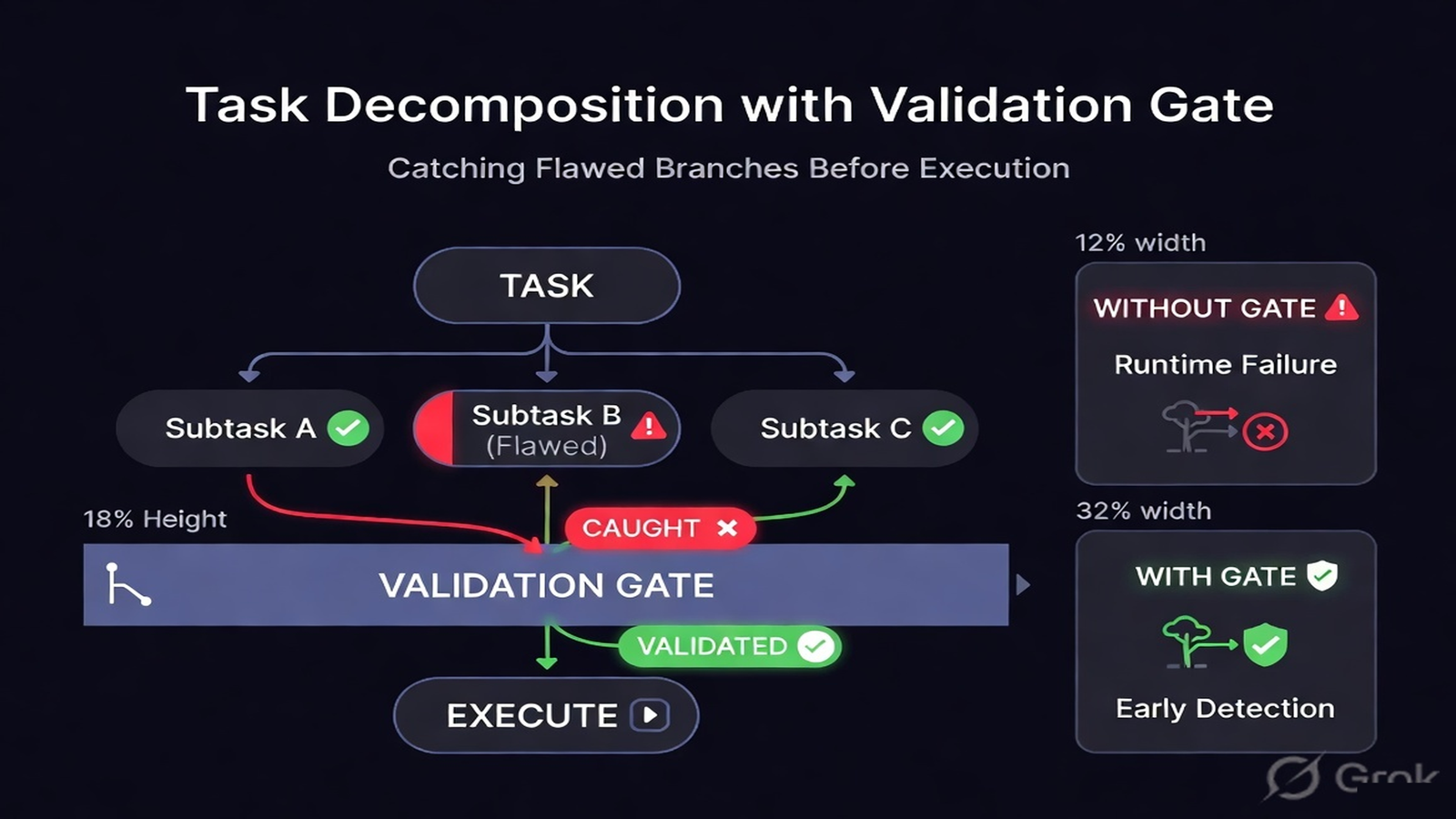
How do you catch a flawed plan early?
| Step | Plan and execute together | Validate the decomposition |
|---|---|---|
| Plan | Implicit, unchecked | Explicit, inspectable |
| Check | None before acting | Against goal and constraints |
| Bad breakdown | Executed in full | Caught at step zero |
| Cost | Wasted execution | Cheap fix |
Validating a decomposition against the real objective requires a clear definition of what the objective is, which is what VibeModel provides as the Pattern Intelligence Layer. By making the goal and its success pattern explicit, it lets the agent's proposed decomposition be checked against what success actually requires before execution, so a flawed breakdown is caught at the cheapest possible moment instead of after every step has been wasted on the wrong plan.
Frequently asked questions
Why is decomposition the critical step?
Because everything after it depends on it. A wrong breakdown means competent execution of the wrong plan, which planning benchmarks show is a common agent failure.
How do you validate a plan?
Have the agent produce the decomposition explicitly, then check it against the goal and constraints, ideally with a critique or an alternative, before any step runs.
Why separate planning from execution?
So the plan can be inspected and corrected cheaply before effort is spent, rather than discovering the flaw after the agent has executed the whole thing.