


Key facts.
- SWE-bench-Live (arXiv:2505.23419) shows that model performance on real, time-current GitHub issues is substantially lower than on the static benchmark, demonstrating that data distribution shifts are a primary reliability factor (SWE-bench-Live, arXiv:2505.23419).
- METR's time-horizon evaluations (arXiv:2503.14499) found that agent performance degrades as task horizons extend and real-world data complexity increases, with long-horizon tasks showing the largest gap between controlled and production performance.
- Measuring Agents in Production (arXiv:2512.04123) documented that production data edge cases - including null fields, unexpected types, and truncated values - are a leading source of tool call failures not captured by standard integration tests.
- PII redaction in production data commonly removes or masks fields that synthetic test data includes in full, causing tool parameters that succeeded in testing to fail when populated from real customer records.
- Schema migration artifacts, where production databases contain records created under three prior schema versions, create field-level inconsistencies that synthetic data never reproduces because synthetic data is generated against the current schema.
Why synthetic test data is structurally incomplete
SWE-bench-Live shows a model that aces clean tests slips on live data; the next model inherits that blind spot. (arXiv:2505.23419)
Synthetic data for tool integration testing is generated from the current schema, with valid-range values, complete fields, and no legacy artifacts. Production data is a time-capsule of every schema version, migration decision, and data entry error that has existed since the database was created. A customer record might have a phone number in three different formats depending on when it was created. An order might have a null tax field because it was created before the tax calculation service was added. Neither case is in your synthetic corpus, and both will break a tool wrapper that validates against the current schema.
SWE-bench-Live's finding that models perform worse on real, time-current issues than on the static benchmark points at the same underlying problem: the test distribution and the production distribution are different. For tool integration, this manifests as the test suite passing while production failures accumulate in the corner of the data distribution that synthetic generation never reaches.
What production-representative testing looks like
The teams that close this gap do two things. First, they run anonymized production data through their tool integration tests on a regular cadence, not just at release time. They extract a representative sample that preserves the schema anomalies, null fields, and edge-case values while removing identifying information. Second, they instrument their production tool calls to log the specific field patterns that precede failures, then add those patterns explicitly to the test corpus. The test suite grows to meet the production distribution rather than staying anchored to the synthetic one.
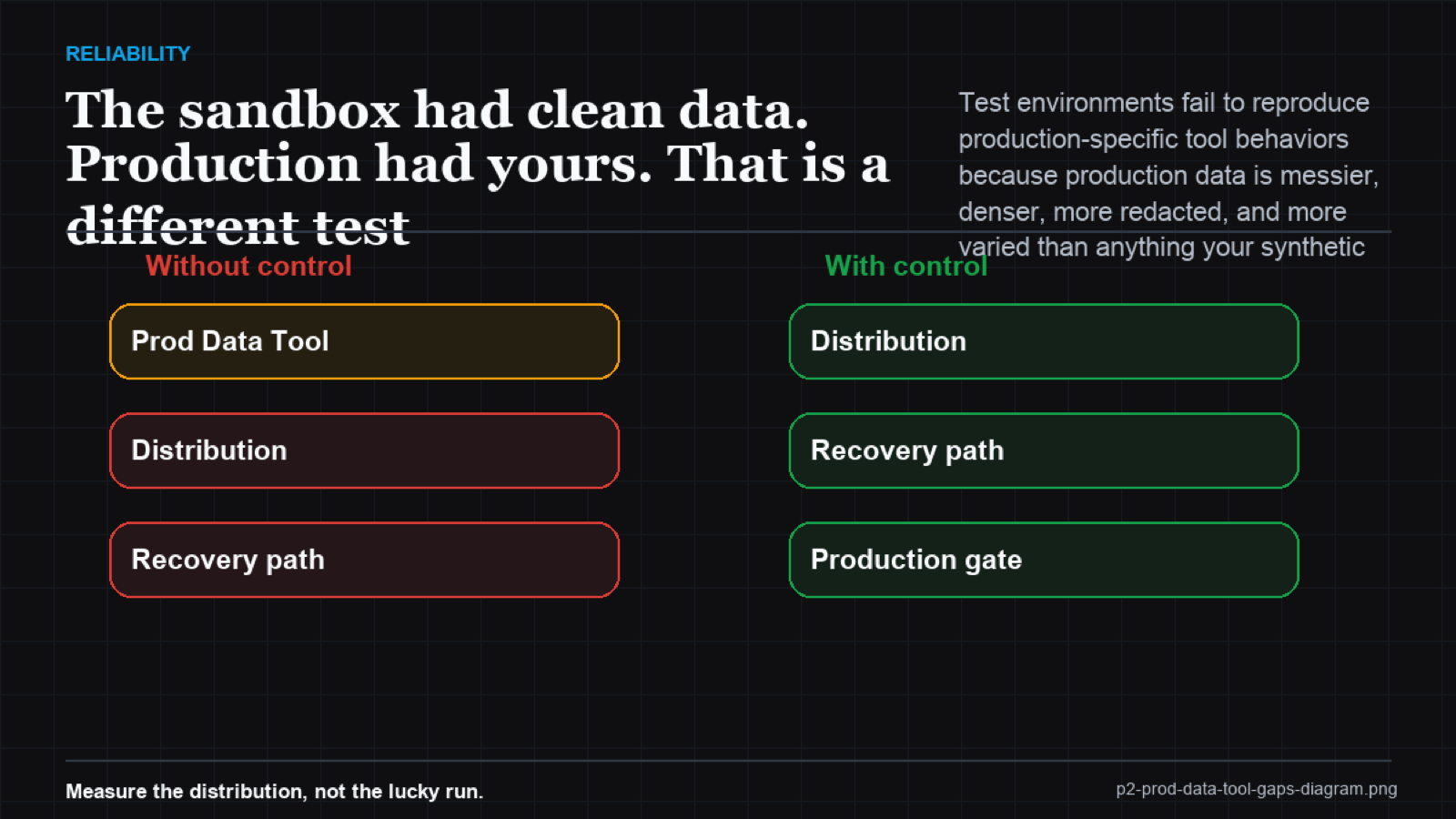
Sandbox vs. production data: the reliability gap
| Data characteristic | Sandbox | Production | Tool failure risk |
|---|---|---|---|
| Field completeness | Near 100% | 60-90% typical | High on null handling |
| Schema version | Current only | Multiple legacy versions | High on field name changes |
| PII handling | Full synthetic values | Redacted / masked | Medium on format assumptions |
| Value cardinality | Low (curated) | High (real user input) | Medium on edge cases |
| Encoding | UTF-8 clean | Mixed, including legacy | Low but real |
VibeModel's Pattern Intelligence Layer learns which data patterns in production requests correlate with tool call failures. When a tool wrapper encounters a field combination that has historically preceded failures, the pattern layer flags it before the call is made rather than discovering the failure after the fact. This turns production data complexity from a reliability risk into a feedback loop for improving tool wrapper coverage.
Frequently asked questions
How do we get production-representative data into our test suite without creating a GDPR problem?
Anonymization pipelines that preserve structural characteristics, field completeness rates, and schema version distribution while replacing identifying values are standard practice. The goal is statistical representativeness, not actual records.
How often should we refresh the test corpus with production samples?
At minimum, before each major release. Ideally, continuously - with an automated pipeline that flags new edge cases in production and adds them to the test corpus within the next sprint cycle.
Is this a tool wrapper problem or a model problem?
Primarily a tool wrapper problem. The model receives what the wrapper extracts. A wrapper that handles null fields, legacy formats, and schema variance gracefully insulates the model from production data complexity. The model's job is then to reason over clean, normalized inputs.