


Key facts.
- The Reversal Curse shows models fail to generalize a learned relationship to its reverse, a domain-knowledge brittleness that produces domain-specific edge cases. source
- Premise Order Matters shows reasoning is sensitive to how facts are ordered, so the same logic fails differently depending on a domain's framing. source
- The Reversal Curse shows models break in domain-specific ways, so generic reliability never transfers; a stronger model inherits the brittle rework. (arXiv:2309.12288)
Why are edge cases domain-specific?
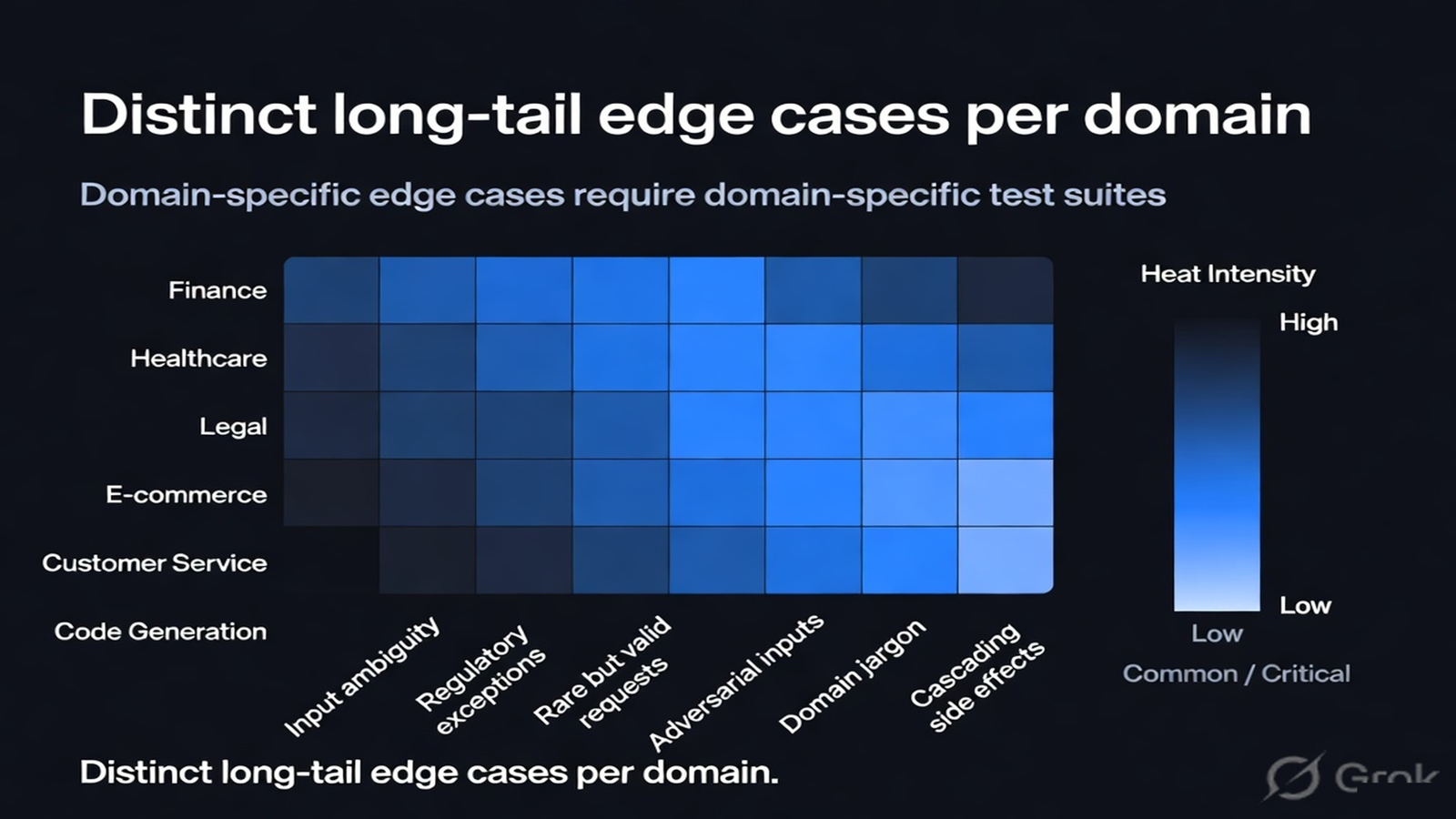
The long tail that breaks an agent is made of rare, real situations and those situations come from the domain. In finance it is the unusual instrument or the corner-case regulation; in support it is the multi-issue ticket or the customer phrasing nobody anticipated; in healthcare it is the atypical presentation. A generic edge-case checklist, copied from a tutorial, covers none of these because it cannot know your domain's rare cases. Worse, models are brittle in ways that depend on the specific knowledge a domain requires: the Reversal Curse shows a model can know a fact one direction and fail the reverse, and Premise Order Matters shows the same reasoning can succeed or fail based on how a domain frames its facts. The brittleness is real and it is shaped by the domain.
So edge-case coverage has to be a domain exercise, not a generic one. Work with the people who know the domain to enumerate the rare, high-impact cases that actually occur in it, the ones a domain expert can list and a generic checklist never would. Build those into the test set and design the agent to detect when it is in an unfamiliar domain-specific state and fall back. The goal is to cover the long tail your work produces, because that is where your incidents will come from, not from the generic edge cases that are easy to think of but rarely the ones that bite.
How do you cover a domain's long tail?
| Approach | Generic checklist | Domain-specific |
|---|---|---|
| Source of cases | A tutorial list | Domain experts |
| What it covers | Obvious edge cases | The rare cases that occur here |
| Brittleness | Unaddressed | Tested in domain terms |
| Incidents | From the missed long tail | Anticipated |
Capturing a domain's long tail and making the agent handle it consistently is what VibeModel does as the Pattern Intelligence Layer. By turning the domain experts' rare, high-impact cases into patterns the agent recognizes and handles the same correct way every time, it covers the long tail that actually matters for your work, instead of leaving the agent to a generic reliability that does not transfer to your domain.
Frequently asked questions
Why not use a generic edge-case list?
Because it cannot know your domain's rare cases and model brittleness is domain-specific. The cases that break your agent come from your work, not a tutorial.
How do you find domain edge cases?
From domain experts, who can enumerate the rare, high-impact situations that actually occur, then build them into tests and fallbacks.
Is model brittleness really domain-shaped?
Yes. The Reversal Curse and premise-order sensitivity show failures depend on the specific knowledge and framing a domain requires.