


Key facts.
- Lost in the Middle finds accuracy is highest when relevant information is at the beginning or end of context and drops when it is in the middle, even for explicitly long-context models.source
- A long multi-channel history pushes early, important facts into the middle of the context, where the model uses them worst.source
- Stuffing the full transcript also raises cost and latency without improving the agent's grasp of the relevant facts.source
Why does more history make the agent worse?
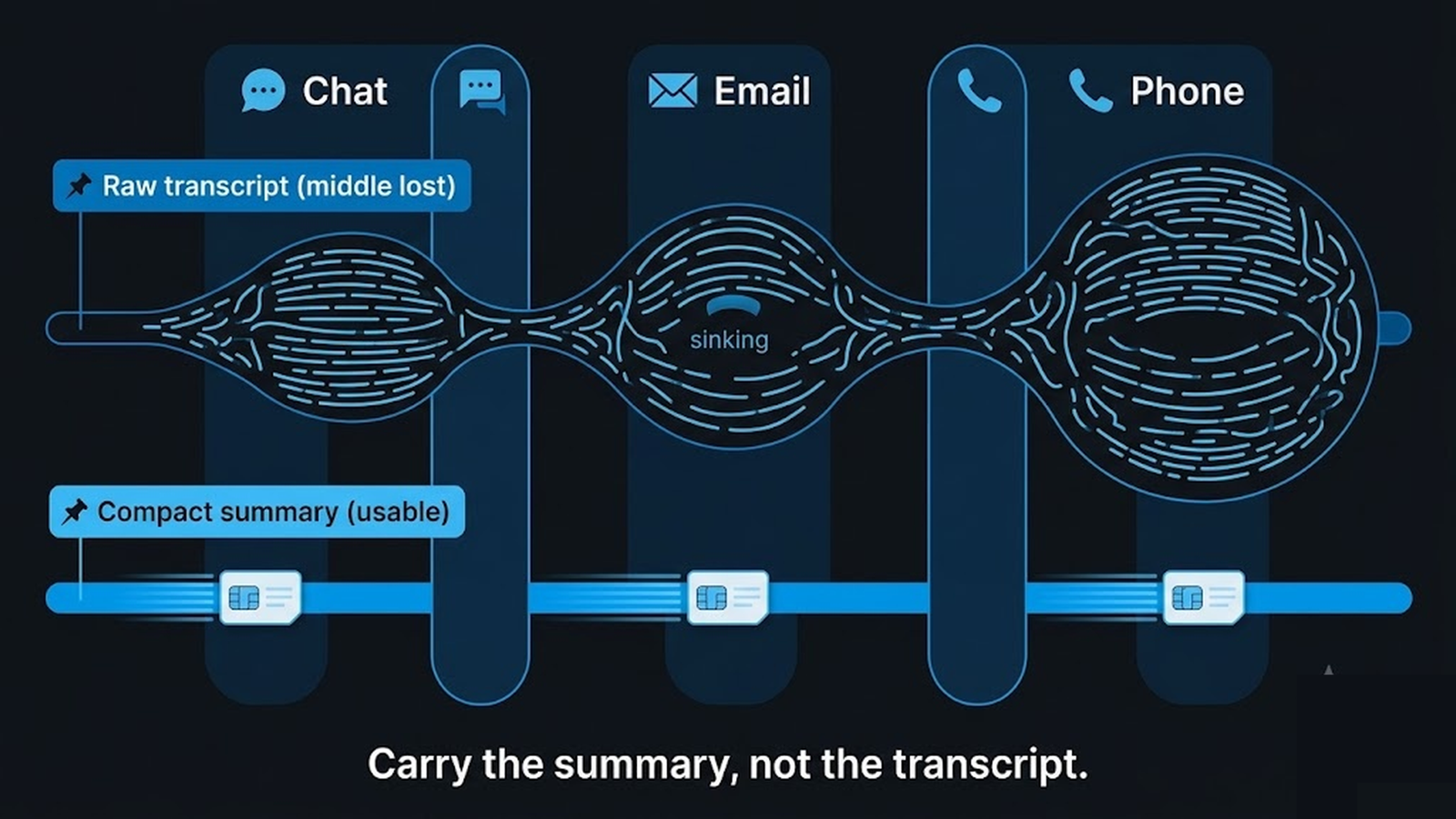
Because adding history does not add usable memory, it adds middle. The Lost in the Middle result is precise about this: the model attends best to the edges of its context and worst to the center. As the conversation grows, the facts from earlier interactions slide into the low-attention zone. The customer who explained their situation on the first chat. Then moved to email, then called, expects the agent to hold that thread. Instead, that opening explanation now sits buried in the middle of a long transcript. Exactly where the model is least likely to use it and the agent re-asks what the customer already told it. The history is technically present and functionally lost.
This is why the naive fix of "give the agent the whole conversation" backfires. It grows the context, which deepens the middle, which is where the important early facts now live. You paid for more tokens and got less usable memory.
What holds the thread across channels?
A compact, maintained summary of what matters, kept current and positioned where the model actually uses it. Instead of carrying the raw transcript, distill the customer's situation. History and unresolved issues into a short state that travels across channels and updates as the conversation moves. The agent reads a tight summary of who this customer is and what is open. Not a sprawling log it cannot attend to. The relationship is preserved because the relevant facts stay usable, rather than accumulating into a middle the model ignores.
| History strategy | What the agent can use |
|---|---|
| Full transcript in context | Edges only; early facts lost in the middle |
| Compact maintained summary | The relevant state, kept usable |
Maintaining that cross-channel state is part of what VibeModel does as the Pattern Intelligence Layer. We model the patterns of what a support agent must remember across a lifecycle and keep it compact and current. The customer is recognized instead of re-interrogated.
Frequently asked questions
Won't a longer context window fix this?
No. A bigger window deepens the middle. Lost in the Middle shows the weak-center effect persists for long-context models. Summarize instead.
What goes in the summary?
The customer's situation, relevant history, open issues and any commitments made. Drop the verbatim chatter that does not inform the next reply.
How does this help cost?
A compact summary is far cheaper than a growing transcript and gives the model better-positioned facts, so you pay less for more usable memory.