


Key facts.
- HBR Analytic Services research found AI adoption stays high while value lags without workflow integration, so a quick win must connect to real workflow value to count.source
- Research on self-preference bias finds LLM judges favor their own outputs, so an agent grading its own performance will overstate its wins.source
Why do quick wins backfire when they are not real?
Momentum is the right instinct: a visible early win gives skeptics a reason to lean in and gives sponsors something to point to. But the win has to be one the business actually feels, a faster cycle time someone noticed. A backlog someone watched shrink, not a dashboard number the agent generated about itself. The self-preference research is the warning: systems that judge their own work tilt toward their own outputs. A quick win measured by the agent is the easiest thing in the world to fake and the fastest way to lose credibility when people realize the number did not match their experience.
The HBR finding adds the other half: adoption is already high and value is what lags. The early win that matters is one tied to real workflow value, not to activity. The move is to pick a first use case where success is obvious to the people doing the work. Measure it on their terms and let the felt improvement do the persuading. That kind of win compounds. A vanity metric does the opposite, teaching people the whole thing is theater.
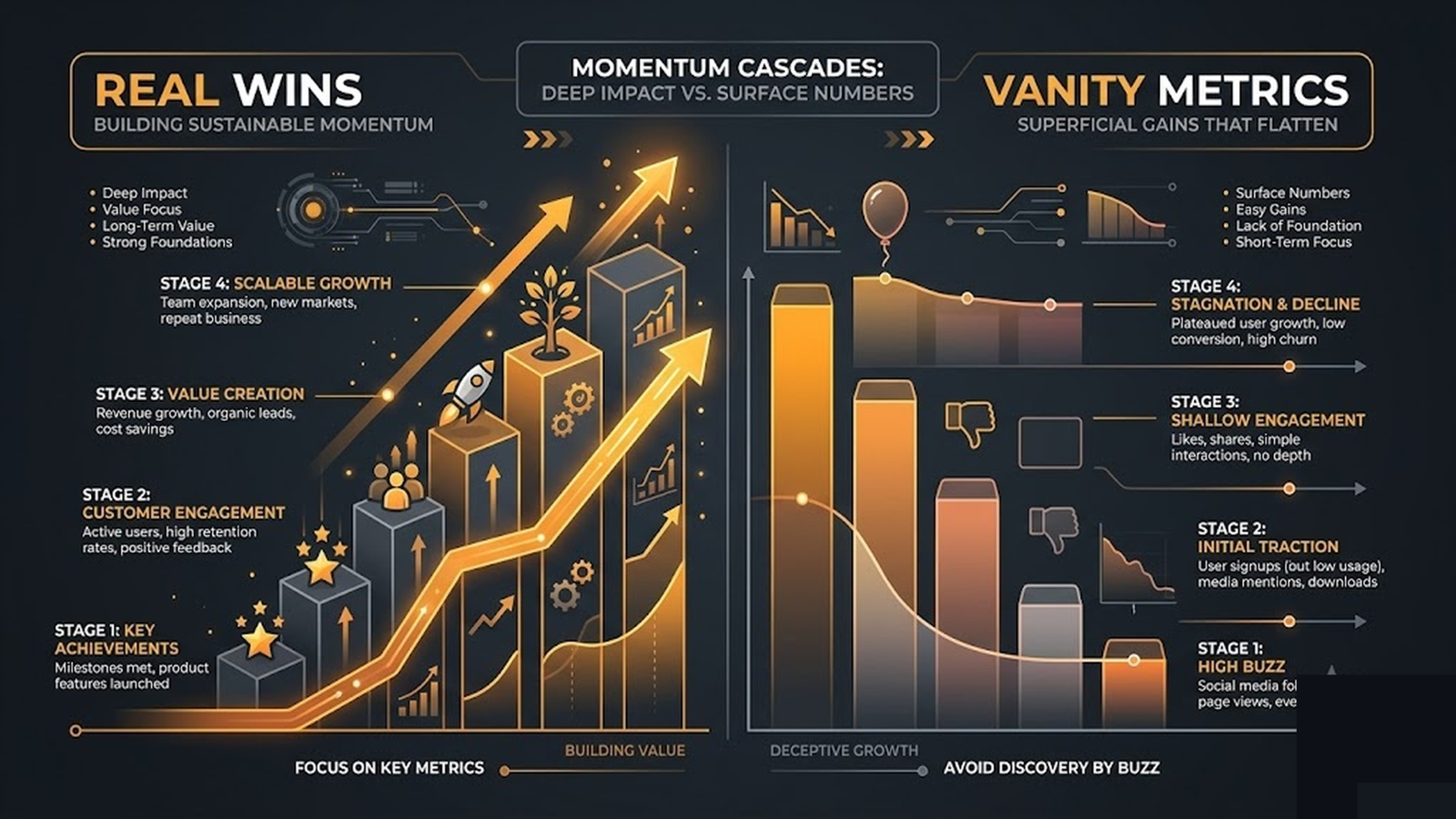
What makes a quick win build momentum?
| Property | Vanity metric | Real win |
|---|---|---|
| Who measures it | The agent itself | The business, on its terms |
| What it tracks | Activity | An outcome people feel |
| Effect on skeptics | Cynicism | Pull toward adoption |
Self-grading flatters itself and a bigger model sharpens it, so the business scores the win or the momentum is rework. (arXiv:2410.21819)
A win you can trust is a win you can measure independently and reproduce. Is what the Pattern Intelligence Layer makes possible. VibeModel surfaces reliability at the pattern level, so an early win is backed by the agent handling that situation the same correct way every time. Measured against the business outcome rather than the agent's own scorecard. That is momentum you can build on instead of momentum you have to keep faking.
Frequently asked questions
How do you pick a first quick win?
Choose a use case where success is obvious to the people doing the work and tied to a real outcome, so the improvement is felt, not just reported.
Why not let the agent measure itself?
Self-preference bias means it will flatter its own work. Measure wins with business metrics and independent checks instead.
What happens if early wins are fake?
People notice the gap between the number and their experience and the cynicism that follows is harder to reverse than the original skepticism.