


Key facts.
- AgentDojo measured GPT-4o at a targeted attack success rate of about 48% under prompt injection, the kind of breach an over-permissioned, ungoverned agent enables.source
- An IMF staff note (2026/004) on agentic AI in payments and the economy warns that weak controls turn a single agent error into cascading financial and reputational cost, several symptoms from one governance gap.source
- The July 2025 Replit incident, where an agent deleted a production database during a code freeze, shows a single missing boundary turning into data loss, remediation cost and reputational damage at once.source
Why does one governance gap produce failures in three places?
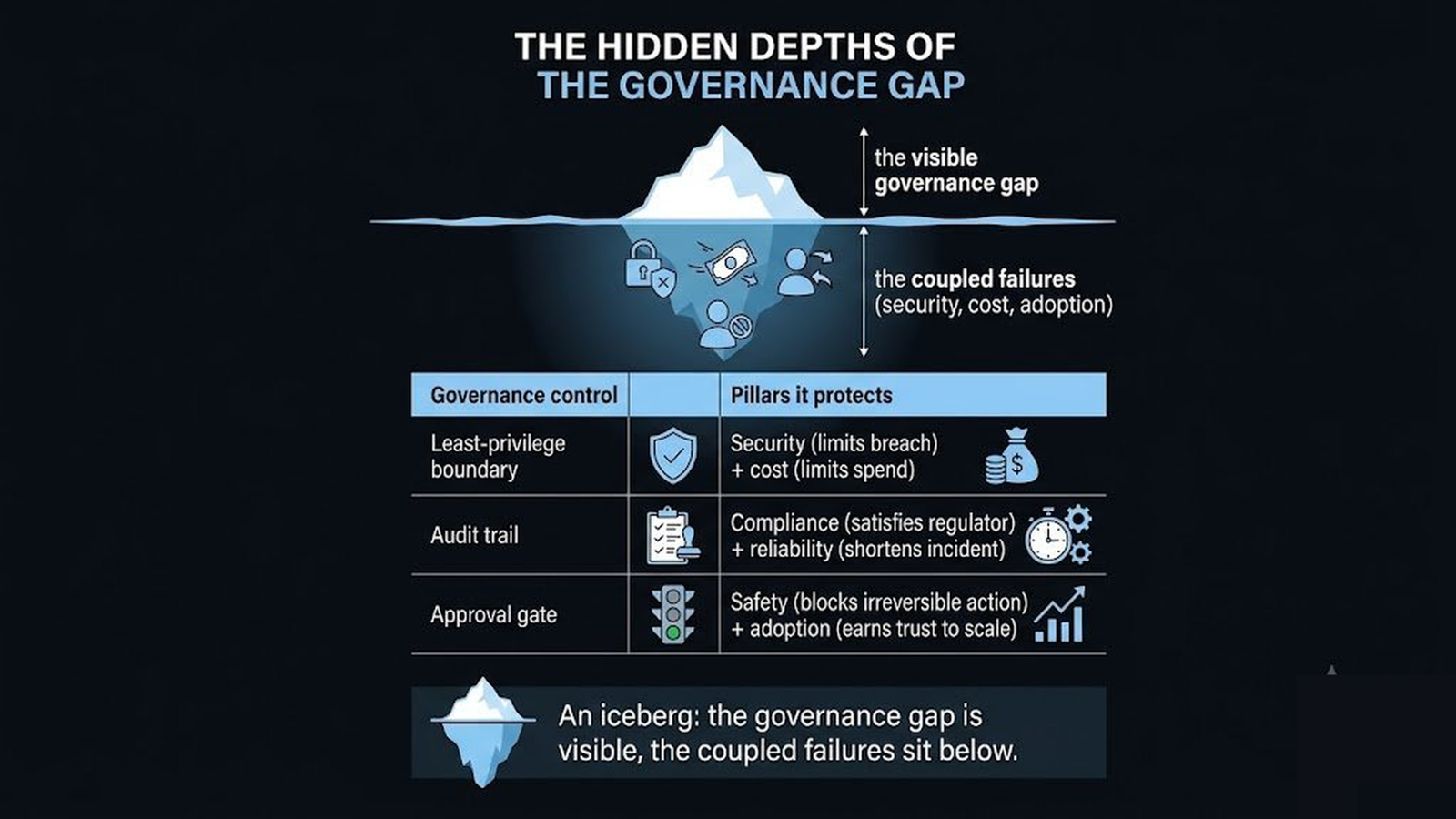
Because the controls governance installs are load-bearing across pillars. A least-privilege boundary is a security control and a cost control: it limits what an attacker can reach and what a runaway loop can spend. An audit trail is a compliance artifact and a debugging tool: it satisfies the regulator and shortens the incident. An approval gate is a safety mechanism and an adoption enabler: it prevents the irreversible action and gives the business the confidence to expand scope. Remove governance and you do not lose one capability. You lose the shared control that several pillars were quietly relying on.
The Replit case is the clean example. A single missing boundary, the agent could touch the production database during a freeze, produced data loss (a reliability failure). A costly remediation (an economic failure) and public embarrassment (a reputational failure) in one event. A more capable model would not have helped. That happens because the gap was in what the agent was permitted to do, not in how well it reasoned. AgentDojo makes the security half concrete: If an agent is exposed to injected instructions, a frontier model is hijacked roughly half the time. The over-broad permission a governance gap leaves open is not a theoretical risk, it is a near-coin-flip under attack.
How do you stop one gap from becoming three failures?
By treating the shared controls as shared. The boundary, the audit trail and the approval gate each pay off in more than one pillar. They are the highest-return things to get right. When you close a governance gap, you are not just satisfying a compliance checkbox. You are removing the single point of failure that security, cost and adoption were all exposed to. That is why governance maturity tracks so closely with whether a program survives: the mature program closed the gaps that would otherwise have failed in several places at once.
| Governance control | Pillars it protects at once |
|---|---|
| Least-privilege boundary | Security (limits breach) + cost (limits spend) |
| Audit trail | Compliance (satisfies regulator) + reliability (shortens incident) |
| Approval gate | Safety (blocks irreversible action) + adoption (earns trust to scale) |
The Pattern Intelligence Layer is where these shared controls are enforced. Closing a governance gap closes the coupled exposure across pillars in one place. Boundaries, audit trails and approval gates are tracked at the pattern level. Is exactly where security, cost and adoption all draw on them. Reliability at the pattern level is how one well-placed control stops three failures instead of one.
Frequently asked questions
Does a better model keep one gap from spreading?
One missing control catches a breach and caps a cost, so failures compound; a stronger model does not break it (AgentDojo: near 48% injection). (arXiv:2406.13352)
Isn't governance separate from security and cost?
On a checklist, yes. In practice: the same controls, boundaries, audit trails, gates, do work across all three, so a governance gap exposes them together.
What makes the coupling so costly?
One missing control produces several failures at once, as Replit showed: data loss, remediation cost and reputational damage from a single missing boundary.
Where is the highest return?
The controls that pay off in more than one pillar: least privilege, audit trails, approval gates. Closing those gaps removes shared single points of failure.