


Key facts.
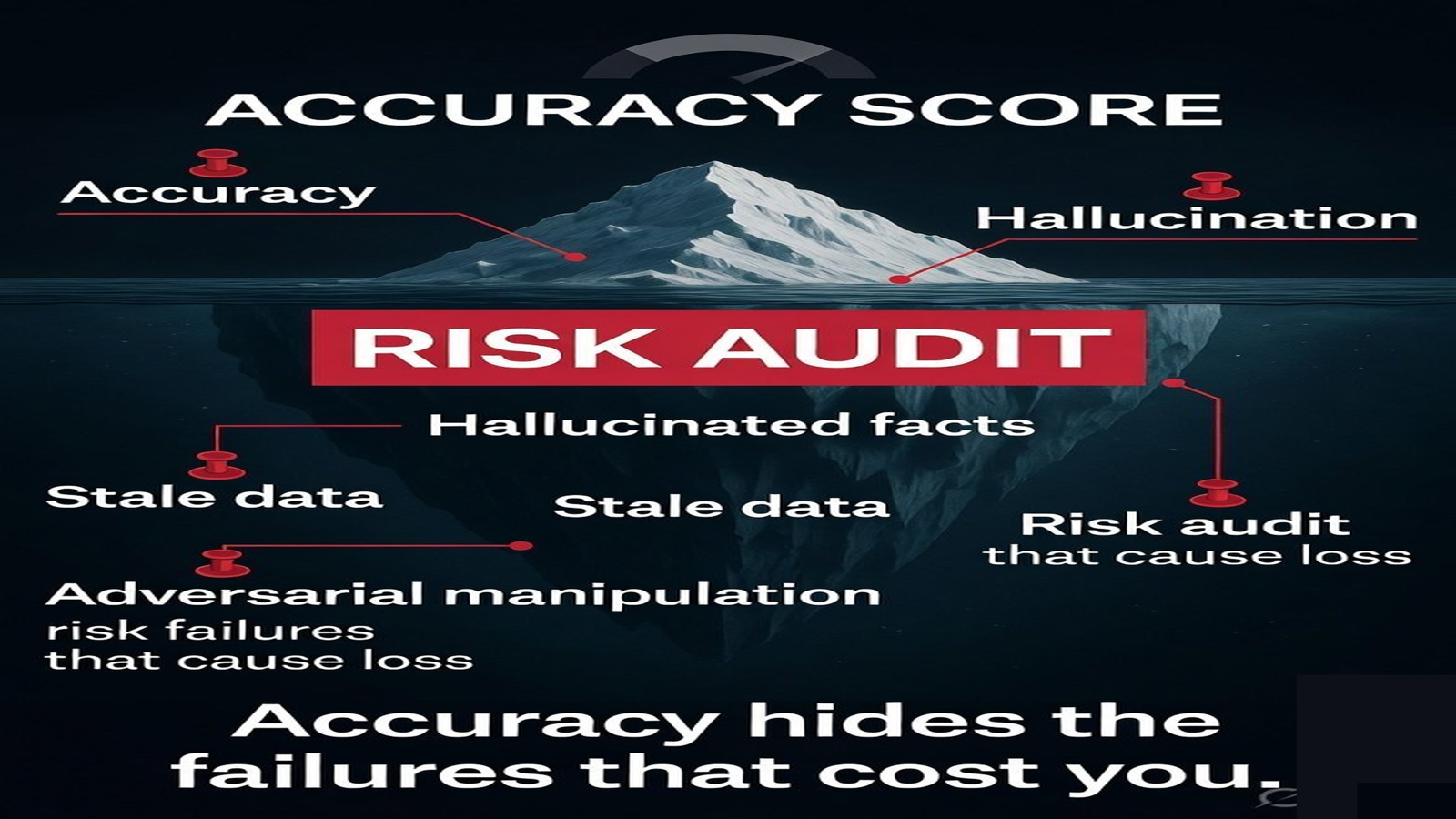
- A 2025 position paper argues finance-agent benchmarks prioritize performance over safety, overlooking hallucinated facts, stale data and adversarial prompt manipulation. source
- Accuracy and return-based scores do not capture whether an agent is safe to deploy in a high-stakes financial setting. source
- In fraud and lending, a wrong decision carries direct financial loss and regulatory liability, raising the cost of the failures the score ignores. source
Why does accuracy hide the dangerous failures?
Because accuracy measures average correctness on a test set and the failures that sink a fraud or lending agent are not average, they are specific and rare and high-cost. The position paper's argument is that a finance agent can post a strong accuracy number while remaining vulnerable to hallucinating a fact it then acts on, relying on stale data that has since changed or being manipulated by an adversarial input, none of which a standard accuracy benchmark stresses. In fraud detection, the rare adversarial case is the one a fraudster will engineer, so an agent that scores well on average but is manipulable is precisely the agent that fails where it matters. In lending, a hallucinated or stale fact in a credit decision is both a financial loss and a fair-lending or compliance violation, regardless of how accurate the agent is on the easy cases. The score measured the easy cases; the risk lives in the hard ones it did not.
This is why "our agent is 95% accurate" is the wrong reassurance for a high-stakes financial deployment. The question is not how often it is right on a benchmark, it is how it fails on the adversarial, stale and hallucinated cases that carry the loss and that is a different measurement the accuracy number does not provide.
What should you measure instead?
Risk behavior under the conditions that cause loss. Audit how the agent behaves on adversarial inputs, whether it acts on hallucinated facts, how it handles stale data and whether a wrong decision is caught before it has financial or regulatory consequence. Treat the deployment decision as a risk audit, not a benchmark comparison and gate the agent on the failures that carry cost, not the average it gets right. A fraud or lending agent earns deployment by being safe on the hard cases, which is exactly what the accuracy score never told you.
| What you evaluate | What it tells you |
|---|---|
| Accuracy score | Average correctness, not safety |
| Risk audit | Behavior on the failures that cause loss |
Auditing those risk patterns is part of what VibeModel does as the Pattern Intelligence Layer. We model the patterns of the hallucinated, stale and adversarial cases that carry financial and regulatory loss, so a fraud or lending agent is judged by its safety on the hard cases rather than its accuracy on the easy ones.
Frequently asked questions
Is accuracy useless for finance agents?
It is necessary but not sufficient. It says nothing about hallucination, stale data or adversarial resilience, which is where high-stakes loss occurs.
What makes fraud especially risky?
An adversary engineers the rare manipulable case, so average accuracy misses the exact input that will be used against the agent.
How do I audit risk?
Stress the agent on adversarial, stale and hallucination-prone cases and gate on whether wrong decisions are caught before they carry cost.