


Key facts.
- FrugalGPT (arXiv 2305.05176, Chen, Zaharia, and Zou, Stanford) proposes a learned LLM cascade and reports it can match the best individual model (e.g. GPT-4) with up to about 98% cost reduction or improve accuracy over GPT-4 by 4% at the same cost. source
- The paper frames three complementary cost strategies: prompt adaptation, LLM approximation (caching, cheaper fine-tuned models) and the LLM cascade itself, which adaptively routes queries across models. source
- LLM API prices differ by up to two orders of magnitude, which is the gap the cascade exploits: sending a query to the cheapest model that can handle it instead of the most expensive one by default. source
Why does a single expensive default waste money?
Because most requests do not need the expensive model to get the right answer. When you route everything to the frontier model, you pay its premium on the large share of easy requests that a cheaper model would have handled correctly and you get no extra reliability for the premium. The FrugalGPT result quantifies the waste: a cascade that tries cheaper models first and escalates only on hard cases reached frontier-level performance for a fraction of the cost. The expensive model is still there, but it is reserved for the requests that actually need it, which is the small share. That is where the up-to-98% saving comes from, not from using a weaker model everywhere, but from using the strong one only where it earns its price.
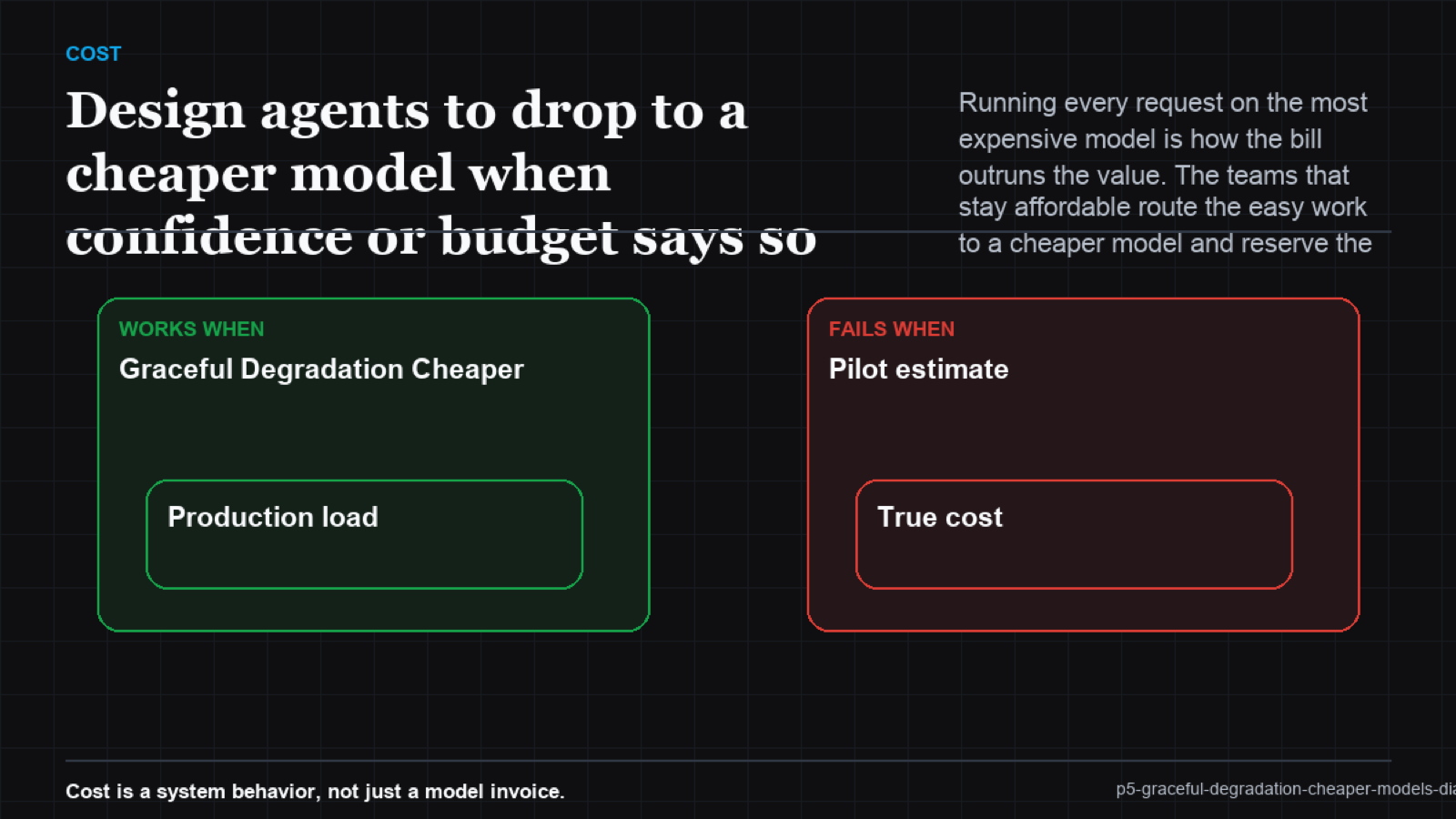
Graceful degradation makes this a runtime decision. When the cheaper model is confident, you keep its answer. When it is not or when the task is flagged as hard, you escalate to the expensive model. And when the budget is tight, the same machinery lets you fall back deliberately rather than failing or blowing the cap. The agent does not get less reliable. It gets less wasteful, because the expensive capability is spent on the cases that need it.
How do you build the fallback without losing accuracy?
With a confidence signal and an escalation rule. The cheaper model produces an answer and a measure of how sure it is, the rule keeps the answer when confidence clears a threshold and it escalates when it does not. Tuning the threshold trades cost against accuracy explicitly: a higher bar escalates more and costs more but catches more hard cases; a lower bar saves more but escalates less. The point is that the trade is a dial you set on purpose, against measured accuracy, not a default you accept by routing everything to the top. Add a budget-aware mode, where the threshold tightens or loosens as spend approaches a cap and the agent degrades gracefully under cost pressure instead of failing or overrunning.
| Approach | Cost | Hard-case accuracy |
|---|---|---|
| Frontier model on everything | Highest | High, but overpaid on easy |
| Cheap model on everything | Lowest | Drops on hard cases |
| Cascade with confidence gate | Low (up to ~98% off) | Preserved via escalation |
| Budget-aware degradation | Capped | Tuned to spend |
Most requests are easy and a few are hard, so a frontier model on the easy ones buys no extra reliability, only a self-inflicted bill. (arXiv:2305.05176)
The Pattern Intelligence Layer is where the routing thresholds are set against real outcomes. Per-pattern accuracy and cost are tracked, so the confidence gate and escalation rule are tuned where they actually pay and the cheap-versus-expensive decision is made on data rather than a blanket default. Reliability at the pattern level is what lets an agent spend the frontier model only where it changes the answer, which is the whole economics of graceful degradation.
Frequently asked questions
Won't a cheaper model hurt accuracy?
Only if you use it everywhere. A cascade keeps the cheap model's answer when it is confident and escalates the hard cases to the expensive one, so accuracy is preserved while cost drops sharply.
How much can routing actually save?
FrugalGPT reported up to about 98% cost reduction while matching GPT-4-level performance, by reserving the expensive model for the requests that genuinely need it.
What does budget-aware degradation mean?
The escalation threshold tightens or loosens as spend nears a cap, so the agent falls back to cheaper models deliberately under cost pressure instead of failing or overrunning the budget.