


Key facts.
- MAKER solved a task exceeding one million LLM steps with zero errors by decomposing it into atomic sub-tasks for small focused models plus an error-correcting vote, showing that reliability can come from structure rather than from a single expensive model. source
- WildToolBench found no evaluated model exceeded roughly 15% session accuracy on realistic multi-turn tool use, so a cheaper model must be matched to a sub-task narrow enough that it can actually complete it. source
- Anthropic reported that token usage alone explained about 80% of performance variance in its agent system, which is why moving routine steps to cheaper, lower-token paths is one of the most direct cost levers available (reported). source
How do you route without breaking quality?
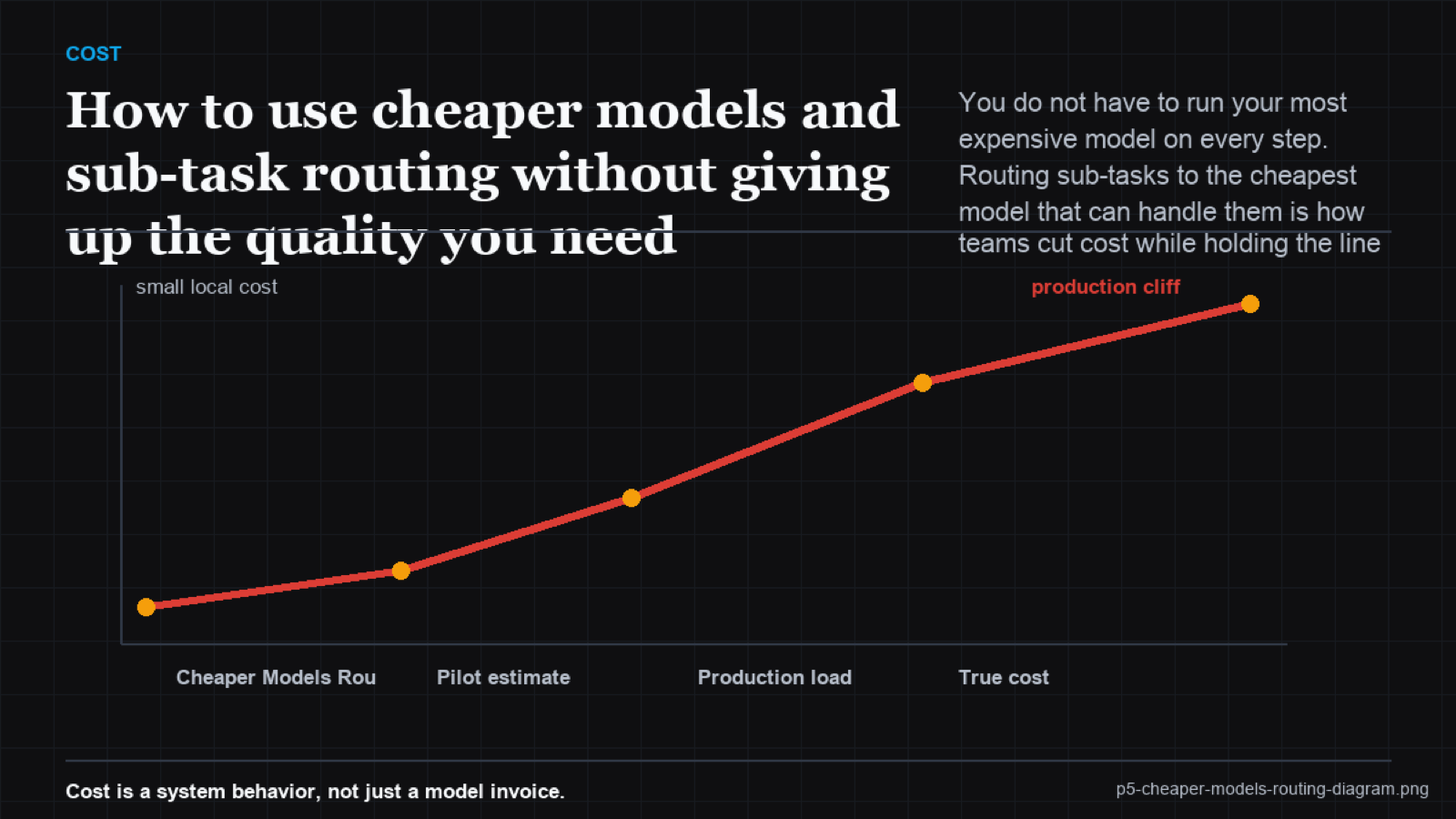
Start by classifying sub-tasks by difficulty and consequence. A routine extraction or formatting step can go to a small cheap model. A step that requires judgment, or one whose error is costly, stays on the stronger model. The MAKER result is the proof of concept that this works at extreme scale: structure and verification, not raw model power, delivered the reliability. The key is that each cheap-model step is narrow enough to be reliable and checked enough to catch the times it is not, which is where the WildToolBench warning bites, because an unverified cheap step that fails silently is more expensive than the model you saved.
So the routing has two parts: send each sub-task to the cheapest model that can handle it, and verify the output before passing it on. The verification is itself often a cheap model or a deterministic check, far cheaper than the generation it guards. Done this way, you pay premium rates only on the steps that need them and catch the cheap-model failures before they compound, which is the combination that cuts cost without cutting quality.
When does routing stop paying off?
When the sub-tasks cannot be made narrow enough for a cheap model to handle reliably, or when the verification cost approaches the saving. If every step needs frontier-level judgment, there is nothing to route down, and the honest answer is that the task is expensive. But most real workflows are a mix, with a few hard steps and many routine ones, and the routine majority is where the saving lives. The teams that get this right measure the per-tier success rate, route aggressively on the steps that hold up cheap, and keep the expensive model for the genuinely hard minority.
| Sub-task type | Model tier | Check |
|---|---|---|
| Routine extraction / formatting | Small, cheap | Deterministic or cheap verify |
| Moderate judgment | Mid-tier | Cheap-model verify |
| High consequence / hard reasoning | Frontier | Full verification |
Running one frontier model on every step overpays for routine work; MAKER cleared a million steps error-free with small focused models, but on WildToolBench none topped ~15%, so routing must verify. (arXiv:2511.09030)
The Pattern Intelligence Layer is where routing and per-tier verification become standing properties rather than per-workflow guesses. Which model handles which sub-task, and how each output is checked, are enforced at the pattern level, so the cost savings hold as models change and the quality bar stays in place. Reliability at the pattern level is what lets you spend premium rates only where they earn their keep.
Frequently asked questions
Won't cheaper models just lower quality?
Only if you route blind. Send each cheap-model step a narrow enough sub-task and verify its output, and quality holds while cost drops on the routine majority.
What makes MAKER relevant to cost?
It showed extreme reliability came from decomposition and voting, not a single expensive model. That structure is exactly what lets you route routine steps down a cheaper path.
Where does routing fail?
When sub-tasks can't be narrowed for a cheap model, or when verification costs as much as it saves. Measure per-tier success before routing aggressively.