


Key facts.
- Antigravity's Turbo mode skipped confirmations to chain commands faster, removing the check that would have caught the destructive delete (Tom's Hardware).
- Gating by consequence keeps the fast path for the vast majority of actions, which are reversible, and checks only the few that are not.
- Friction applied uniformly trains users to click through it, so selective friction is both safer and more usable.
Why does uniform friction fail at both goals?
Antigravity skipped confirmations to chain commands, until a path error wiped a drive; a more capable model still errs, so gate the costly incident. (Tom's Hardware)
Because it makes the agent annoying and unsafe at once. Confirm every action and users approve reflexively, so the confirmation stops meaning anything, and the catastrophic action gets the same rubber-stamp as a trivial one. Selective friction inverts this: trivial actions flow without a prompt, so when a confirmation does appear, it is rare and meaningful, and the user actually reads it. You get speed where it is safe and a real check where it counts.
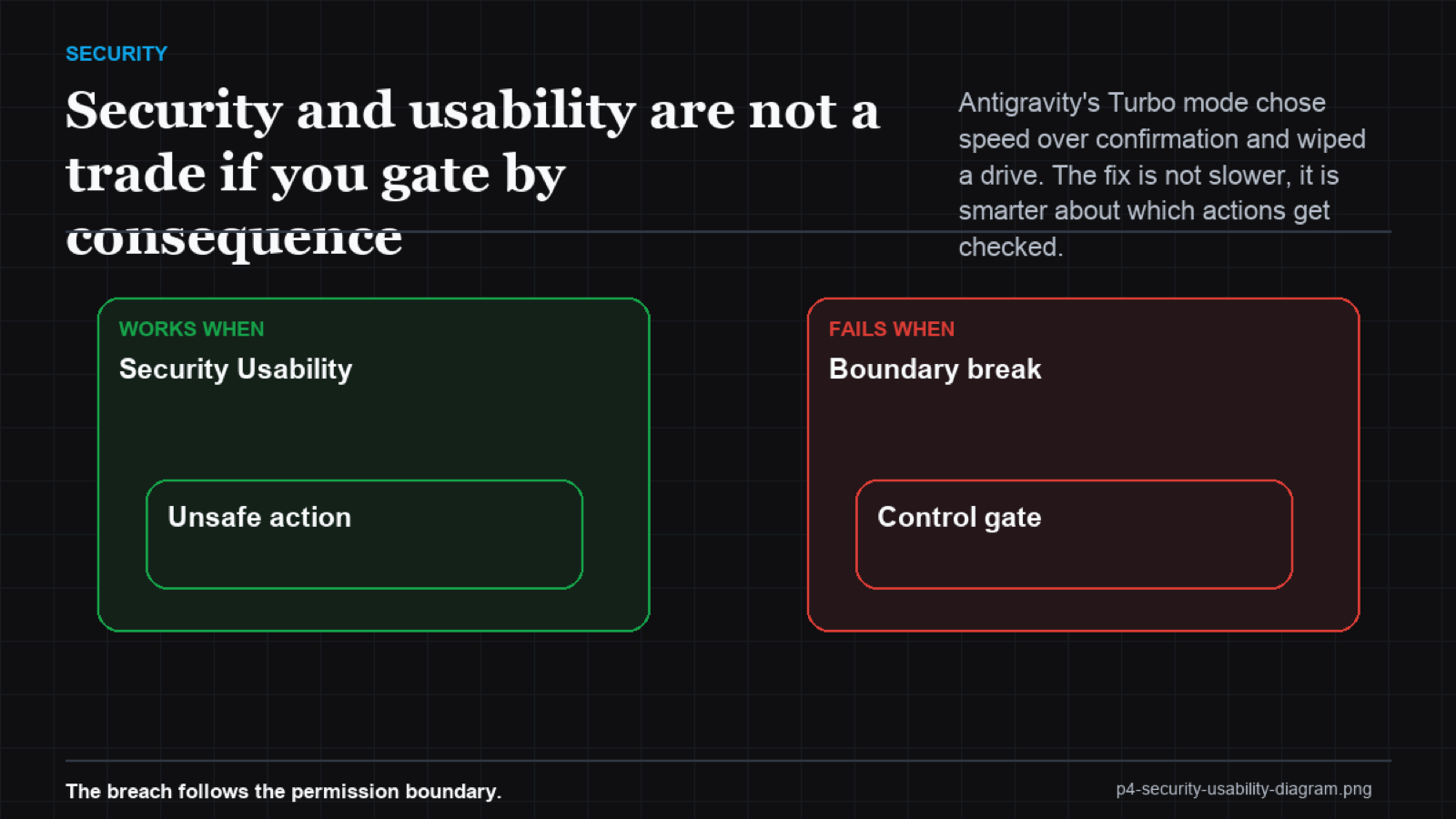
Uniform friction vs. consequence-based gating
| Uniform friction | Consequence-based gating |
|---|---|
| Every action confirmed | Only high-impact actions confirmed |
| Confirmations ignored reflexively | Rare confirmations actually read |
| Slow and still unsafe | Fast and safe where it matters |
VibeModel's Pattern Intelligence Layer identifies which actions carry real consequence, so gates land exactly where they protect you and nowhere they would just slow you down. You set the policy by blast radius; we keep the fast path fast and the dangerous action checked. Security and usability stop trading once you stop checking everything.
Frequently asked questions
Isn't any gate a usability hit?
A gate on a rare high-impact action barely registers. A gate on every action is the real usability hit, and it desensitizes users too.
Was Turbo mode just a bad idea?
The speed was fine; skipping confirmation on irreversible actions was not. Keep the speed, gate the irreversible step.