


Key facts.
- With an LLM the same input can produce different outputs, so behavioral baselines are moving targets and deterministic anomaly detection misses the signal or floods you with noise. source
- A practical pattern: run guardrails in shadow mode first against live traffic with no enforcement, measure F1 and latency, then turn on enforcement. source
- Runtime policy enforcement (for example Open Policy Agent) validates every outbound API call against safety rules before it executes. source
- OpenTelemetry-based instrumentation gives vendor-neutral agent telemetry that plugs into existing monitoring stacks. source
Why isn't a strong launch review enough?
A static review samples the agent under known conditions. Production is the opposite of known. The data the agent retrieves changes, the documents it reads can carry hostile instructions, and the tools it can call are live. None of that is visible in a review held before any of it happened. An agent that passed every check on Monday can call a destructive tool on Thursday because an injected ticket told it to, and no static artifact will have caught it.
The non-determinism makes it harder. The same prompt can yield different actions, so you cannot diff against a fixed expected output. You have to baseline behavior (typical tool sequences, normal data-access patterns, expected request rates) and alert on deviation, which only runtime monitoring can do.
What does runtime monitoring actually watch?
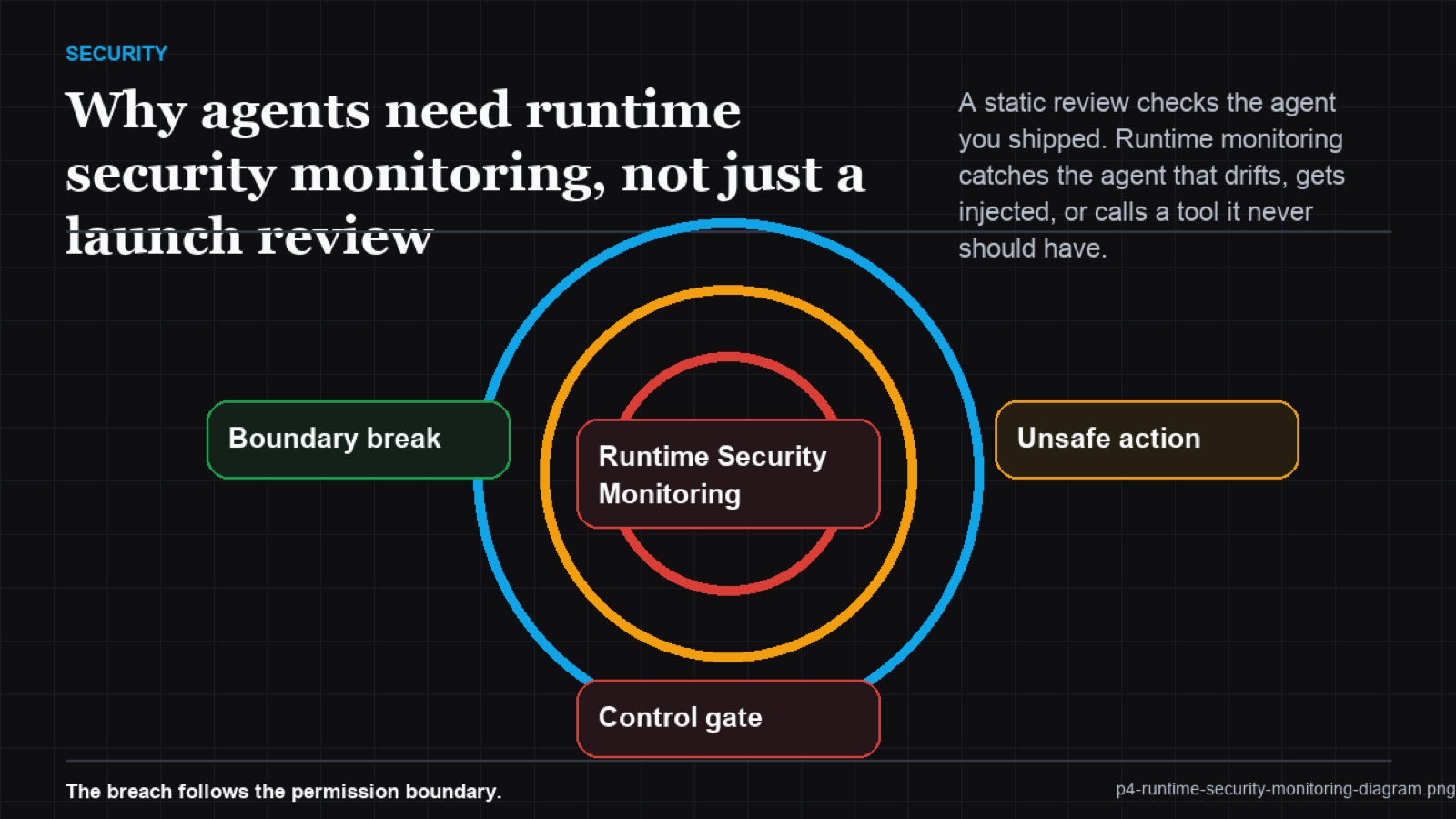
Three layers. Validate inputs as they arrive, so a hostile document is flagged before the agent acts on it. Baseline and watch behavior at runtime, so an unusual tool sequence or a spike in data access trips an alert. Enforce policy on every outbound action, so a tool call that violates a rule is blocked before it executes, not investigated after.
| Aspect | Static launch review | Runtime monitoring |
|---|---|---|
| When it runs | Once, before launch | Every action, always |
| Catches injection | Only patterns known that day | Anomalous behavior as it happens |
| Handles drift | No, data is frozen | Yes, baselines track live traffic |
| Blocks bad tool calls | No | Yes, policy enforced pre-execution |
Runtime monitoring is a pattern-level control by definition, which is why it belongs in a Pattern Intelligence Layer. Reliability and security at the pattern level mean behavior is baselined, watched, and policy-gated around the agent on every run, independent of the model. The launch review still matters, but it certifies a moment. The pattern watches the lifetime.
Frequently asked questions
Does a stronger model let me skip runtime monitoring?
A launch review proves safety at sign-off, not at 2am when an injection steers a tool call, and a frontier model falls at 90%, so incidents wait. (source)
Can't deterministic alerting work if I tune it hard enough?
No. Identical prompts yield different outputs, so fixed-threshold alerting either misses real anomalies or buries you in false positives. You baseline behavior instead.
How do I roll this out without breaking production?
Shadow mode. Run guardrails against live traffic with no enforcement, measure F1 and latency, then enable enforcement once the baseline is trustworthy.
What blocks a bad tool call in time?
Policy enforcement on every outbound action, evaluated before execution. A monitoring stat after the fact does not stop the call.