


Key facts.
- Across agentic coding editors and frontier models, injection succeeded 41 to 84%, with some categories above 90% (AIShellJack, 2025).
- A strong defense shifts the number sharply: Constitutional Classifiers reduced jailbreak success from 86% to 4.4%, still non-zero (Anthropic, 2025).
- Context matters: the attacker's goal, the agent's tools, and the data it can reach all move the rate, so a single headline number is misleading.
Why does the variance matter for your defense?
Because a borrowed benchmark number tells you almost nothing about your exposure. A 4% figure from a heavily-defended lab setup does not apply to your undefended agent with broad tools, and an 84% headline does not credit the defenses you have added. You have to measure your own configuration: your model, your defenses, your context. Then you design for that rate and, because it is never zero, you contain the residual. The variance is the reason generic reassurance is worthless and your own measurement is essential.
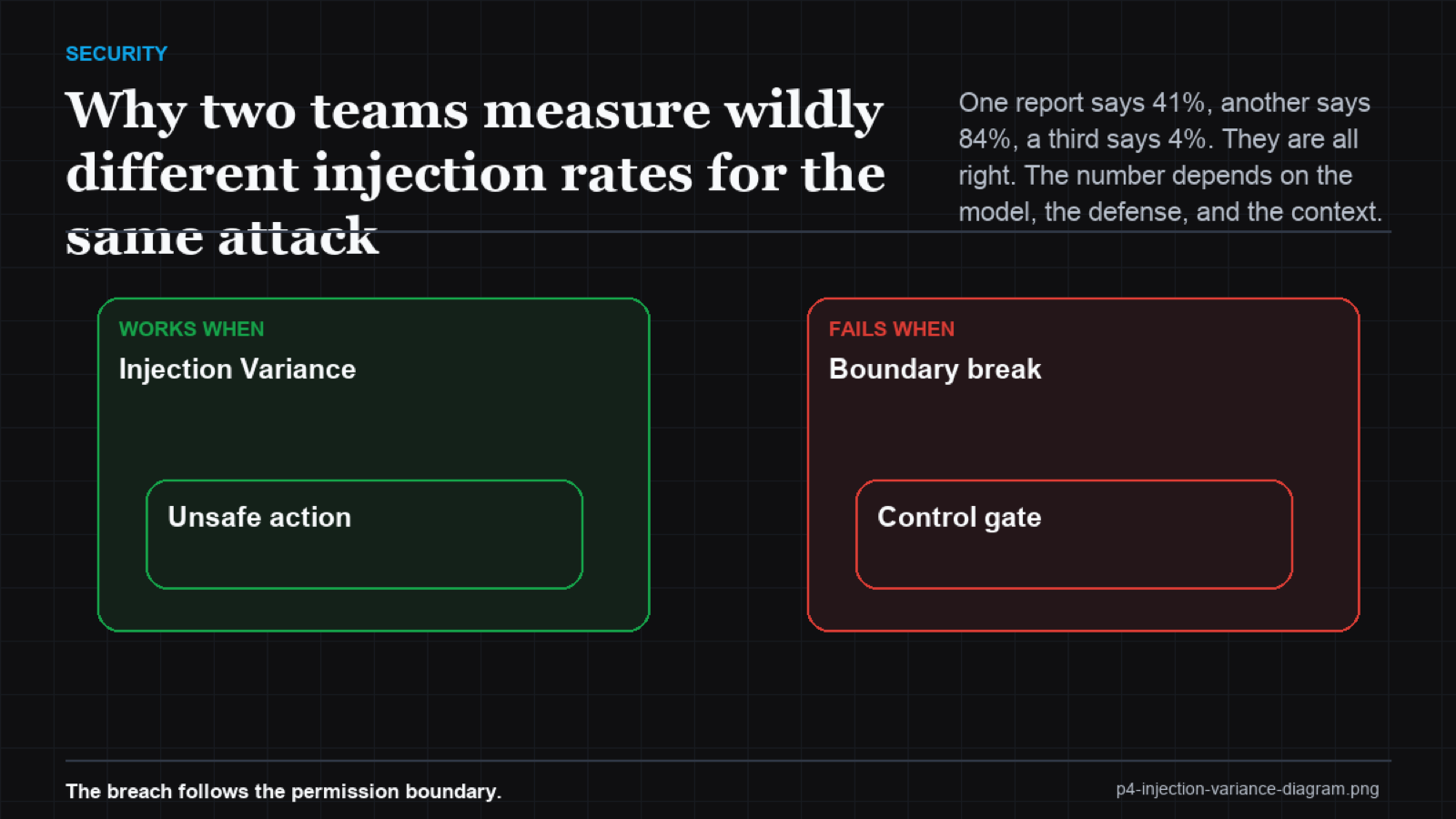
Headline number vs. your number
| Borrowed headline | Your measured rate |
|---|---|
| From someone else's setup | From your model, defenses, context |
| Misleads either way | Reflects your actual exposure |
| No plan for the residual | Residual measured and contained |
VibeModel's Pattern Intelligence Layer measures injection behavior in your actual deployment and contains the residual it finds, so you are working from your number, not a headline. You set the model, the defenses, and the context; we tell you where you really stand and stop what gets through. The rate varies, the residual is real, and the only number that matters is yours.
Frequently asked questions
So which published number should I trust?
None of them as your rate. Use them to understand the range, then measure your own configuration. The variance is exactly why borrowing a number fails.
Does a low measured rate mean I am safe?
Lower is better, but it is never zero. Contain the residual regardless, because the one attack that succeeds is the one that matters.