


Key facts.
- A dedicated prompt-injection benchmark lands targeted attacks on GPT-4o 47.69% of the time, and agents solve under 66% of tasks even with no attack present (AgentDojo, 2024).
- Injection succeeded 41 to 84% across frontier-backed coding agents, with some attack categories above 90% (AIShellJack, 2025).
- The root cause is that instructions and data share one channel, so no single filter fully separates them.
If defenses don't reach zero, what's the point of them?
An upgrade lowers the injection rate, never to zero: AgentDojo lands 47.69% on GPT-4o with defenses, so the incident is late, not absent. (arXiv:2406.13352)
The point is defense in depth plus containment. Input filtering, output checks, and instruction-data separation each reduce the rate, and stacking them reduces it further. But the decisive move is to assume some injection gets through and limit what it can do: gate exfiltration-capable actions, require approval for irreversible steps, and treat untrusted-content ingestion as a taint event. You aren't trying to make injection impossible, you're trying to make a successful injection harmless.
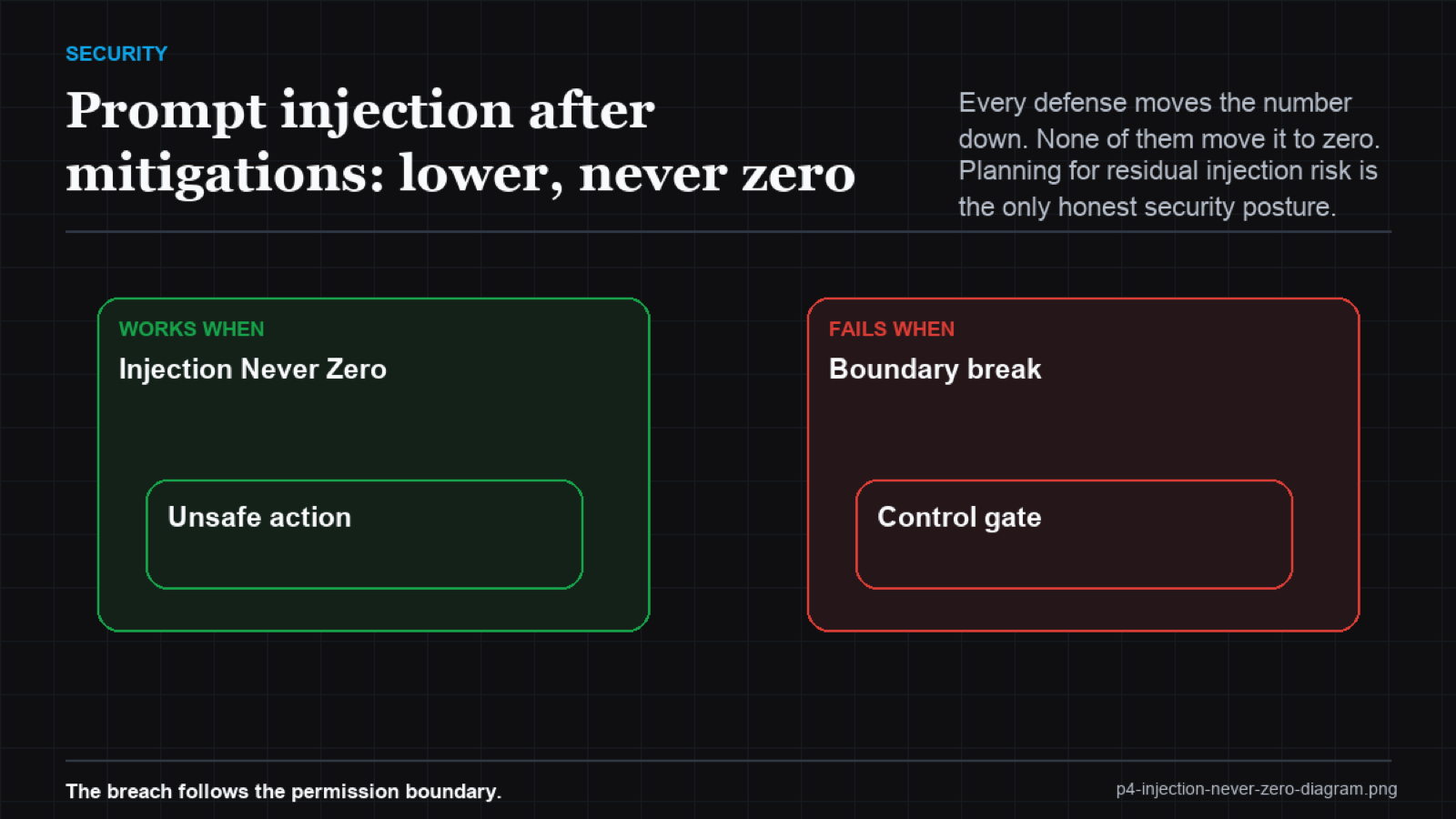
Eliminate vs. contain
| Trying to eliminate | Reduce and contain |
|---|---|
| One filter assumed sufficient | Layered defenses plus a containment gate |
| Surprised when injection succeeds | Plans for residual success |
| Blast radius unbounded | Blast radius limited by gates |
VibeModel's Pattern Intelligence Layer is built for the residual. We recognize the behavioral pattern of a successful injection, an agent acting on an instruction it shouldn't have, and stop the dangerous action even when the injection itself slipped past the filters. Lower the rate however you can; we make sure what gets through can't hurt you.
Frequently asked questions
Will a future model solve this?
Unlikely soon. The instruction-data confusion is fundamental to how LLMs read text. Plan for residual risk regardless of model.
what's the single highest-value defense?
Containment: gate exfiltration and irreversible actions. It turns a successful injection into a non-event.