


Key facts.
- Only 21% of organizations have a mature governance model for autonomous agents (CSA, 2025).
- The industry created a separate LLM-application threat list because classic application security did not cover the new attack classes.
- Threat modeling an agent means reasoning about injection, tool trust, data flows, and the lethal trifecta, skills most teams are still building.
- Only 21% have mature agent governance, and the gap is not capability: a stronger model still solves 15% of GAIA, landing on teams that never threat-modeled the system. (CSA, 2025)
What does the expertise gap actually miss?
It misses the threats that do not look like the old ones. A team experienced in web security will lock down authentication and still leave an agent that reads untrusted documents and can send email, the lethal trifecta, wide open, because that pattern was not in their training. They will scan for malformed input and miss a polite paragraph carrying a malicious instruction. The fix is not heroics, it is adopting the new frameworks (the dedicated LLM-application threat list, the lethal trifecta, MAST for multi-agent) as the baseline for agent threat modeling.
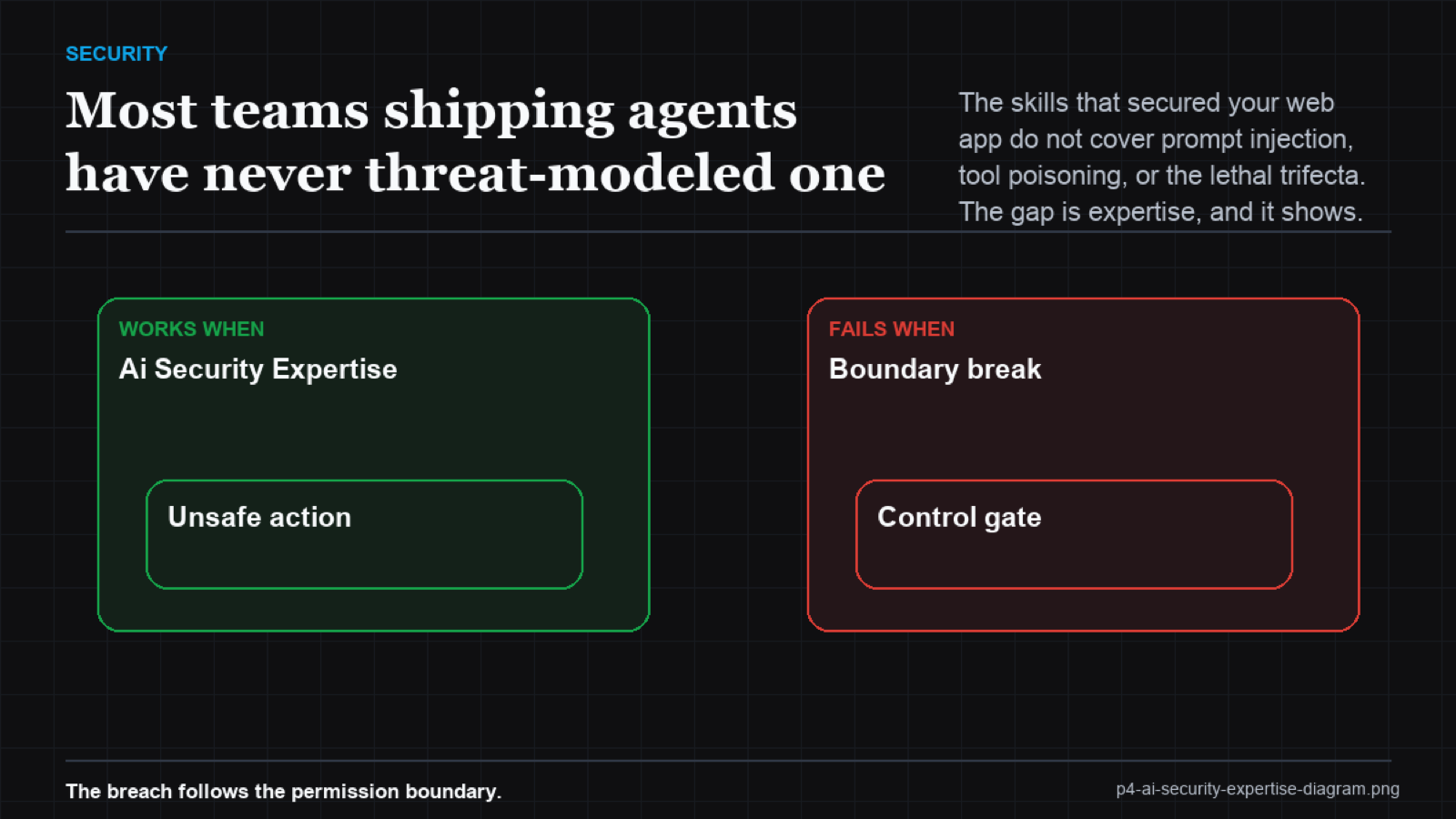
Old playbook vs. agent-aware playbook
| Old playbook | Agent-aware playbook |
|---|---|
| Auth, perimeter, input validation | Plus injection, tool trust, data-flow |
| Trifecta left open | Trifecta explicitly modeled |
| 21% have mature governance | Threat model built on new frameworks |
VibeModel's Pattern Intelligence Layer encodes the agent-aware threat model so teams do not have to build the expertise overnight: the injection patterns, the trifecta, the composition attacks are what we detect by default. You adopt the new frameworks as your baseline; we operationalize them while your team comes up the curve. The expertise gap is real, and you do not have to wait to close it before you are protected.
Frequently asked questions
Where should a team start?
The dedicated LLM-application threat list and the lethal trifecta for single agents, MAST for multi-agent. Use them as the baseline checklist for threat modeling.
Do I need to hire a specialist?
It helps, but you can start by adopting the frameworks and tooling that encode this knowledge, then build the in-house skill over time.