


Key facts.
- NIST launched an AI Agent Standards work effort in 2026 focused on agent identity, security, and interoperability, extending existing standards (OAuth, OpenID Connect, SPIFFE, and the Model Context Protocol) for scoped, auditable agent authentication.source
- MCPTox, the first large-scale tool-poisoning benchmark, found that across 20 leading agents on 45 real MCP servers, malicious instructions hidden in tool metadata reached attack success rates up to 72%, the kind of agent-specific risk this stack is designed to address.source
- Anthropic's 2026 work on measuring agent autonomy in practice found that users grant agents more autonomy over time, which makes post-deployment monitoring and designed-in intervention points essential rather than optional.source
- Containment is moving toward isolated execution (hardened sandboxes and microVMs) plus least-privilege tool access, because an agent will probe and chain whatever it's given.source
Why is the future not just a better model?
Agent security is converging on identity and sandboxing, not a better model, since on MCPTox tool-poisoning hits 72% and stronger models are often more susceptible, so the rework sits in the structure. (arXiv:2508.14925)
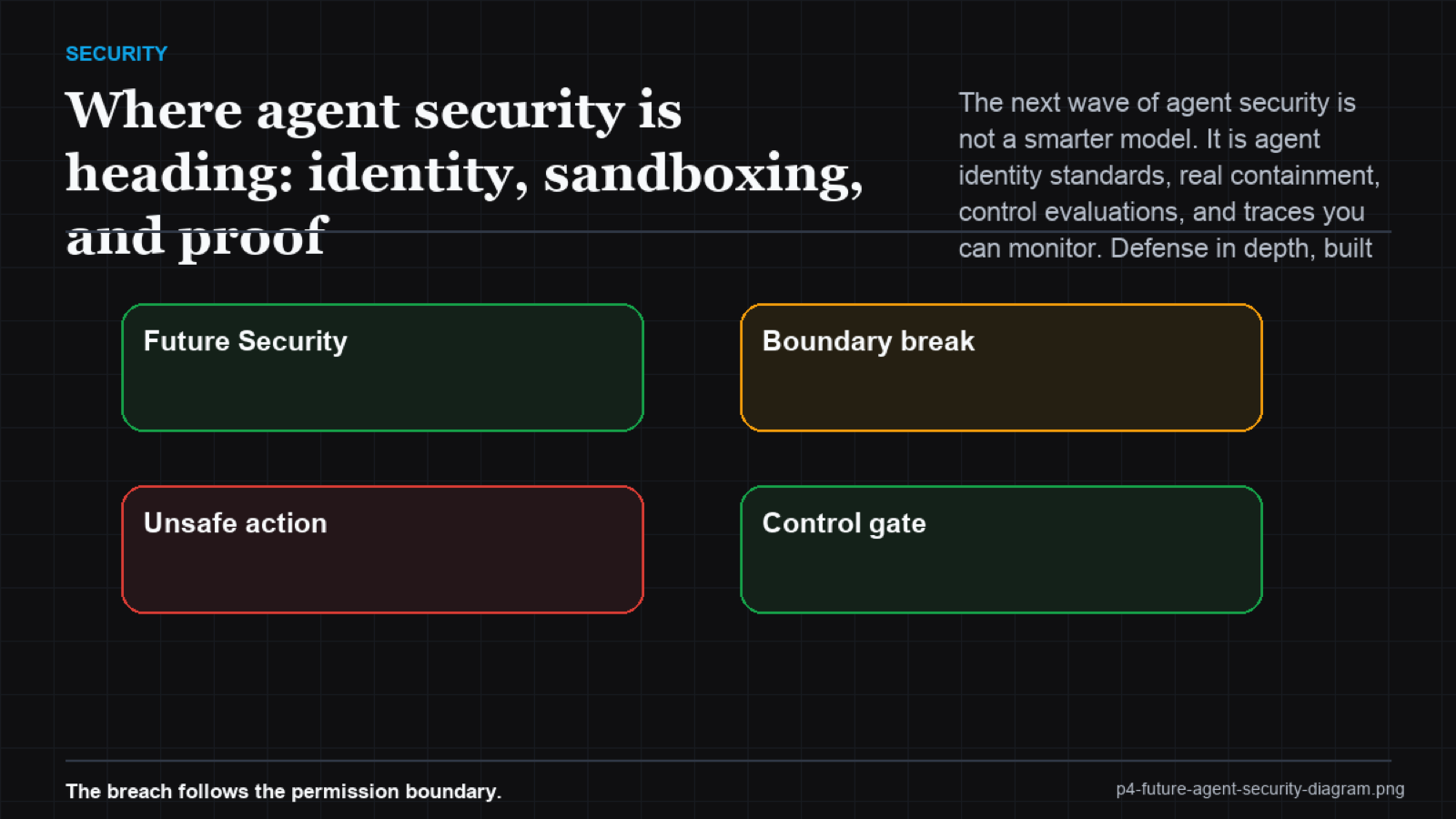
Because the failures that matter aren't failures of intelligence, they're failures of structure. A more capable model still gets prompt-injected, still inherits over-broad permissions, still acts non-deterministically, and still produces confident mistakes. Making it smarter can even widen the blast radius by making it more autonomous. So the research is putting its weight on the layers around the model: who the agent is (identity), what it can touch (least privilege and sandboxing), whether oversight actually works (control evaluations), and whether you can see its reasoning in time to intervene (interpretability and tracing). Each of these is a property you build, not a behavior you hope for.
Identity is the clearest example of the shift. The emerging consensus treats an agent as a first-class non-human identity with its own scoped, short-lived credentials, rather than a process borrowing a human's session. that's a standards problem, not a model problem, which is exactly why NIST's 2026 agent-standards effort centers on it.
What should a team adopt now versus watch?
Adopt the mature layers today: distinct agent identity with least privilege, real sandboxing, audit tracing, and runtime monitoring. These are production-ready and map directly to NIST's agent-standards guidance and tool-poisoning research like MCPTox. Watch the emerging layer: formal verification toward provably safe actions is promising but early, and not every "provable" claim scales to open-ended agents yet. The honest framing is that defense in depth carries you now, and provable guardrails are where the field is reaching, not where it has arrived.
| Direction | Maturity | What it gives you |
|---|---|---|
| Agent identity standards | Adopt now | Scoped, auditable, non-inherited access |
| Sandboxing / containment | Adopt now | Limited blast radius on a bad action |
| Control evaluations | Adopt now | Evidence that oversight actually works |
| Interpretability monitoring | Maturing | See reasoning in time to intervene |
| Provable guardrails | Emerging | Mathematically constrained actions |
Every one of these is a Pattern Intelligence Layer concern. Reliability and security at the pattern level mean identity, containment, evaluation, and monitoring are enforced around the agent on every run, independent of the model, and ready to absorb provable guardrails as that work matures. The future of agent security isn't a model you finally trust. it's a pattern you can prove, watch, and upgrade without starting over.
Frequently asked questions
what's the single highest-value thing to adopt first?
Distinct agent identity with least-privilege, short-lived credentials. It removes privilege inheritance, the most common way one issue becomes a breach, and it's production-ready today.
Are provable guardrails real or hype?
Real research, early maturity. Formal-verification approaches exist and are promising, but scaling them to open-ended agents is unsolved. Treat them as a direction to track, not a control to depend on yet.
Does any of this remove the need for monitoring?
No. Anthropic's autonomy research shows users grant more autonomy over time, so post-deployment monitoring and intervention points only become more important, not less.